
Halting fighting only way to stop Hezbollah attacks: Israeli media
 3 Min Read
The Israeli war on Lebanon is generating mounting political costs while failing to stop Hezbollah's missile capabilities, exposing the limits of its military strategy.
-
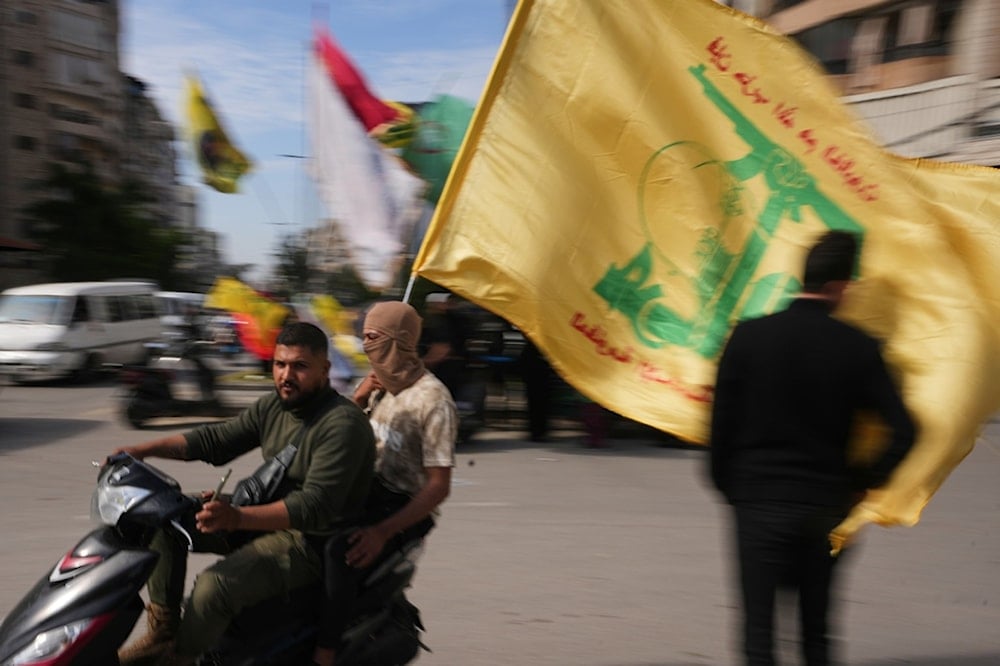
Men ride a scooter while waving a Hezbollah flag during a small gathering in Dahieh, Beirut's Southern Suburb, Lebanon, Saturday, April 25, 2026 (AP)
"Israel" is facing mounting political fallout from its war on Lebanon, as senior officials acknowledge that military force has failed to neutralize Hezbollah’s missile capabilities, Israel Hayom reported.
A senior Israeli official said that, despite ongoing attacks, halting the offensive remains the only effective way to stop rocket and missile fire toward northern occupied territories, a position that comes amid internal criticism over the recently announced ceasefire.
The report noted that the Israeli cabinet had never formally tasked the army with eliminating Hezbollah’s military capacity, reflecting an implicit recognition that such an objective cannot be achieved through force alone.
While targeted assassinations and continued strikes may degrade capabilities, the official conceded they cannot fully stop missile and rocket launches.
Any attempt to do so would require a far broader ground invasion and a substantial increase in troop deployment, an option described as unrealistic given the strain on Israeli forces, which remain engaged across multiple fronts and continue to rely heavily on reservists.
Deterrence erosion
Beyond the battlefield, the war has exposed deeper structural limits. Despite months of escalation, Hezbollah has retained its core deterrent capacity, continuing to launch rockets under fire and demonstrating an ability to adapt to Israeli aggression.
The persistence of these attacks points to an erosion of "Israel’s" deterrence, as military superiority has not translated into control over the pace or outcome of the confrontation.
The Israeli military is also facing signs of overstretch, with prolonged deployments, repeated reserve call-ups, and limited capacity to expand operations further. Analysts warn that this dynamic reflects a broader pattern of overextension, where sustained campaigns across multiple fronts weaken the ability to achieve decisive results.
Global and domestic pressure
At the same time, the war has inflicted growing political, diplomatic, and reputational costs. The campaign has reinforced "Israel’s" image internationally as an aggressor, amid mounting accusations of disproportionate force and violations of international law.
Efforts within the European Union to reassess agreements with "Israel" have reportedly resumed, while political pressure in the United States is increasing, with a majority of Democratic senators backing moves to halt weapons sales.
Domestically, the war is feeding political instability, as opposition figures reorganize ahead of elections and criticism intensifies over the government’s handling of multiple fronts. The economic burden of prolonged mobilization and continued conflict is also rising, adding to long-term strategic strain.
Costly stalemate
The report further indicated that fears of a ground incursion into northern Israeli settlements have largely receded, raising doubts about the strategic value of continuing the war. Instead, the confrontation is increasingly viewed as a war of attrition, with limited military gains and expanding costs.
“The military benefit is doubtful, while the political costs are enormous,” the official was quoted as saying.
War toll
Since March 2, Israeli attacks on Lebanon have killed nearly 2,500 people and displaced more than one million, according to Lebanese authorities.
On April 17, Donald Trump announced a 10-day ceasefire between "Israel" and Lebanon, later extending it by an additional three weeks, as calls intensify to end the war that has failed to achieve its objectives while deepening "Israel’s" political and strategic losses.
Read more: Hezbollah: We won't rely on failed diplomacy, incapacitated authority


