
Hamas reaffirms right to resist on Al-Aqsa Flood anniversary
 4 Min Read
Hamas marks three years since Operation Al-Aqsa Flood by reaffirming resistance against occupation, calling for Gaza’s reconstruction and demanding accountability for Israeli leaders.
-
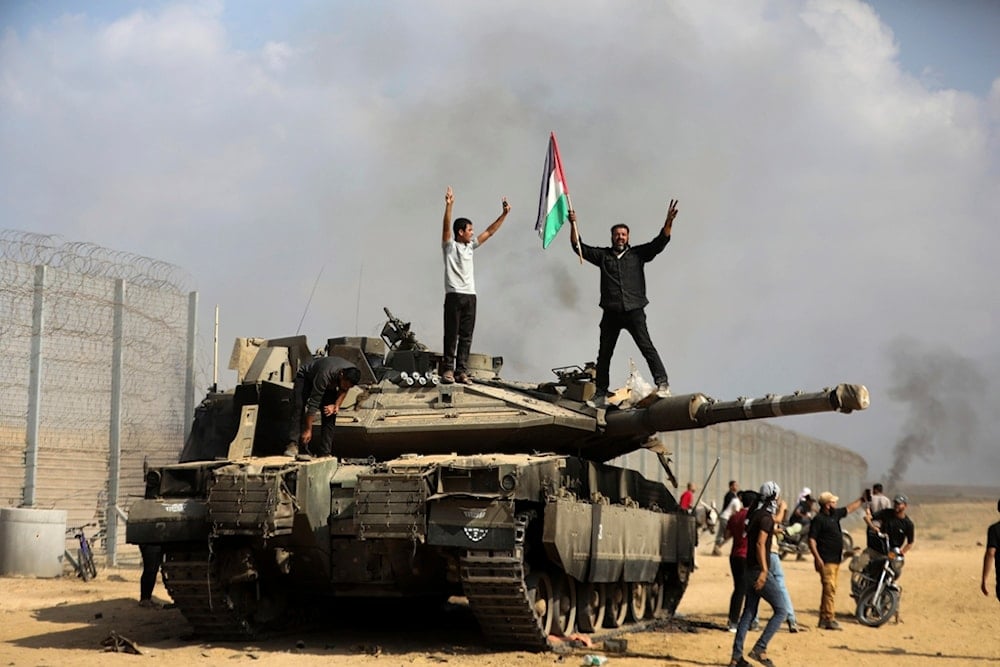
Palestinians wave their national flag and celebrate by a destroyed Israeli tank at the southern Gaza Strip fence east of Khan Younis on Saturday, Oct. 7, 2023 (AP Photo/Yousef Masoud)
Three years after the launch of Operation Al-Aqsa Flood, Hamas reaffirmed its position that Palestinian resistance is a legitimate right until the Israeli occupation is defeated and Palestinian land and holy sites are liberated.
In a statement issued Wednesday marking the third anniversary of October 7, 2023, Hamas called the operation a “historic and honorable milestone” in the Palestinian struggle and a major episode in what it characterized as the national battle for freedom and self-determination.
The movement said the events of October 7 and the ensuing war on the Gaza Strip had brought renewed international attention to the Palestinian cause, which "Israel" and its allies marginalized through decades of occupation, siege, settlement expansion, and denial of Palestinian rights.
Marking the third anniversary of Operation Al-Aqsa Flood, Palestinian Resistance groups and officials issued statements reflecting on the October 7 operation and the three years of war that followed. The Palestinian factions said October 7 exposed major failures within the Israeli military, security, and intelligence apparatus, arguing that the years since have demonstrated that military power and technological superiority alone cannot determine the outcome of wars. For its part, Hamas said the confrontation did not begin on October 7, stressing that "Israel" waged a genocidal war against #Gaza over the past three years. The movement reaffirmed the Palestinian people’s right to resist the occupation and called for a unified Palestinian national strategy. Meanwhile, the Al-Qassam Brigades’ military spokesperson described October 7 as an “extraordinary military achievement” in planning, execution, and strategic deception.
— Al Mayadeen English (@MayadeenEnglish) October 7, 2026
Hamas also praised Palestinian steadfastness across Gaza, the West Bank, and occupied Al-Quds, pointing to Palestinians returning to their homes and the remains of destroyed neighborhoods as evidence of their attachment to the land and rejection of displacement.
The movement said Operation Al-Aqsa Flood was a “natural response and culmination of bitter suffering,” citing decades of Israeli military operations, restrictions, killings, settlement policies, and measures affecting Al-Aqsa Mosque and Palestinian detainees.
It further rejected the notion that the conflict began on October 7, arguing that its roots extend much further back.
Read more: Al-Aqsa Flood shattered 'Israel’s' invincibility myth: IRGC
Hamas blasts 'Israel' for continuing attacks after ceasefire
Hamas called out "Israel" for committing genocide and deliberately destroying civilian infrastructure in Gaza, saying the war had killed more than 74,000 Palestinians and injured 175,000, according to figures cited in its statement.
The movement also said Israeli attacks had continued after the ceasefire through what it termed “silent genocide,” citing nearly 1,500 Palestinians killed and more than 5,000 injured since the truce took effect.
In the occupied West Bank and Al-Quds, Hamas pointed to continued raids, arrests, home demolitions, and settler attacks, arguing that these measures contribute to efforts to displace Palestinians and expand Israeli settlements.
The movement also said the war had generated growing international opposition to Israeli policies, including boycott campaigns targeting Israeli academic, economic, and security institutions.
Movement calls for ceasefire implementation and legal action
Hamas reaffirmed its commitment, alongside other Palestinian Resistance factions, to carrying out its obligations under the ceasefire agreement and working with mediators to preserve it.
At the same time, it reprimanded "Israel" for violating its commitments, tightening the siege, and worsening Gaza’s humanitarian crisis. Hamas called on the US administration and ceasefire guarantors to compel "Israel" to implement its obligations and the roadmap accepted by the movement.
It said the process should result in a complete end to military operations, humanitarian assistance, reconstruction, and the full withdrawal of Israeli occupation forces from Gaza.
Hamas also called on the International Criminal Court and International Court of Justice to pursue Israeli officials it holds responsible for war crimes and genocide, naming Israeli Prime Minister Benjamin Netanyahu, members of his government, and military commanders.
The movement urged Arab and Muslim states and international solidarity groups to increase pressure over the war and support Palestinian demands for freedom and independence.
Hamas concluded by reaffirming the Palestinian people’s right to defend their land, rights, and holy sites and to resist occupation. It called for the establishment of a fully sovereign Palestinian state with Al-Quds as its capital.
The statement also commemorated Hamas figures Ismail Haniyeh, Saleh al-Arouri, Yahya Sinwar, and Mohammed Deif as “guiding beacons” on the path toward liberation and return.


