
Hegseth says Europe 'freeriding' on US rather than aiding US in Hormuz
 3 Min Read
US War Secretary Pete Hegseth criticized European allies, accusing them of “freeriding” and inaction over the Strait of Hormuz crisis, although the US is blockading Hormuz as well.
-
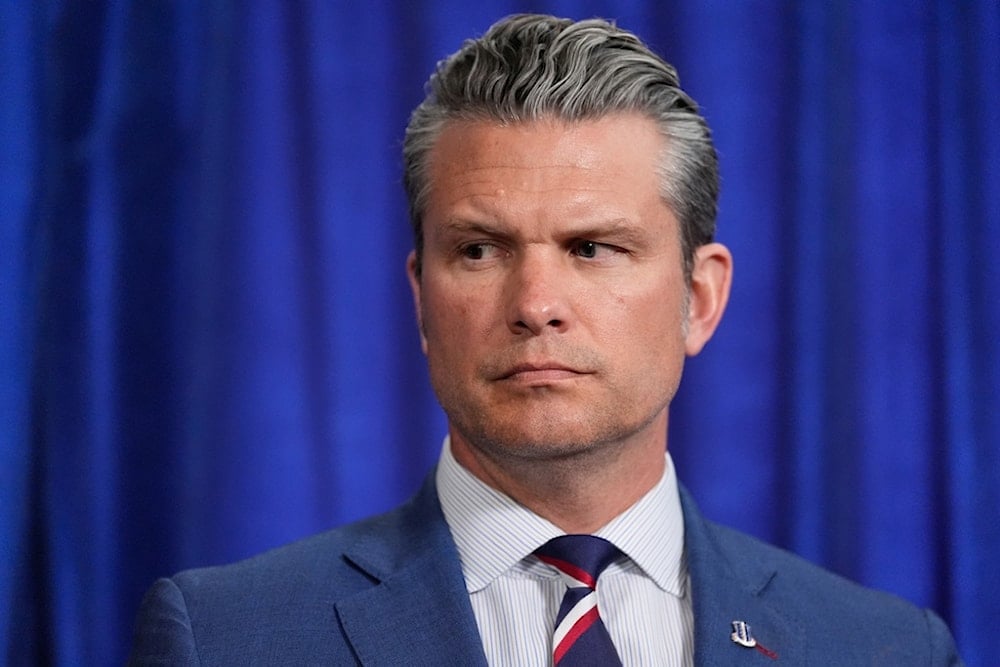
US War Secretary Pete Hegseth listens during a news conference with President Donald Trump at Mar-a-Lago, Saturday, January 3, 2026, in Palm Beach, Florida (AP)
US War Secretary Pete Hegseth accused traditional US allies in Europe of “freeriding” and being disloyal by not using their own forces to open the Strait of Hormuz, that’s been closed due to the US-Israeli aggression on Iran.
“We are not counting on Europe, but they need the Strait of Hormuz much more than we do,” Hegseth stated. He mocked a recent European confab, saying US allies “might want to start doing less talking” instead of holding “a fancy conference” and “a silly conference.”
This comes after European leaders convened in Nicosia on Friday for a high-level summit aimed at addressing the escalating energy crisis driven by regional tensions and the potential closure of the Strait of Hormuz, a critical artery for global oil supplies.
Europe previously expressed hesitation and aversion to direct action in the Strait of Hormuz, saying the war was not ignited by Europe. Rather than taking military action, Europe focused on post-war initiatives to resolve the issue.
The summit brought together heads of EU member states under the leadership of Antonio Costa and Ursula von der Leyen, alongside Cypriot President Nikos Christodoulides.
A central feature of the gathering was an expanded working lunch that included European leaders and counterparts from West Asia. Among the attendees were Syria’s transitional president Ahmad al-Sharaa, Egyptian President Abdel Fattah el-Sisi, Lebanese President Joseph Aoun, Jordan’s Crown Prince Hussein bin Abdullah II, and GCC Secretary-General Jassim Mohammed Al-Budaiwi.
Global energy crisis looming
Earlier, Fatih Birol, executive director of the International Energy Agency, told CNBC that the world "is facing the biggest energy security threat in history. As of today, we've lost 13 million barrels per day of oil... and there are major disruptions in vital commodities."
Birol has previously warned that the war and the subsequent closure of the Strait of Hormuz would result in "the largest energy crisis we have ever faced." Before the war, an average of 20 million barrels of oil and petroleum products were shipped through the strait every day.
The vital maritime passage is currently under what Birol described as a "double-blockade," with neither Iran nor the United States allowing vessels to enter or exit the channel.
It is worth noting that when an agreement was reached between the United States and Iran, the Strait of Hormuz was reopened as per the provisions of the agreement. However, when the US and "Israel" breached the ceasefire regulations, Iran effectively shut close the Strait, stating that a halt to the aggression on Lebanon would be key to allow transit through the waterway.
US President Donald Trump then ordered a blockade on the key waterway, and recently ordered the US Navy to shoot any Iranian boat, which he previously claimed have been obliterated, further intensifying the aggression on Iran and in the Strait of Hormuz.
Read more: US Navy Secretary fired amid US-imposed naval blockade of Hormuz


