
EU holds Nicosia summit on energy crisis, Strait of Hormuz
 2 Min Read
European and Middle Eastern leaders meet in Nicosia to discuss the energy crisis, supply risks, and Strait of Hormuz tensions impacting global markets.
-
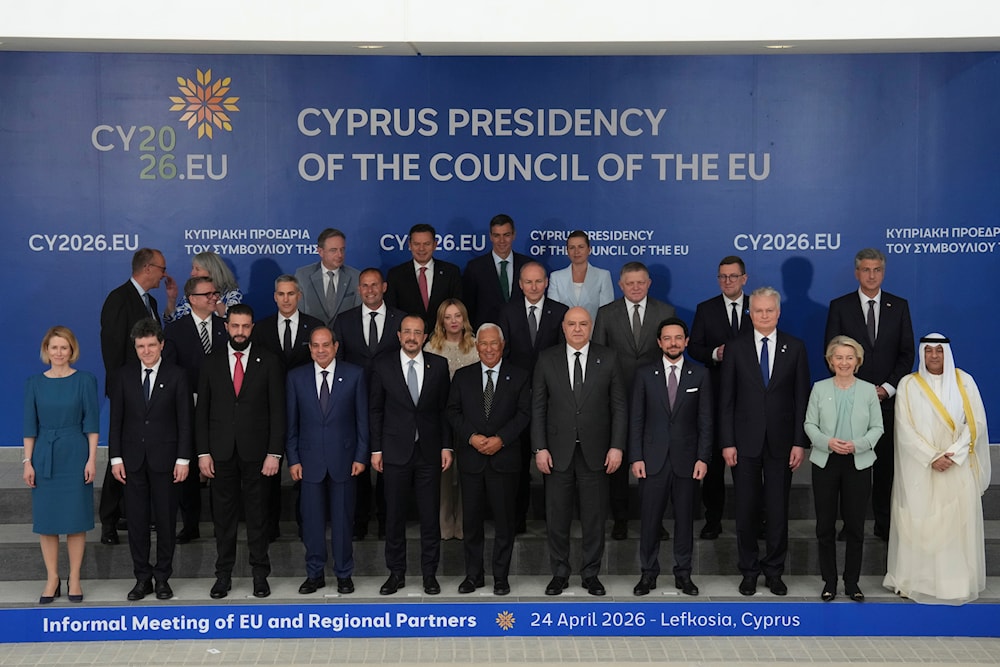
EU and Middle East leaders pose for a family photo of the EU Summit in Nicosia, Cyprus, April 24, 2026 (AP)
European leaders convened in Nicosia on Friday for a high-level summit aimed at addressing the escalating energy crisis driven by regional tensions and the potential closure of the Strait of Hormuz, a critical artery for global oil supplies.
The summit brought together heads of EU member states under the leadership of Antonio Costa and Ursula von der Leyen, alongside Cypriot President Nikos Christodoulides.
A central feature of the gathering was an expanded working lunch that included European leaders and counterparts from the Middle East. Among the attendees were Syria’s transitional president Ahmad al-Sharaa, Egyptian President Abdel Fattah el-Sisi, Lebanese President Joseph Aoun, Jordan’s Crown Prince Hussein bin Abdullah II, and GCC Secretary-General Jassim Mohammed Al-Budaiwi.
President Christodoulides emphasized that the summit places strong importance on engagement with the Middle East, stressing the need for a strategic partnership with regional states. He noted that tangible progress cannot be achieved without the direct involvement of key regional actors.
Lebanese President uses summit to make a point
During remarks at the informal EU leaders’ meeting, President Aoun stated that Lebanon rejects being used as a bargaining chip in regional conflicts. He underscored that Lebanon, like other countries in the region, prioritizes de-escalation and the pursuit of stability and peace.
Aoun also called on the European Union to organize an international conference focused on reconstruction and recovery, increase humanitarian funding, and activate a French-backed initiative to support the Lebanese army.
According to regional and international media reports, discussions at the summit are centered on aligning European policies to mitigate the crisis’ impact on prices and supply chains, diversifying energy sources, and averting a potential “economic disaster” during the summer, alongside broader issues such as collective security.


