
Hezbollah affirms Ali al-Taher Hill remains under its control
 3 Min Read
Hezbollah affirms the strategic Ali al-Taher hill remains under its control, rejecting Israeli claims that occupation forces captured the position near Nabatieh.
-
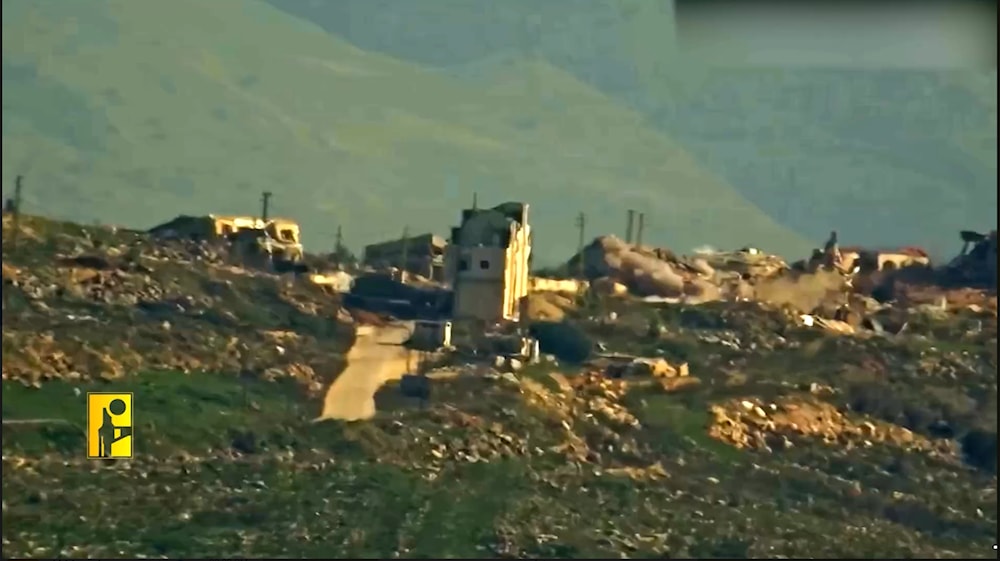
Screengrab from a video of Resistance operations showing plumes of smoke from an operation in an undisclosed area in southern Lebanon, undated. (Screengrab/Hezbollah Military Media)
The strategic Ali al-Taher Hill remains fully under the control of Hezbollah, the Resistance declared on Friday, asserting that there are no Israeli forces present there.
"The Islamic Resistance categorically denies what was published by official bodies affiliated with the Israeli enemy army regarding its control over Tell Ali al-Taher on the eastern outskirts of the city of Nabatieh," Hezbollah asserted.
The Resistance group further affirmed that "the hill is devoid of any presence of occupation forces," asserting that Resistance fighters still have control over the strategic location, and "are in full readiness to confront any attempt of advance or incursion carried out by the enemy forces."
The strategic significance of the Ali al-Taher hill stems from its commanding geography. Rising to an elevation of nearly 700 meters, the hill functions as a natural observation tower, providing any force that controls it with a sweeping view over the eastern sector of southern Lebanon, including the key city of Nabatieh and surrounding villages.
Hezbollah's statement comes in response to Israeli claims that the Israeli Occupation Forces have taken full control over the Ali al-Taher Hill.
Kfar Tibnit–Ali al-Taher axis will remain impervious to Israeli forces: Hezbollah
Earlier on June 19, Israeli media acknowledged that occupation forces had failed to occupy the Ali al-Taher heights in the Nabatieh district of South Lebanon, reporting that "difficult incidents" occurred during confrontations with Lebanese Resistance forces.
According to Israeli reports, Hezbollah fighters targeted Israeli tanks and troop movements with anti-tank guided missiles and drone strikes, causing multiple casualties among occupation soldiers. The reports confirmed that wounded personnel had been evacuated from Lebanese territory.
Channel 14 added that "the situation in Lebanon is very dangerous for our soldiers," stating that "if there is no chance of success for our soldiers there, simply remove them." Other outlets described the security situation for Israeli forces in Lebanon as one of the most difficult in the country's military history, citing incidents of a tank driving over an IED and heavy missile fire striking military vehicles.
The Islamic Resistance also confronted overnight Israeli attempts to advance towards Kfar Tibnit, targeting military movement with guided missiles and pre-positioned ambushes. Eyewitnesses reported flames and plumes of smoke at the attack site on the outskirts of the village.
Hezbollah affirmed that the Kfar Tibnit–Ali al-Taher axis would remain impervious to Israeli incursions, vowing that its fighters would write "Karabala-like epics" in defense of the nation. In a statement, the group said its fighters monitored an Israeli force consisting of armored and infantry units attempting to infiltrate toward the northern side of the Ali al-Taher hill.
Detailing the operation, Hezbollah said it lured Israeli forces into a kill zone before engaging them with various weapons and targeting three Merkava tanks. The statement framed the confrontation within the context of "Ashura operations" and the "legitimate right to resist occupation."


