
Hezbollah cross-border ops. intensify; rocket, drone launches surge
 6 Min Read
The Islamic Resistance in Lebanon announces a series of operations against invading Israeli forces in Lebanon and Israeli military assets in occupied northern Palestine.
-
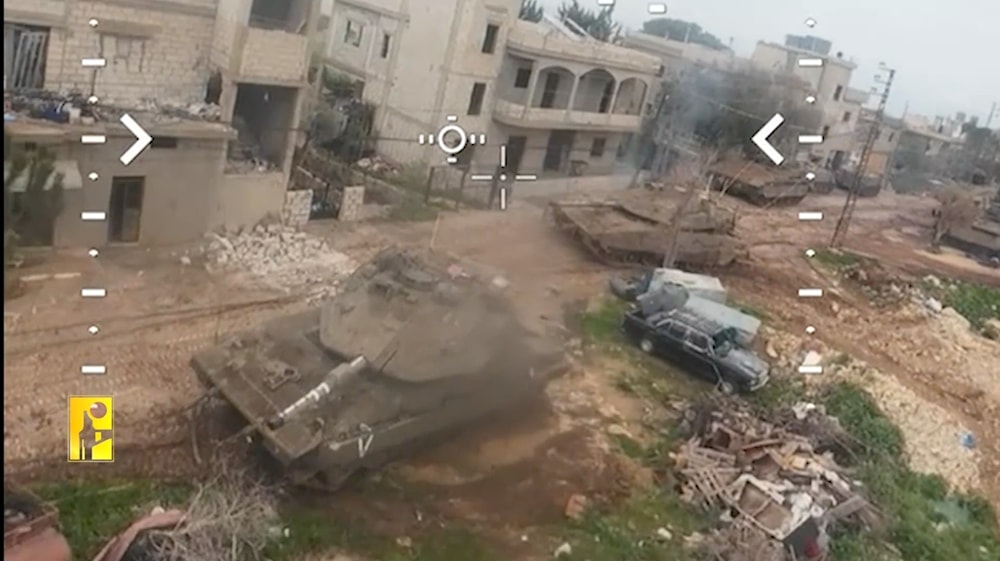
An Israeli Merkava tank can be seen through the lens of a Hezbollah-operated FPV drone in Aynatha, southern Lebanon, May 13, 2026 (Islamic Resistance in Lebanon/Military Media)
The Islamic Resistance in Lebanon - Hezbollah remains steadfast in defending Lebanon and its people as the Israeli aggression rages on, announcing a new set of military operations targeting Israeli assets inside Lebanon and across the border.
Among the declared operations, two were carried out on Saturday, May 30, during which Resistance fighters targeted an Israeli Merkava tank at 11:20 pm in al-Bayyada with a precision-guided missile, achieving a direct hit.
30 minutes later, an Israeli enemy force, consisting of soldiers and their vehicles, was targeted in al-Bayyada with a rocket barrage.
Operations carried out on Sunday, May 31
Kickstarting today's operations, Hezbollah targeted an assembly of Israeli soldiers and their vehicles in al-Bayyada at 4:00 am.
At 8:40 am, a grouping of Israeli soldiers gathered at a helipad in the illegal settlement of Shlomi was targeted with an FPV drone.
At 11:45 am, Hezbollah's fighters targeted Israeli military infrastructure in Nahariya with a rocket barrage.
At 12:30 pm, Israeli military infrastructure in the Krayot area, northern Haifa, was targeted with a rocket barrage.
At 12:50 pm, an enemy force in the eastern outskirts of Yohmor al-Shaqif in southern Lebanon was targeted with an Ababil FPV drone.
Northern settlements under fire
As Hezbollah's operations continue undeterred, Israeli media reported nonstop sirens across the illegal settlements in northern occupied Palestine following continuous rocket launches from South Lebanon. Sirens were activated in the settlements of Kfar Giladi and Metula, before spreading to Akka and beyond.
Israeli Army Radio reported that five rockets were launched from southern Lebanon toward Nahariya after sirens were activated amid fears of a rocket attack. Israeli media also reported sirens in Rosh Hanikra, Bassa Beach, and several northern settlements, including Shlomi, Limann, Hanita, Ya'ara, and Adamit, following suspicions of a drone infiltration from Lebanon.
Al Mayadeen's correspondent in South Lebanon also reported that four rocket barrages were fired toward illegal settlements in northern Palestine within 30 minutes. In detail, our correspondent revealed that two heavy rocket salvos were launched toward Akka and Haifa Bay in occupied Palestine, with sirens sounding in the area.
Hezbollah won't be destroyed
In this context, Israeli channel i24 News said that Hezbollah continues to expand the scope of its operations and increase the rate of rocket fire toward the north.
Meanwhile, Israeli Channel 12 noted that “even if the Israeli army continues fighting in this manner for many more months, it will not lead to the elimination or destruction of Hezbollah.”
Israeli claims of ground success debunked
Hezbollah's operations have intensified and expanded despite the Israeli bombardment and aggression against South Lebanon, the Bekaa valley, and Beirut's Southern Suburb. While "Israel" claims success, reports on the ground point to a completely different reality.
In this context, Hezbollah sources affirmed to Al Mayadeen that what "Israel" is portraying as a major battlefield achievement amounts to only limited gains after months of sustained fighting.
Israeli forces selected the shortest route and the axis nearest to the border in their push toward the Litani River and are now portraying that movement as a significant achievement, as per the same sources. The sources argued that "Israel" is framing its restricted territorial advance as a success even though it has failed to establish lasting control or ensure the security of troops operating in the areas it entered.
The distance between the border sector in the al-Jalil Panhandle from which Israeli forces advanced and the Litani River is less than three kilometers, the sources asserted to Al Mayadeen.
Furthermore, they added that it took Israeli troops approximately three months to capture around eight Lebanese villages situated along the route leading to the river. Of these eight villages, three had already been destroyed and no longer contained residents or resistance military positions, according to the sources.
They maintained that Resistance fighters were able to hold back Israeli advances along the same axis for three months, inflicting substantial losses despite the deployment of elite Israeli units.
Israeli forces have so far failed to establish stable control in any area they have entered, describing this as the primary tactical and operational benchmark on the battlefield. The battlefield, they said, continues to witness shifting advances and withdrawals as confrontations persist.
After 4 months of battles, IOF reach al-Shaqif fortress, only 3 km from border
Earlier today, Al Mayadeen's correspondent reported that after one of the longest and most delayed advances in the history of the struggle against "Israel", Israeli occupation forces (IOF) reached the strategic al-Shaqif fortress after four months of ground battles in South Lebanon.
An Israeli infantry unit reached the fortress via a flanking route from the direction of Deir Mimas, according to our correspondent, knowing that the point of arrival is merely 3 kilometers from the Lebanese-Palestinian border.
The four-month advance in the Israeli war on Lebanon marks a significant departure from the pace of previous Israeli invasions into Lebanese territory, our correspondent noted, stressing that the IOF reaching al-Shaqif fortress does not mean its forces are safe from resistance fire, asserting that troops in the area remain vulnerable to attacks.
The Israeli advance to al-Shaqif fortress follows days of intensified military activity in the surrounding area, including extensive combing operations, heavy artillery shelling, and sustained violent airstrikes. It came amid a broader effort to secure access routes and suppress resistance activity across the region, with Israeli warplanes and drones carrying out repeated attacks on nearby towns and strategic positions, all to no avail. Despite the heightened bombardment and ground operations, the area has remained an active theater of confrontation.
-
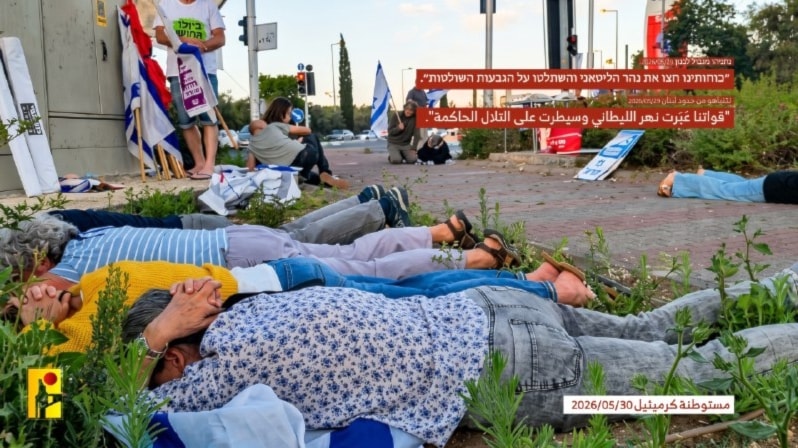
Israeli settlers take cover in Karmiel, northern occupied Palestine, on May 30, 2026, after air raids sound. Caption: 'Our forces crossed the Litani River and captured its hills' (Military media)


