
Hezbollah FPVs, rocket salvos pound IOF troop, vehicle assemblies
 5 Min Read
Hezbollah continues its operations against Israeli soldiers, vehicles, and military sites in southern Lebanon and now expanding to northern occupied Palestine.
-
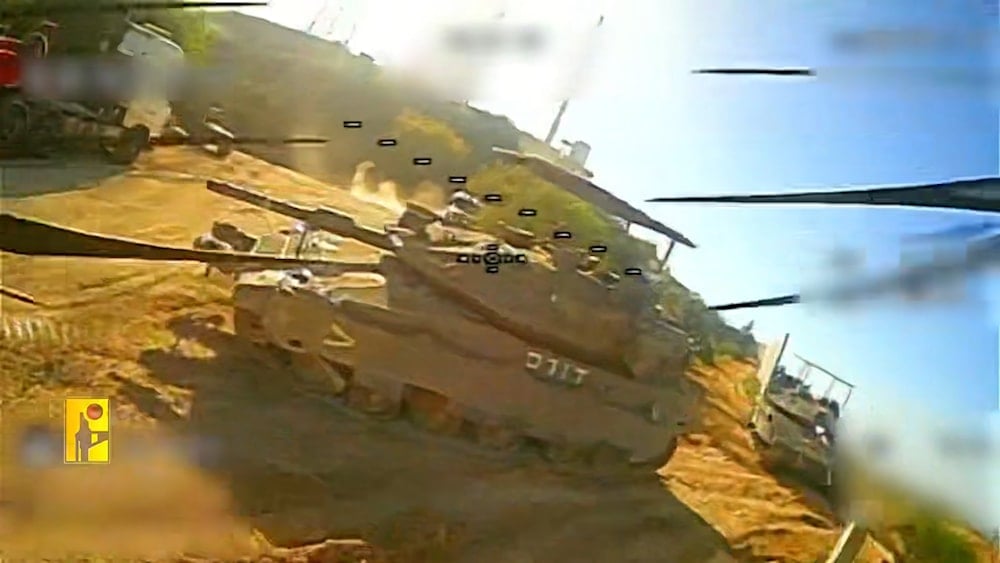
An Israeli Merkava tank can be seen through the lens of a Hezbollah-operated FPV drone in Khirbet al-Manara, the Lebanese-Palestinian border, May 11, 2026 (Islamic Resistance Military Media)
The Islamic Resistance in Lebanon - Hezbollah continues its defensive operations in southern Lebanon in response to ongoing Israeli ceasefire violations, including strikes on villages and civilians that have killed several people in Lebanon, ahead of another round of Lebanon "Israel" talks.
At 2:00 am, Hezbollah said its fighters targeted a grouping of Israeli soldiers between the Wadi al-Uyoun area and the town of Sribbine with a rocket barrage.
At 6:00 am, Hezbollah said its fighters targeted an Israeli Namer armored vehicle in the Wadi al-Uyoun area with a guided missile, achieving a direct hit.
At 8:30 am, Hezbollah said its fighters targeted an Israeli D9 bulldozer at Khallet al-Raj in the town of Deir Seryan, using an FPV drone.
Simultaneously, Hezbollah said its fighters targeted an Israeli military vehicle in the town of Rsheif, using an FPV drone.
At 9:00 am, Hezbollah said its fighters targeted an assembly of Israeli soldiers and vehicles near the Moussa Abbas complex in the city of Bint Jbeil using an FPV drone.
At 9:05 am, Hezbollah said its fighters targeted an assembly of Israeli soldiers and vehicles in the town of al-Qawzah with a rocket barrage.
At 9:15 am, Hezbollah said its fighters targeted the newly established Blat military site in southern Lebanon with a rocket barrage.
At 10:00 am, Hezbollah said its fighters targeted an Israeli troop carrier in the city of Bint Jbeil with an FPV, achieving a confirmed hit.
At 10:30 am, an Israeli Merkava tank in the town of Ainata was targeted with an FPV, achieving a confirmed hit.
At 2:00 pm, Hezbollah said its fighters ambushed an Israeli military force attempting to advance from the town of Rsheif toward the outskirts of the town of Haddatha, detonating an explosive device against the advancing force and engaging its members with light and medium weapons and rocket-propelled grenades. A follow-up statement revealed the details of the ambush.
At 5:00 pm, an assembly of Israeli vehicles in the vicinity of the Mousa Abbas complex in the city of Bint Jbeil was targeted with a swarm of attack drones.
At 5:30 pm, a Merkava tank in the Al-Dawawir area in Houla was precisely struck with an FPV drone.
At 7:15 pm, Hezbollah's fighters targeted newly installed technical equipment in al-Khiam with an attack drone.
At 7:45 pm, an Israeli vehicle concentration in Iskandarouna was targeted with two attack drones. At 8:20 pm, the concentration came under attack for the second time with a rocket salvo.
Hezbollah publishes footage of operations
In addition to the statements, the Islamic Resistance published more footage of its operations targeting Israeli occupation forces in southern Lebanon.
One video shows a first-person view operation, targeting a Merkava tank inside the Khirbet al-Manara site on the Lebanese-Palestinian border. The footage shows the drone as it approaches the sight and scans the area, before spotting the tank and flying toward it, hitting its turret.
#WATCH | The Islamic Resistance in Lebanon released footage of an operation, dated May 12, targeting an Israeli Merkava tank in the vicinity of Khirbet al-Manara on the southern Lebanese border with northern occupied Palestine using an #FPV drone.#Lebanon #SouthLebanon pic.twitter.com/op5nQH8IBk
— Al Mayadeen English (@MayadeenEnglish) May 13, 2026
Another video published by Hezbollah shows another FPV drone operation, targeting a D9 military bulldozer on the al-Naqoura road in southern Lebanon.
#WATCH | The Islamic Resistance in Lebanon released footage of an operation, dated May 11, targeting an Israeli engineering vehicle (D9) on the al-Naqoura road in South Lebanon using an FPV drone. #SouthLebanon #Lebanon #LebanonUnderAttack #FPV #FPVDrone pic.twitter.com/3LHs4LiITU
— Al Mayadeen English (@MayadeenEnglish) May 13, 2026
Hezbollah also showed the targeting of an Israeli Humvee in the southern Lebanese town of Tayr Harfa using an FPV drone.
#WATCH | Hezbollah Military Media publishes footage of an operation carried out on May 11, targeting an Israeli Humvee in the southern Lebanese town of Tayr Harfa using an FPV drone.#Hezbollah #Lebanon #SouthLebanon pic.twitter.com/RV93jx2rb9
— Al Mayadeen English (@MayadeenEnglish) May 13, 2026
Hezbollah carries out 'largest' FPV operation in 'Israel'
Earlier, Israeli media outlet i24NEWS reported that Hezbollah carried out a large-scale swarm attack using FPV drones against a military target in northern “Israel", describing it as one of the most extensive drone operations to date.
Citing a security source, the report said, “This is the most intense drone attack on Israel to date,” adding that it was the first recorded instance of a coordinated assault of this scale directed at a single target inside Israeli territory.
According to the report, Hezbollah launched two waves of FPV drone swarms toward northern “Israel". In the first wave, two drones were reportedly launched toward Israeli army forces in southern Lebanon, resulting in injuries to two soldiers, one moderately and one lightly wounded. Two additional drones were also said to have been launched toward a site along the northern border, sparking a fire, while the Israeli Air Force attempted to intercept one of them.
The outlet added that less than an hour later, a second and more intense wave followed, involving multiple FPV drones targeting the same location inside Israeli-occupied territory. The drones were reportedly observed hovering over the area for several minutes in what appeared to be search patterns for optimal impact points.
An Israeli soldier was quoted as saying, “I saw two hitting the target, and within five seconds, we detected another one hovering between buildings looking for people. You can see everything with your own eyes: the fiber spool, the drone, and a large explosive device.”
An Israeli security source familiar with the incident said the main concern was the level of coordination between the drones, warning that even if some were intercepted, others could still reach the target.


