
Fishnets for safety? Hezbollah FPVs have IOF troops grasping at straws
 4 Min Read
Haaretz says Israeli forces are using fishing nets against Hezbollah FPV drones amid growing failures to intercept fiber-optic drones.
-
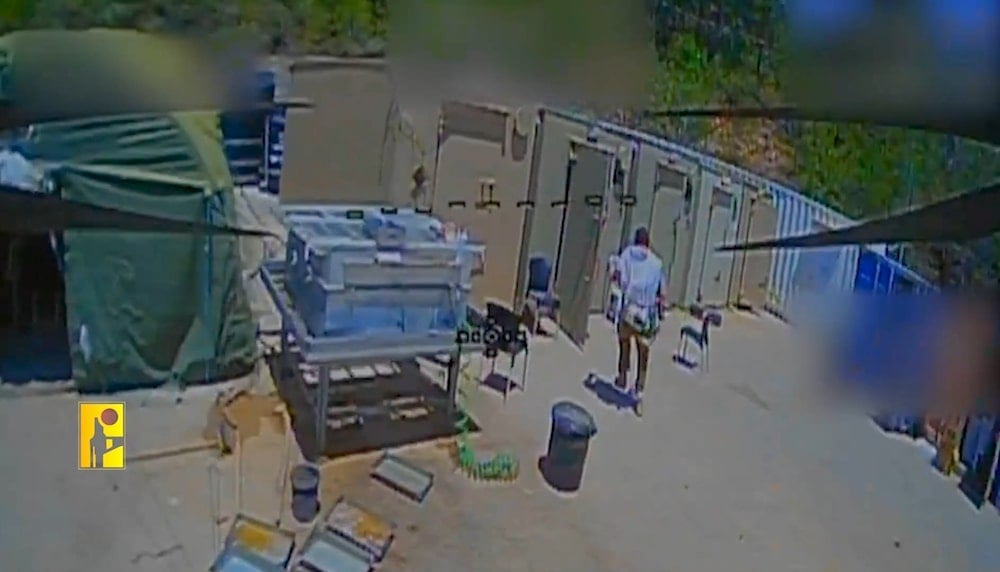
An Israeli soldier flees towards a shelter in a helipad zone seen through the lens of a Hezbollah-operated FPV drone in the Israeli settlement of Shlomi, occupied Palestine, May 9, 2026 (Islamic Resistance Military Media)
The Israeli military is facing a critical field reality on the Lebanese front and over Lebanese territory, where fish farms belonging to the Valley kibbutzim have begun supplying forces with fishing nets as a make-shift protection against drones launched by Hezbollah, Haaretz revealed on Tuesday.
According to the report, which was cleared for publication by military censorship, the measure comes amid an acknowledgment by a senior official in the ground reserve forces that “there is no technological solution yet to confront fiber-optic-based drones,” stressing that pushing Hezbollah away beyond the Litani River is ineffective, as these drones can be launched over distances of up to 60 kilometers.
The official told Haaretz that “the army is handcuffed” due to the policies of both Benjamin Netanyahu and Donald Trump, adding that current activity is limited to the destruction of villages by private contractors, while warning of a severe shortage in the number of soldiers and officers.
No technological solution to Hezbollah’s explosive-laden drones
On its part, Channel 7 revealed that Israeli Chief of Staff Eyal Zamir held a security discussion with the participation of the leadership of the Technology Division, Unit 81, and the Research and Development Directorate at the Ministry of Security in an attempt to find a solution to Hezbollah’s growing capabilities in the field of explosive-laden drones.
The channel confirmed that the meeting ended without reaching an operational solution, despite the presence of leading technological minds from the Israeli army and the Security Ministry. It noted that the central challenge raised during the discussion was fiber-optic drones.
Cheap, lethal Hezbollah weapon versus multi-million-dollar defense systems
It explained, “Unlike regular drones that operate via radio waves and can be jammed using electronic warfare systems, the new drones are connected by a thin fiber-optic cable to the operator. This connection provides two lethal advantages: there is no way to sever the link between the operator and the drone through electronic warfare. In addition, the operator receives a smooth and accurate video feed until the moment of impact, allowing surgical precision in targeting.”
It added that Hezbollah uses a low-tech but deadly weapon costing no more than $500. These drones are launched from distances of 10 to 15 kilometers and strike soldiers, engineering equipment, and vehicles, while the Israeli army deploys expensive aerial systems and multi-million-dollar defense technologies.
The channel further revealed that in the absence of a technological response, instructions given to soldiers in southern Lebanon have remained relatively primitive, relying on physically attempting to counter drones around positions and vehicles using small-arms fire.
FPV drones continue to inflict casualties on Israeli forces
The report coincided with "Israel’s" announcement of the killing of reserve soldier Alexander Glubniov (47) and the injury of three others yesterday in FPV drone operations conducted by Hezbollah. The responsibility, according to the report, was attributed to Prime Minister Benjamin Netanyahu, his Security Minister Israel Katz, and Chief of Staff Eyal Zamir.
The Israeli military admitted on Monday that it cannot currently intercept such drones, acknowledging that Hezbollah continues to operate “skilled cells” from southern Lebanon against its forces, according to the Walla news site.
Two days earlier, Israeli media quoted a soldier commenting on resistance drones as saying, “The army has nothing to do, as a soldier is assigned only to watch the sky.”
Concern growing, no solution in sight
Israeli media reports have highlighted growing concern within "Israel" over Hezbollah’s expanding drone operations, with military correspondents reporting a sense of frustration among troops stationed in northern occupied Palestine.
Israel Hayom’s military affairs correspondent said Hezbollah continues to inflict a “very heavy price” on Israeli occupation forces through FPV drones. In contrast, the military has yet to present an effective response.
The report referred to what it called the “Lebanese dilemma", noting that Hezbollah drones continue to reach targets in northern areas despite ongoing Israeli military operations in southern Lebanon.
According to the report, soldiers in the North have described moments of helplessness when encountering small drones overhead without prior warning systems being activated, while existing countermeasures were described as largely ineffective.
It also noted that several soldiers were injured in recent days as a result of drone attacks, including nine reported wounded over the past week, with three of them said to be in serious condition.


