
Hezbollah model reshapes asymmetric warfare: Kataib Hezbollah official
 3 Min Read
Kataib Hezbollah official says Hezbollah’s model in Lebanon reshaped asymmetric warfare, forcing adversaries into agreements and impacting regional dynamics.
-
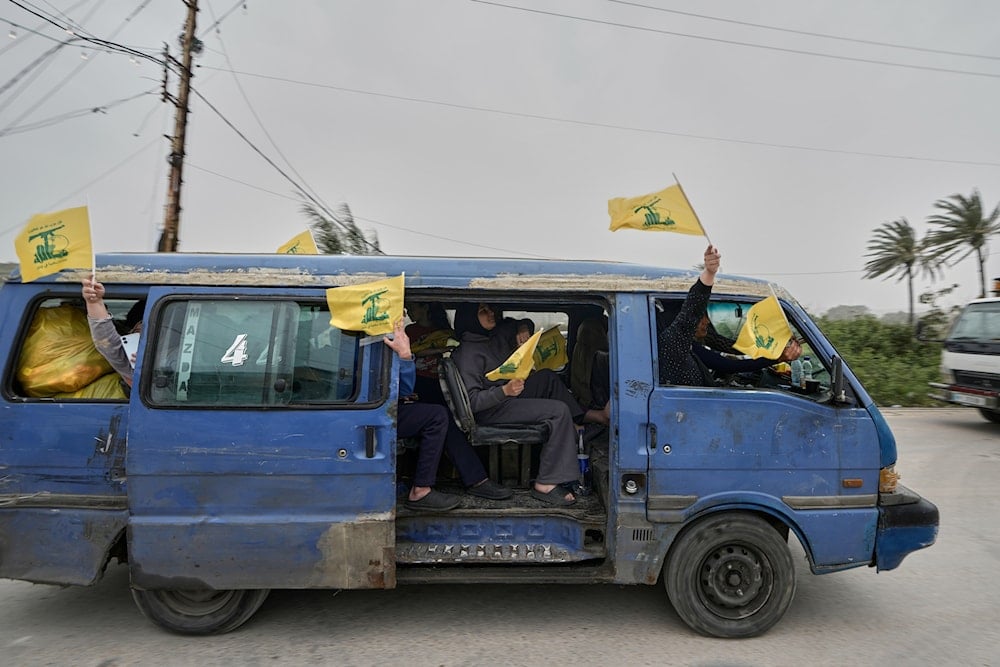
Displaced people sit in a van and wave Hezbollah flags, as they return to their villages on the second day of a ceasefire in Lebanon, in Qasmiyeh, near Tyre city, southern Lebanon, April 18, 2026 (AP)
The steadfastness of Hezbollah fighters in Lebanon has helped establish a new model in asymmetric warfare, ultimately forcing the opposing side into an agreement, a security official from Iraq’s Kataib Hezbollah, Abu Mujahid al-Assaf, said on Saturday.
He stated that the outcome as a clear victory despite external pressure and Lebanon’s internal complexities.
Al-Assaf added that the concept of “unity of arenas” has left a tangible impact on their adversaries, calling for the development of new coordination mechanisms between resistance groups and other parties to enhance cooperation and open additional fronts in confronting the United States and “Israel.”
Understanding reached regarding Camp al-Tawhid
He also revealed that understandings had been reached between Kataib Hezbollah and an Iraqi mediator regarding the security of Camp al-Tawhid (the US embassy), linking this to a commitment not to target residential areas inside Iraq. He added that the group intends to work toward ending the presence of occupation-linked institutions and their influence within official state bodies.
On Iraq’s domestic political scene, al-Assaf stated that if specific candidates for the position of prime minister cannot be secured, the premiership should be selected from within the relevant political blocs, rejecting what he described as the monopolization of top positions by a single party.
In a separate context, he addressed developments in Kuwait, criticizing measures that harm segments of the population and warning of potential repercussions.
Al-Assaf's statement follows a 10-day ceasefire between Lebanon and "Israel" came into effect on April 17 at 12 a.m. Beirut time, following sustained pressure from Iran that tied any agreement with the United States to a cessation of Israeli strikes on Lebanon.
During the Israeli war on Lebanon, Hezbollah conducted a sustained campaign of military operations over a 45-day period, describing it as a prolonged test of endurance and defiance marked by continuous defensive engagement.
According to the group, a total of 2,184 military operations were carried out between March 2 and April 26, 2026, targeting Israeli forces across southern Lebanon and extending deep into occupied territories. These operations included strikes on military positions, barracks, and bases, as well as engagements with Israeli troops on Lebanese soil.
Hezbollah said it also launched attacks using one-way drones and various types of rocket fire against Israeli settlements and cities, “from the Lebanese-Palestinian border to beyond Tel Aviv,” reaching depths of up to 160 kilometers. The group framed these attacks as a response to what it described as Israeli actions against civilians and widespread destruction of residential areas and infrastructure.
On average, the group carried out approximately 49 operations per day. Despite the Israeli military’s technological and intelligence advantages, Hezbollah maintained that its fighters continued operations throughout the conflict, emphasizing their commitment to defending Lebanese territory.


