
Hormuz squeeze leaves Trump facing Iran, voters, and rising fuel costs
 5 Min Read
Iran's leverage over the Strait of Hormuz is adding to US economic pressure and complicating Trump’s position ahead of the November midterm elections.
-
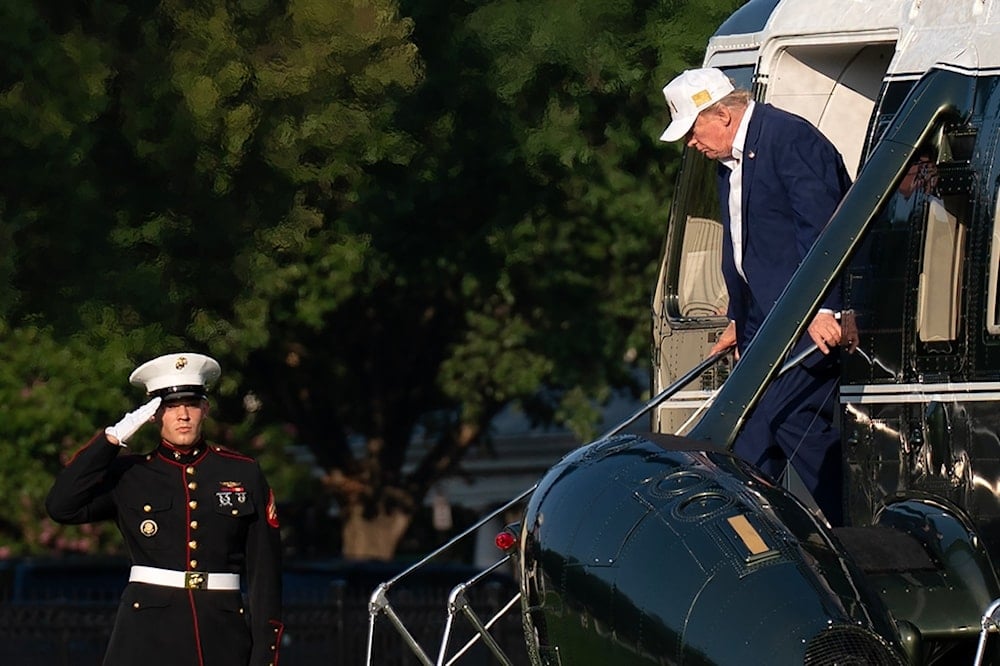
US President Donald Trump steps off from Marine One upon his arrival at the Ellipse just outside of the White House, Sunday, Aug. 9, 2026, in Washington (AP)
US President Donald Trump is facing mounting political pressure ahead of the November midterm elections as the consequences of the US war on Iran weigh on energy prices and deepen dissatisfaction with the domestic economy, according to an analysis published by CNN.
The analysis, authored by Stephen Collinson, said Tehran now holds significant leverage over Washington through the Strait of Hormuz, leaving Trump caught between accepting conditions he has resisted and risking renewed escalation.
Trump has put himself in a more politically vulnerable position over Iran than any US president since Jimmy Carter, according to CNN. The situation echoes the 1979–80 hostage crisis, when Iran was able to exert significant political pressure on a US president ahead of a national election.
Just a week earlier, Trump’s administration had predicted that an agreement to reopen the Strait of Hormuz was close. Instead, Tehran has since strengthened its leverage and is setting demanding conditions for Washington, leaving the US president facing a difficult choice between making concessions and risking further escalation.
For context, the 1979 embassy seizure unfolded against decades of US interference in Iran, including Washington’s role in the 1953 coup against Prime Minister Mohammad Mossadegh, its subsequent support for Shah Mohammad Reza Pahlavi, and Carter’s decision to admit the deposed Shah to the United States.
Talks ruled out, thus more pressure
Meanwhile, Iranian officials have consistently described their position as reciprocal. Foreign Ministry spokesperson Esmaeil Baghaei said in July that Tehran’s approach to the Islamabad memorandum is based on “commitment for commitment,” arguing that Iran has complied while Washington has not.
Foreign Minister Abbas Araghchi said Sunday that indirect messages are still being exchanged but rejected formal negotiations while US violations continue.
“From our point of view, until the violation of the Islamabad memorandum by the American side comes to an end and the United States compensates for what it has violated, the possibility of resuming negotiations does not exist,” he said.
Hormuz turns US pressure back on Washington
CNN noted that Iran retains a pressure point capable of feeding the costs of the war directly into the US economy.
The Strait of Hormuz remains central to global energy flows, and expectations over its reopening have repeatedly influenced oil and gasoline prices. AAA reported US gasoline averaged just above $4 per gallon on August 9, after earlier declines tied to hopes of improved Hormuz access.
CNN argued that repeated US suggestions of an imminent reopening may have weakened Washington’s position by highlighting how quickly prices could fall if a deal is reached.
Iranian officials have also linked the standoff to US domestic politics. Mohammad-Bagher Zolghadr, who was recently appointed as the Iranian Leader's political advisor, warned that continued US pressure would have global economic and political consequences.
“The continuation of the US regime’s maritime blockade and warmongering will further tighten the closure of the Strait of Hormuz… and American voters will pay the price,” he said on August 1.
Trump caught between escalation and concessions
The situation leaves Trump with limited options: accepting Iranian conditions risks appearing as a failure of US pressure, while escalation could further disrupt energy markets and raise fuel prices.
Trump told Axios the administration is relying on pressure rather than full negotiations.
“We are low-keying it. We are only semi-negotiating with them,” he said.
CNN said the strategy assumes Iran will weaken economically before US voters feel the political cost of higher energy prices. But with elections approaching, Tehran is not operating on the same timeline.
Expediency Council Chairman Sadegh Amoli Larijani said Iran would not restore Hormuz to prewar conditions.
“Under no circumstances will we retreat, and the Strait of Hormuz will not return to its previous conditions,” he said.
Trump, however, expressed confidence the situation would resolve.
“It’s like a chess game,” he told Axios.
Economic pressure reaches US voters
The dispute is unfolding alongside broader economic concerns in the US. Gasoline remains above $4 per gallon, while inflation and living costs remain elevated.
The CNN analysis also cited data showing the US economy lost 23,000 jobs in July, though the White House rejected claims of weakness.
“The bottom line is that… things are really, really booming,” National Economic Council Director Kevin Hassett told CNN, attributing the decline to temporary factors.
CNN noted that while the economy may be resilient, voters experience it through prices and wages, linking Hormuz-related energy costs directly to political sentiment. Polling suggests Republicans have lost ground to Democrats on both economic and national security issues.
US strategy faces political deadline
CNN said Iran’s leverage through Hormuz is a key factor shaping Trump’s political vulnerability ahead of the midterms, though it stressed the crisis emerged from a broader cycle of US-Iran escalation rather than unilateral Iranian action.
Washington initially sought to use military and economic pressure to force concessions from Tehran. Instead, Iran has maintained its own leverage over global energy flows, while conditioning any normalization on US policy changes.
Democrats are now seeking to capitalize on economic dissatisfaction, while Republicans warn of political risks from progressive candidates gaining influence.
The immediate challenge for the White House, CNN concluded, is finding a way out of the confrontation that eases economic pressure without appearing to concede failure in its strategy toward Iran.
Read more: Bloomberg: What are the factors shaping Trump's calculations on Iran?


