
House Republicans fear losing majority as costs, war on Iran weigh
 5 Min Read
House Republicans increasingly fear losing their majority as rising living costs, opposition to the Iran war and Trump’s declining approval ratings threaten their midterm prospects, CNN reported.
-
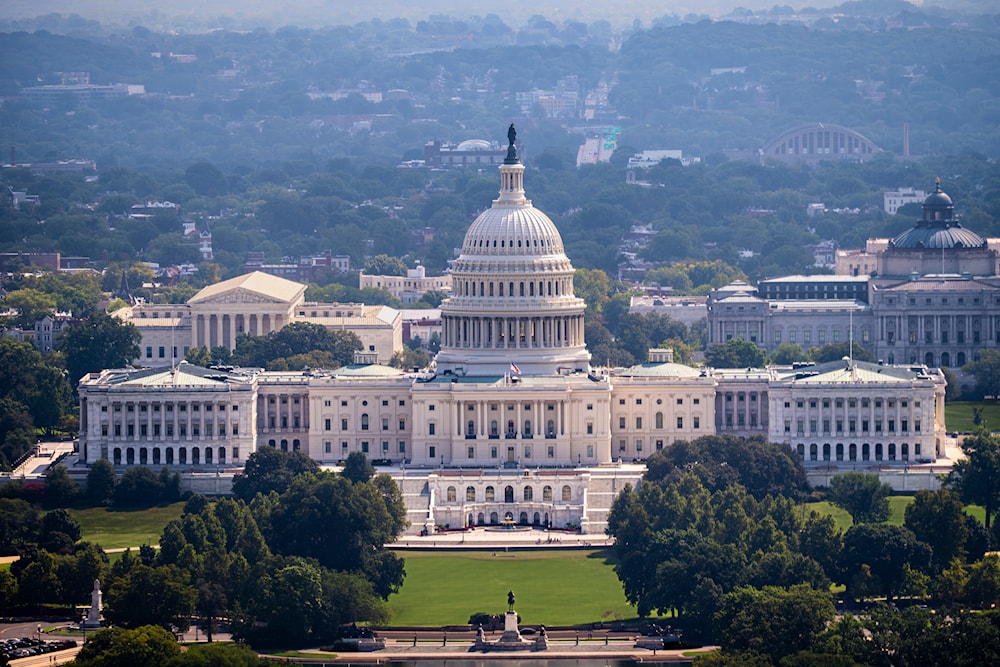
The U.S. Capitol is seen from the Washington Monument in Washington, Friday, Aug. 28, 2026 (AP)
Rising living costs and mounting opposition to the war on Iran are deepening Republican concerns about November’s congressional elections, with some party figures increasingly focused on containing potential losses rather than preserving their House majority, CNN reported.
Citing more than a dozen people familiar with internal discussions, the network said Republican polling had registered a deterioration in President Donald Trump’s approval ratings over the past two weeks, including in areas usually considered reliable party strongholds.
The shift has prompted discussions about concentrating resources on the most defensible seats, while preparing for the possibility that Democrats could take control of the chamber.
Economic pressures fuel Republican anxiety
Republicans interviewed by CNN identified soaring diesel prices, persistent inflation and growing resistance to the Iran war as major obstacles they have little ability to overcome before voters cast their ballots.
Retiring Republican Representative Dan Newhouse acknowledged the uncertainty surrounding his party’s prospects.
“There’s a lot of close races, and it’s hard to make a prediction,” he said, adding: “Affordability is a big deal. People see the gas prices every single day.”
While defending Republican efforts to address living costs, Newhouse said the pressures extended across the country.
“There’s just a lot of things making it tough right now for rural America – which I can speak to specifically – but for Americans all over the country.”
The unease has spread beyond closely divided constituencies. Republican members and aides are also worried about districts Trump carried by double-digit margins, where incumbents have rarely faced serious general-election challenges.
Limiting a Democratic majority
Some Republican strategists are discussing how to leave Democrats with the smallest possible governing margin if the House changes hands, according to CNN.
Several people familiar with those discussions said the aim was to keep a potential majority under Democratic leader Hakeem Jeffries to fewer than 10 seats. Such an outcome could leave Democratic leaders struggling to secure votes whenever members break ranks.
Republicans have experienced similar difficulties under Speaker Mike Johnson, whose narrow majority has repeatedly complicated efforts to control the House floor.
As part of their preparations, party figures have discussed withdrawing funding from races they increasingly regard as difficult to win. CNN cited contests involving Representative Mariannette Miller-Meeks in Iowa, a Republican-held seat in New Jersey and an open seat in Nebraska.
Party leaders, however, reject the idea that defeat is inevitable. A political aide told the network that Johnson remained “absolutely still convinced” he could retain the majority and was not taking any seats “off his board.”
Johnson’s team said he had recently visited New Jersey and planned to appear with Miller-Meeks in Iowa the following week. The House Republican campaign organization also strongly disputed suggestions that control of the chamber was already lost.
Spending and redistricting offer a possible lifeline
Republicans are counting on their financial advantage and favorable changes to congressional district boundaries to counter losses elsewhere.
According to AdImpact figures cited by CNN, Republican advertising spending exceeds Democratic spending in each of the 10 most expensive House contests during the remaining campaign period.
That advantage includes races for Democratic-held seats in North Carolina and Maine. Republicans are also targeting Representatives Marcy Kaptur in Ohio and Marie Gluesenkamp Perez in Washington.
Meanwhile, Trump-aligned groups are spending to defend districts in Colorado, Kentucky and Montana that have become more competitive despite their Republican leanings.
“The environment is bad but Democrats still have to win on GOP terrain,” one Republican operative told CNN.
New district boundaries in Texas and Florida could also prove decisive, although the outcome in several redrawn constituencies remains uncertain.
“At the end of the day, redistricting could be the lifesaver either way – either minimizing the losses or the reason we potentially hold onto the majority,” a Republican leadership aide said.
Republicans remain particularly confident about Representatives Brian Fitzpatrick in Pennsylvania and Mike Lawler in New York, both of whom represent districts Kamala Harris won in 2024.
Taxes, immigration and policing dominate campaign ads
In the campaign’s closing weeks, Republican candidates are emphasizing taxation, immigration and law enforcement as they seek to defend their records and attack Democratic opponents.
An analysis of AdImpact data cited by CNN found that tax policy appeared in roughly one-third of Republican House advertisements in September, making it the most prominent issue tracked by the firm.
Candidates have highlighted tax provisions in the “One Big Beautiful Bill Act” while criticizing Democrats who opposed the legislation. Other advertisements have focused on immigration, crime and transgender policies.
Despite the increasingly pessimistic private discussions, some Republicans still see a route to retaining the House, particularly if fuel prices fall substantially before the election. Few of those cited by CNN anticipate a Democratic gain exceeding 30 seats, but the report points to growing concern that even traditionally secure Republican territory may require an expensive defense.
Read more: GOP lawmakers challenge Trump as midterms approach


