
How dwindling US munitions are quietly reshaping 2026 Midterms
 9 Min Read
From depleted THAAD stockpiles to rising gas prices, see how Pentagon logistical shortages in the Middle East are quietly deciding the 2026 midterm vote.
-
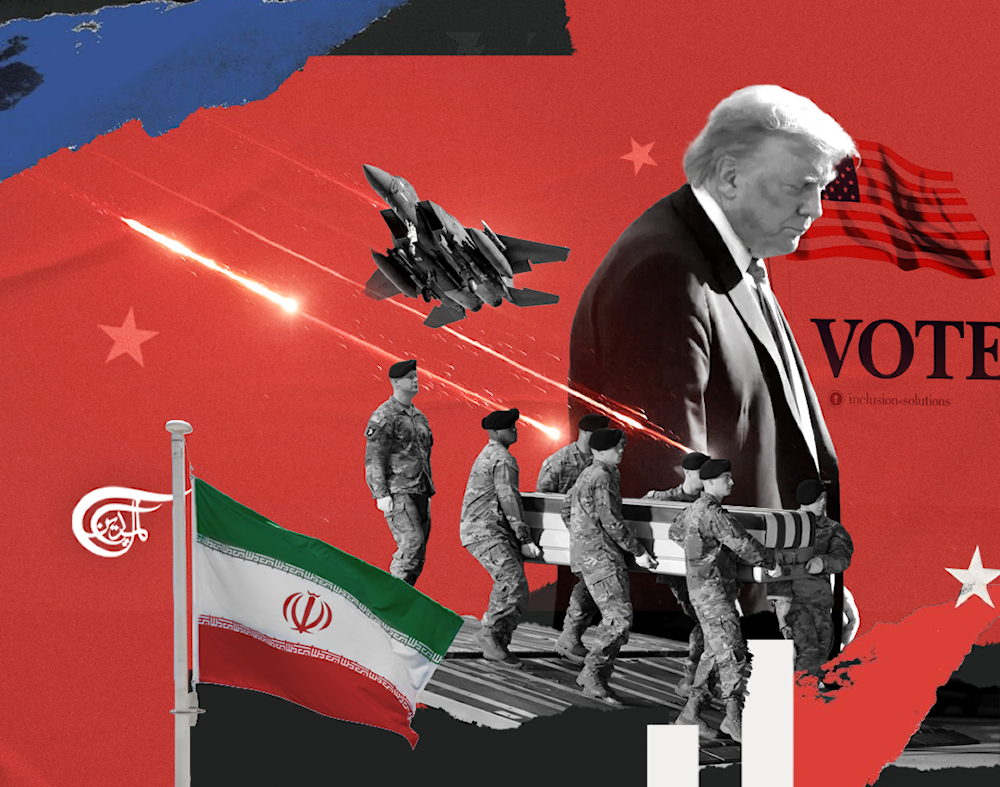
US President Donald Trump alongside a military honor guard carrying a casket, incoming missile strikes, a fighter jet, the Iranian flag, and midterm election graphics (Illustrated by Mahdi Rtail; Al Mayadeen English)
As American voters prepare to head to the polls for the November 2026 midterms, political strategists are obsessively tracking the usual metrics of presidential approval ratings, inflation indices, and consumer sentiment. But beneath the surface of campaign rhetoric lies a hidden variable quietly shaping the electoral landscape: the severe depletion of the United States military’s air defense munitions.
What began as a highly technical logistical challenge for the Pentagon has rapidly metastasized into a pervasive political and economic vulnerability. Following a grueling aggression against Iranian assets earlier this year, the US military burned through a staggering portion of its high-end interceptors.
Now, an inability to rapidly replenish those stockpiles is forcing difficult tactical compromises for the US and its allies in West Asia. The US military’s reduced capacity to unilaterally secure vital shipping lanes in the Gulf and Red Sea has sent shockwaves through the global supply chain. For the American electorate, this strategic shortfall is not an abstract geopolitical concern; it is a kitchen-table crisis felt directly at the gas pump and the grocery store.
US President Donald Trump currently faces approval ratings hovering around 36%, with public dissatisfaction heavily anchored in economic anxiety and the fatigue of a prolonged, indecisive conflict.
A thorough analysis of military supply chains, economic indicators, and public sentiment reveals a profound link between the erosion of America's munitions stockpile and the erosion of the governing party’s political capital.
Running on empty
To understand the political fallout, one must first confront the tactical reality of modern asymmetric warfare. The Iranian response to American aggression was defined by the relentless barrage of inexpensive drones and ballistic missiles, which the US attempted to counter using some of the most sophisticated, expensive, and difficult-to-produce air defense systems in its arsenal.
According to an April 2026 assessment by the Center for Strategic and International Studies (CSIS), US forces expended roughly 45% of their Patriot interceptors and an alarming 50% of their Terminal High Altitude Area Defense (THAAD) interceptors during the seven-week aggression. The sheer volume of incoming fire forced the Pentagon into an unsustainable cost-exchange ratio, routinely firing multimillion-dollar interceptors to neutralize threats that cost a fraction of that amount to produce.
The crisis lies in the fact that these interceptors cannot be quickly replaced. The US defense industrial base, optimized for peacetime efficiency rather than wartime surge capacity, is currently strained to its limits. In May 2026, War Secretary Pete Hegseth warned that replacing the munitions heavily used during the Iran conflict would take “months and years... depending on the weapon system."
CSIS analysis corroborates this timeline. While the Army has requested 857 THAAD interceptors in its Fiscal Year 2027 budget, deliveries are not projected to begin until mid-2029. Replacing the expenditures from the Iran campaign alone will take the US until the end of the decade.
Standard Missiles (SM-3s and SM-6s) utilized by the Navy face similar bottlenecks, with inventories not expected to return to prewar levels until early 2029. This massive gap between consumption and production has left the US military in a precarious state of rationing.
Tactical hesitation and the illusion of decisive victory
For military planners, a hollowed-out interceptor stockpile alters every operational calculus. Prior to the escalation, ousted US Army Chief of Staff General Randy George warned in late 2025 that THAAD and Patriot stocks were critically low. Those warnings were borne out as the US-Israeli aggression progressed.
Because the military cannot guarantee an impenetrable defensive shield, commanders are forced into a strategy of "selective countering". They must conserve dwindling interceptors for high-value military targets, sometimes leaving lesser infrastructure exposed. The human cost of this vulnerability became clear in July, when a restart of attacks and counterattacks saw Iranian retaliatory strikes penetrate these thinned defenses, killing three US troops.
Depletion has also affected offensive capabilities, as Mark Cancian, a senior advisor at CSIS, noted that a lack of long-range interceptors and standoff munitions requires US forces to use "short or medium range munitions instead... and that means you have to get in much closer. Makes the platforms much more vulnerable."
This vulnerability naturally breeds operational hesitation. The US is constrained from launching the kind of overwhelming, large-scale offensive operations required to force an adversary's surrender because it lacks the defensive umbrella to protect its own forces from the inevitable counter-attacks. Consequently, the prospect of a "decisive victory" evaporates.
Historically, the American public has little patience for wars of attrition. Voters crave clear objectives and definitive resolutions. Public support rapidly decays when a military campaign drags on with no apparent end in sight. The electorate perceives a superpower bogged down by its own logistical limitations, fostering an anxiety that the nation is trapped in a perpetual, low-boil conflict that drains resources without delivering security. A recent AP-NORC poll from early 2026 found that 59% of Americans felt US military action in Iran had "gone too far." This fosters an anxiety that the nation is trapped in a perpetual, low-boil conflict that drains resources without delivering security.
The toll at the pump, checkout aisle
If the munitions shortage were purely a battlefield concern, its impact on the 2026 midterms might be muted. But West Asia is the central artery of global energy markets and international shipping, and the US military's inability to secure it has immediate domestic consequences.
Without a sufficient stockpile of high-end interceptors to counter persistent drone and anti-ship missile salvos, the US Navy cannot maintain a persistent defensive umbrella over commercial shipping lanes in the Red Sea and the Gulf. Commercial carriers, wary of unintercepted strikes, have increasingly rerouted vessels around Africa’s Cape of Good Hope or absorbed soaring war-risk insurance premiums to transit the Gulf. These maritime bottlenecks act as an indirect tariff on the US economy, driving up freight fees, delaying components, and reinforcing elevated energy benchmarks.
That logistical friction translates rapidly into domestic consumer sentiment. According to an October 2026 Harris Poll conducted for The Guardian, the vast majority of Americans report struggling to afford everyday necessities like gas and groceries, forcing households to cut back on discretionary spending. The reporting characterized consumers as “angrier than ever” ahead of the midterms, caught between high baseline food and energy costs and a cooling, uncertain labor market.
While a voter in a swing district is unlikely to track the inventory figures of PAC-3 MSE or SM-6 interceptors, they register every price change at the pump and the grocery checkout. The logistical shortfall that limits US power projection abroad translates into economic vulnerability at home.
Public sentiment shift
The political weaponization of this dynamic is already evident in the polling data. A recent Pew Research Center survey conducted in early October 2026 highlighted how deeply the war on Iran and its economic ripples have permeated the electorate.
The data illustrate a striking intersection of foreign policy and domestic anxiety. Seventy-three percent of surveyed respondents reported being "extremely or very concerned" about higher gas and fuel prices directly resulting from the US military action against Iran, up from 69% in March. Furthermore, public awareness of the military's logistical struggles is growing, as 45% expressed extreme or very high concern over a "shortage of weapons for the US military," a significant jump from 31% earlier in the year.
These are not isolated data points; they are the architecture of a midterm backlash. The public is highly averse to further escalation, with 72% expressing deep concern over the prospect of the US sending ground troops to Iran.
The administration finds itself in an electoral trap. It cannot achieve a decisive military victory without an unacceptable loss of American lives or a miraculous surge in munitions production, yet the ongoing confrontation continues to drive the inflation that is sinking its political fortunes.
Trump’s approval ratings reflect this inescapable bind. With an aggregate approval sitting around 36%, and dipping as low as 30% in Pew's October tracking, the administration is facing the brunt of an electorate that feels squeezed economically and anxious globally.
Verdict on the ballot
The 2026 midterms will be debated in terms of inflation, leadership, and economic policy. Yet, any post-mortem of this election must recognize the profound, indirect role of the defense industrial base. The US munitions depletion is the structural foundation upon which much of the current economic and political instability rests.
After the world's leading superpower expended half of its critical air defense interceptors in seven weeks, the consequences inevitably bled out of the battlefield and into the supermarket. The inability to protect shipping lanes drives up energy prices; the resulting inflation angers voters; and the lack of a decisive military resolution fuels a narrative of perpetual instability.
As the new Congress convenes after November, the most pressing question will not just be how to manage inflation, but how to rebuild the hollowed-out shield of the American military. Until the gap between munitions consumption and production is closed, the logistical limits of the US armed forces will continue to act as a silent, powerful constraint on both American foreign policy and domestic political survival.
Read more: Would a Democratic Congress change US policy on Iran, Palestine?


