
Hungary accepts US invitation to join Gaza 'Board of Peace'
 3 Min Read
Hungarian PM Viktor Orban accepts Trump's invitation to join the Gaza "Board of Peace", joining key US and international figures in the colonial-style initiative.
-
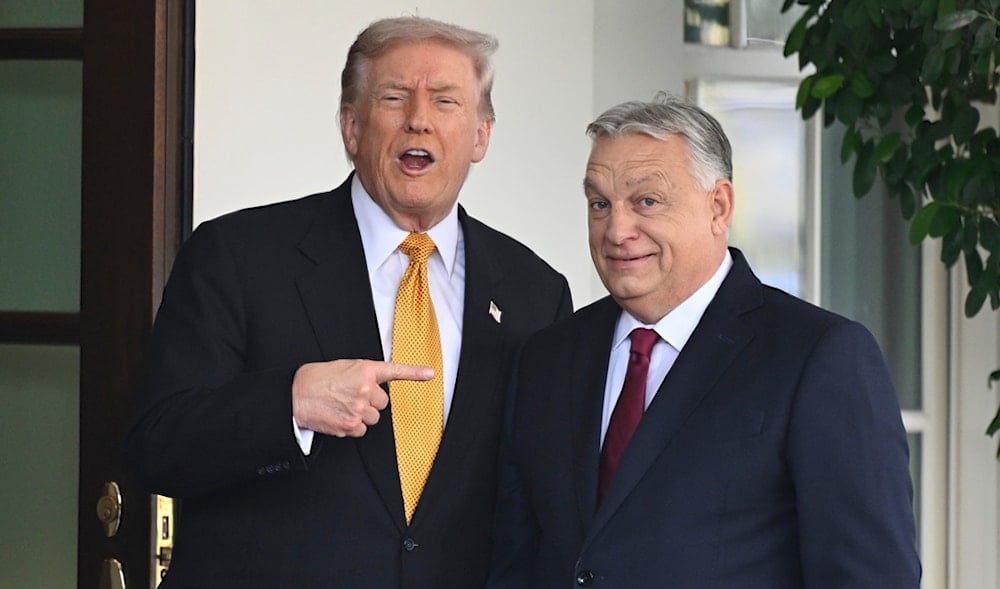
President Donald Trump, left, greets Hungary's Prime Minister Viktor Orban at the White House, Friday, Nov. 7, 2025, in Washington. (AP)
Hungary has accepted an invitation from US President Donald Trump to join the so-called colonial-style "Board of Peace", newly established to control the Gaza Strip.
Hungarian Prime Minister Viktor Orban announced on Sunday that Trump's invitation to join the board as a founding member has been accepted. "President Trump has invited Hungary to join the work of The Board of Peace as a founding member. We have, of course, accepted this honourable invitation," Orban stated on X.
The Hungarian leader shared an image of the letter he received from Trump, in which the formal address "Dear Prime Minister" had been corrected by hand to read "Dear Victor."
🇭🇺🇺🇸📩 With President @realDonaldTrump comes peace. Another letter has arrived.
— Orbán Viktor (@PM_ViktorOrban) January 18, 2026
Hungary’s efforts for peace are being recognised.
President Trump has invited Hungary to join the work of The Board of Peace as a founding member. We have, of course, accepted this honourable… pic.twitter.com/6XZnho9bjj
Members featured
The Gaza "Board of Peace", introduced earlier this month by Trump, features several controversial high-profile political figures, including:
- US Secretary of State Marco Rubio
- Special envoy Steve Witkoff
- Former UK Prime Minister Tony Blair
- Trump's son-in-law Jared Kushner
- World Bank President Ajay Banga
- US Deputy National Security Advisor Robert Gabriel
What does the 'Board of Peace' actually bring to Gaza?
The formation of the committee coincides with Trump's unveiling of the so-called Gaza Peace Council, a broader body composed of international and regional representatives. According to the announcement, the council will allegedly oversee "peace and conflict management initiatives", starting with the Gaza Strip, under direct US leadership.
Palestinian resistance members issued condemnations of this US-backed initiative, stating that it represents an externally imposed framework that undermines Palestinian sovereignty. In November 2025, resistance leaders issued a joint statement of condemnation, stating that the proposed establishment of a so-called Board of Peace, which attempts to enforce trusteeship or install an international force in Gaza without Palestinian approval, violates national rights and risks worsening political fragmentation.
The efforts by foreign powers to establish government structures within the Gaza Strip have drawn significant pushback from rights groups.
The Gaza Center for Human Rights (GCHR) warned that US‑backed reconstruction efforts and proposed governing bodies risk violating international law by reshaping demographics and undermining Palestinian rights to land ownership, adequate housing, and freedom of movement, as well as sidelining direct Palestinian participation in decisions about their future.
Alongside the concerns raised about foreign administrative influence, the United Nations Security Council adopted a US‑backed resolution late in 2025, which aims to authorize an international force in Gaza under the guise of securing borders, supporting reconstruction, and maintaining order. The adoption of that resolution, seen by supporters of the Gaza peace process as a step toward stabilization, was welcomed by US leadership but also sparked criticism from regional actors worried that such deployments could entrench external control over Palestinian affairs.
Read more: Netanyahu rejects Trump’s Gaza committee as against "Israel’s" policy


