
ICE bounty hunters: 10 firms earn millions tracking immigrants
 6 Min Read
Ten companies, from defense contractors to private investigators, are earning millions tracking immigrants for ICE, with total contracts worth over $1 billion.
-

Customs and Border Patrol agents question occupants of a vehicle they pulled over, during an immigration crackdown in Kenner, La., on December 5, 2025. (AP Photo/Gerald Herbert)
Immigration and Customs Enforcement has awarded contracts to ten private companies for its controversial immigrant tracking initiative, with firms collectively earning over $1 million to date and positioned to receive upward of $1 billion by 2027, according to procurement records examined by The Intercept.
The contractors recruited for this "skip tracing" operation represent a diverse spectrum of corporate capabilities, from military intelligence veterans to traditional private investigators, all now unified in their pursuit of locating immigrants for potential deportation in exchange for financial incentives.
The corporate players
Leading the financial windfall is Capgemini Government Solutions, a Virginia-based federal consultancy with extensive ties to the Defense and Homeland Security departments. The McLean firm stands to collect over $365 million through its participation in the program, leveraging its established intelligence service portfolio for ICE operations.
Florida's Bluehawk LLC ranks second in potential earnings at more than $200 million. The company brings a resume built on Pentagon and intelligence community work, including counterintelligence operations.
Constellation Inc., which has previously secured administrative contracts throughout the Department of Homeland Security, faces a potential $58 million payday from the tracking initiative.
Government Support Services, typically known for staffing janitorial and security positions across federal agencies, has entered the tracking business with contracts potentially worth $55 million.
Meanwhile, EnProVera, whose CEO, Larry Grant, previously conducted clandestine overseas operations and authored classified studies of foreign technical capabilities, could earn nearly $3 million deploying its intelligence-gathering expertise for Customs and Border Protection-related work.
SOS International, commonly known as SOSi, secured a bounty hunting agreement worth up to $123 million. The military contractor's background spans Iraqi base operations to overseas propaganda campaigns, and its website indicates the deployment of large language models in government projects.
Surveillance, tracking methods
Private investigation firms bring ground-level tracking capabilities to the initiative. Gravitas Investigations, positioned for over $32 million in earnings, promotes "comprehensive surveillance operations" on its website.
The company emphasizes its commitment to following subjects "on foot, in a vehicle, onto public property, and anywhere legal," while surveillance operatives covertly document activities using handheld high-definition camcorders and concealed cameras. Gravitas extensively mines social media platforms and online databases to pinpoint individuals, according to its promotional materials.
Similarly, Fraud Inc. employs public and private database searches alongside video surveillance, boasting capabilities to "obtain legally high-altitude video" for client operations.
AI Solutions 87 introduces technological innovation to the tracking apparatus, providing "AI agents" to ICE that autonomously map out targets and their family networks and associates with increased speed, according to recent reporting.
-
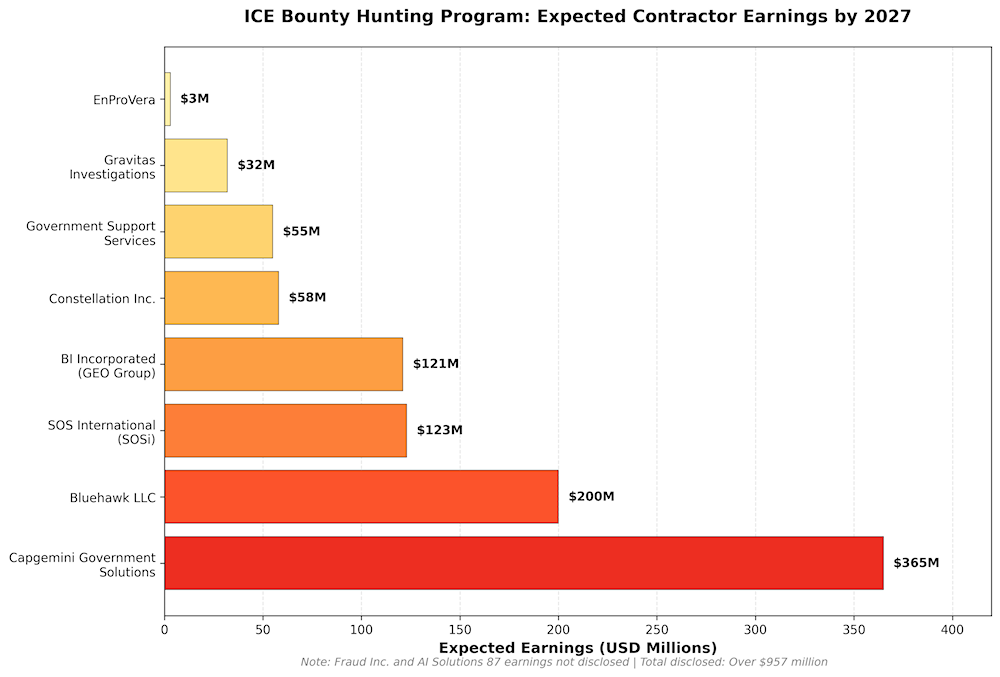
Expected earnings for ICE bounty hunting contractors through 2027. Two additional firms, Fraud Inc. and AI Solutions 87, did not disclose projected earnings. (Source: The Intercept; visualized by Al Mayadeen English)
The prison corporation connection
Perhaps most significant is BI Incorporated's participation, a subsidiary of GEO Group, the for-profit prison corporation. With bounty hunting contracts potentially generating $121 million by 2027, GEO Group now profits across multiple deportation campaign stages: locating immigrants, detaining them, and ultimately transporting them for removal.
This vertical integration reflects broader industry consolidation within what analysts term the "immigration-industrial complex." GEO Group and CoreCivic, the two dominant private prison operators, have transformed immigration enforcement into remarkably profitable enterprises.
ICE contracts account for 30-44% of their respective revenues, with combined annual earnings from federal immigration detention exceeding $1.5 billion.
The business model's financial appeal became immediately apparent following the 2024 presidential election. GEO Group shares surged 76% while CoreCivic stock climbed 75% within days of the results. GEO Group founder George Zoley characterized the moment as "unprecedented," projecting potential additional annual revenue of $400 million simply by filling existing detention capacity.
Both corporations maintain substantial idle infrastructure awaiting activation. GEO Group can scale from 13,500 to over 31,000 ICE detention beds, while CoreCivic holds 13,479 beds ready for immediate deployment. This excess capacity creates powerful incentives to maximize occupancy, aligning corporate profit motives directly with aggressive enforcement policies.
Labor economics
The economics of detention operations depend significantly on the "Voluntary Work Program," through which detained immigrants perform essential facility operations, including cooking, cleaning, laundry, and clerical tasks, for $1 daily, regardless of hours worked. This translates to approximately 13 cents per hour, a rate unchanged since Congress authorized compensation for detained immigrant labor in 1950.
Despite the "voluntary" designation, multiple lawsuits document coercive practices. At GEO Group's Aurora, Colorado facility, detainees alleged forced work "under threat of being thrown into solitary confinement." Legal actions at CoreCivic's San Diego location similarly claimed threats of punishment, including solitary confinement and physical restraint, for refusal to participate.
At the Tacoma facility alone, GEO Group estimated that detainee labor replaced approximately 85 full-time employees, directly boosting profit margins while US taxpayers fund $126 daily per detained individual to ICE.
Political investment
The private prison industry has invested heavily in political influence. GEO Group and CoreCivic, alongside their executives and subsidiaries, contributed nearly $2.8 million to the 2024 presidential election efforts and inaugural fund. GEO Group's political action committee alone directed $3.26 million toward the campaign and Republican candidates.
This financial backing has already translated into concrete policy outcomes. ICE has issued Requests for Proposals totaling up to $45 billion for new detention facilities, with both companies bidding on sites across California, the Midwest, and the Southwest. In parallel, recent legislation earmarks $45 billion specifically for ICE detention expansion, effectively guaranteeing continued funding for these contractors.
The convergence of bounty hunting operations with detention and deportation services creates an integrated profit system spanning the entire enforcement pipeline.
With the Trump administration targeting as many as 1.5 million immigrants, according to ICE procurement records, the ten newly revealed contractors join an expanding network of corporations positioned to profit from each stage of what has become a multibillion-dollar deportation apparatus.


