
Incoming Mossad chief's Iran 'regime change' forecast falls short
 4 Min Read
Mossad’s prediction of "regime change" in Iran fails to materialize after 40 days of war, raising questions over Israeli intelligence assessments.
-
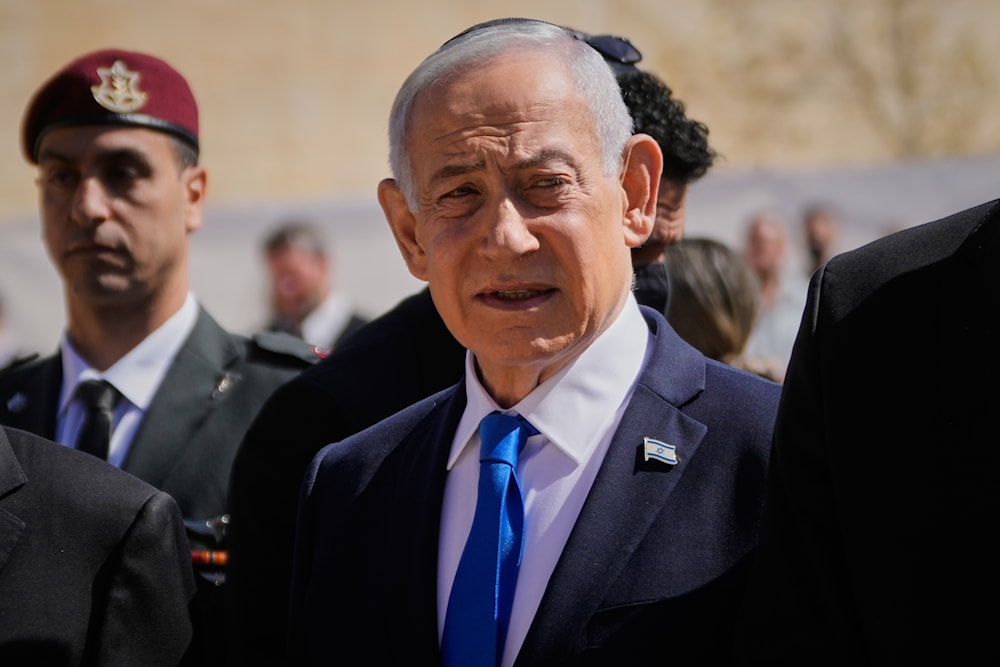
Israeli Prime Minister Benjamin Netanyahu attends a ceremony marking the annual Holocaust Remembrance Day at the Yad Vashem Holocaust Memorial in al-Quds, April 14, 2026 (AP)
Incoming Mossad chief Roman Gofman predicted that a war on Iran could lead to the collapse of the Iranian government, an assessment that has failed to materialize after more than 40 days of fighting, according to Israeli sources familiar with internal discussions.
Gofman, currently serving as military secretary to Prime Minister Benjamin Netanyahu, reportedly told the Israeli leader during pre-war planning that "regime change" in Iran was achievable. The view was shared within the Mossad, which he is set to lead, but has since proven to be a major miscalculation.
Set to take office in June for a five-year term, Gofman will replace current Mossad chief David Barnea, who also backed the notion that a war on Iran could achieve the said objective.
Barnea, who has led the agency since 2021, played a central advisory role in the lead-up to the US-Israeli strike on Iran on February 28 that triggered the ongoing war, according to Israeli security sources. As reported by The New York Times, Barnea proposed a strategy to Netanyahu and US President Donald Trump centered on assassinating Iranian leaders and conducting intelligence-driven operations to incite internal unrest.
The plan aimed to mobilize Iran’s saboteurs and spark armed riots and acts of defiance that could ultimately bring down the government. “The Mossad’s position was that regime change is a likely outcome and that they can make it happen,” one Israeli security source told CNN.
Mossad made promises it cannot deliver
However, the Israeli occupation forces reportedly took a more cautious stance, expressing doubts about the likelihood of a rapid collapse and instead pushing for a strategy focused on weakening the government and setting conditions for a longer-term uprising.
“The Mossad made a series of promises it didn’t deliver,” the source said, underscoring the gap between expectations and reality as the conflict drags on.
Netanyahu announced Gofman’s appointment in December, selecting him over internal candidates, an unusual move given that Mossad chiefs are typically drawn from within the agency. At the time, the Israeli premier described him as an “outstanding, bold and creative officer” with “out-of-the-box thinking.”
Loyalty triumphs expertise
The appointment of incoming Mossad chief Roman Gofman has drawn sharp criticism from security experts, who question both his qualifications and the circumstances behind his selection.
Veteran defense analyst Amir Oren told CNN that Gofman lacks experience in key areas central to the work of the Mossad, including intelligence gathering, special operations, and coordination with foreign intelligence services. Oren described these as skills “in which one must be well versed for years and probably decades before daring to command others.”
Instead, Oren argued that Gofman’s appointment was driven primarily by his loyalty to Prime Minister Benjamin Netanyahu, rather than professional merit. “There is a unanimous appraisal by serving as well as veteran military and security professionals that these appointments were not intended to benefit the security of Israel but rather help Netanyahu personally and politically,” he said.
Several appointments under Prime Minister Benjamin Netanyahu have drawn criticism over claims that political loyalty has at times outweighed professional expertise. On January 29, 2023, Netanyahu appointed Itamar Ben-Gvir as Police Minister and Bezalel Smotrich as Finance Minister, both long-time political allies from the governing coalition.
Critics argued the appointments reflected loyalty over expertise, pointing to Ben-Gvir’s past convictions for incitement and support for extremist movements, and Smotrich’s lack of formal experience in fiscal management or macroeconomic policy, despite taking charge of "Israel’s" budget and economic planning.
On November 5, 2024, Prime Minister Benjamin Netanyahu dismissed Security Minister Yoav Gallant during wartime and replaced him with long-time ally Israel Katz, another example of prioritizing political loyalty over defense expertise, particularly as Gallant had repeatedly clashed with Netanyahu over war strategy and decision-making.


