
Iran 'entirely within its rights' to respond to US blockade: Ex-UK amb
 3 Min Read
A former British ambassador to Iran warns that Tehran has the right to respond to Donald Trump's blockade, slammed as a potential "act of war."
-
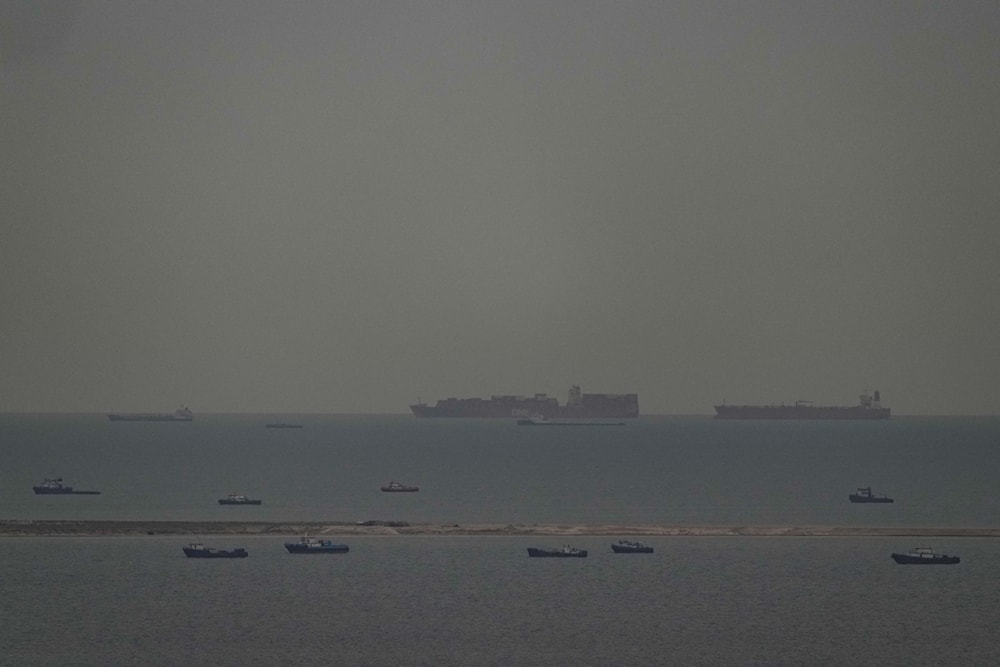
Fishing boats dot the sea as cargo ships, in the background, sail through the Gulf toward the Strait of Hormuz off the United Arab Emirates, March 27, 2026 (AP)
Tehran would be "entirely within its rights to retaliate" to Trump's blockade of the Strait of Hormuz, former British ambassador to Iran Sir Richard Dalton said on Monday.
Speaking to Sky News, Dalton, who served as ambassador to Iran from 2002 to 2006 under Tony Blair, said the US president's popular base was "idiotically" supportive of the war despite the "misery it might bring to the world economy and the peoples of the region".
He stressed that Trump's blockade on Iran would amount to "an act of war" if implemented, granting Tehran the right to respond. "Iran would be entirely within its rights to retaliate," he said.
"So the chances of maintaining this ceasefire, this pseudo ceasefire, look as though they are receding and getting worse hour by hour," he added.
Trump threatens Iran with blockade
US President Donald Trump announced on Sunday that Washington would impose a naval blockade on the Strait of Hormuz following the collapse of negotiations with Iran.
In a post on Truth Social, Trump said discussions had yielded progress on several fronts but ultimately broke down over Washington’s insistence that Tehran halt uranium enrichment, which Iran maintains is a sovereign right under international law. “So, there you have it, the meeting went well, most points were agreed to, but the only point that really mattered, NUCLEAR, was not,” he wrote.
“Effective immediately, the United States Navy, the Finest in the World, will begin the process of BLOCKADING any and all Ships trying to enter, or leave, the Strait of Hormuz,” he said.
Iran responds: Security for all or for none
In response, the spokesperson for the Khatam al-Anbiya Central Headquarters, Lieutenant Colonel Ebrahim Zolfaghari, said that security in the Gulf and the Sea of Oman will be enforced on a reciprocal basis.
Zolfaghari said Iran considers the defense of its territorial waters a “natural and lawful duty," stressing that the presence of foreign-aligned vessels in key maritime corridors will not be permitted.
“The Armed Forces of the Islamic Republic of Iran explicitly and decisively declare that the security of ports in the Persian Gulf and the Sea of Oman is either for everyone or for no one,” the spokesperson said, warning that any threat to Iranian maritime security would result in broader regional consequences.
The statement reaffirmed Tehran’s position that it will continue to regulate passage through the Strait of Hormuz under a “permanent regime” implemented by its armed forces. It also stated that vessels affiliated with adversaries “do not have and will not have the right to pass” through the strategic waterway, while other ships would be allowed transit under Iranian regulations.
Iran emphasized that US restrictions on maritime navigation are “illegal” and an act of “maritime piracy”.
Read more: Bluff or blockade? Trump’s Hormuz talk under scrutiny


