
Trump announces 'Hormuz blockade' after Iran talks collapse
 6 Min Read
US President Donald Trump announced a naval blockade of the Strait of Hormuz after talks with Iran collapsed over uranium enrichment.
-
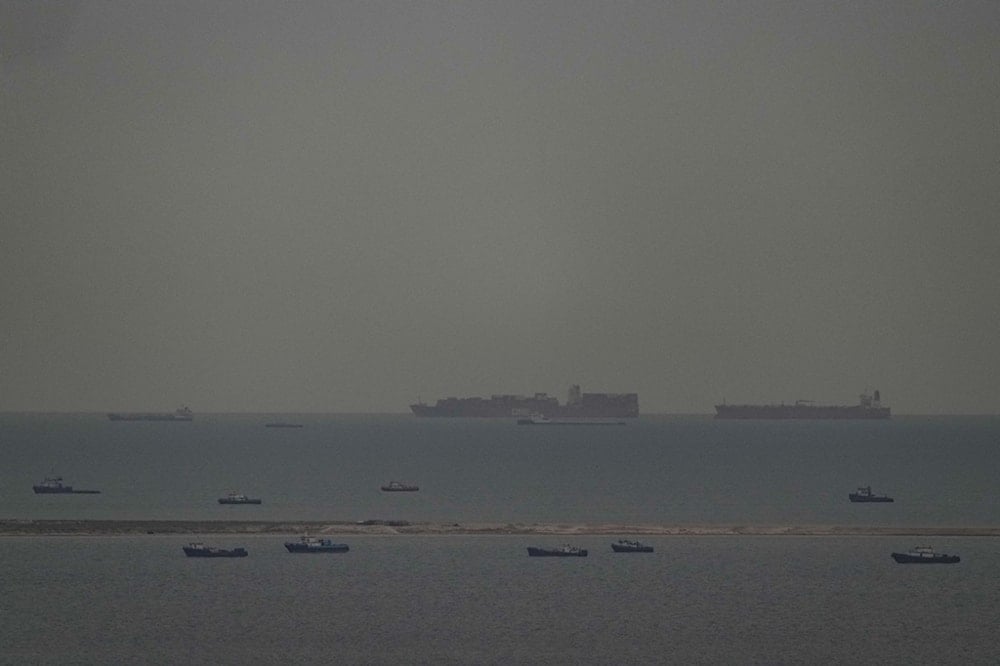
Fishing boats dot the sea as cargo ships, in the background, sail through the Arabian Gulf toward the Strait of Hormuz off the United Arab Emirates, Friday, March 27, 2026 (AP Photo)
US President Donald Trump announced on Sunday that Washington would impose a naval blockade on the Strait of Hormuz following the collapse of negotiations with Iran, signaling a renewed risk of US escalation.
The move follows high-level talks in Islamabad that ended without agreement, with Iranian officials rejecting what they said were excessive US demands, particularly regarding their nuclear program. In a post on Truth Social, Trump said discussions had yielded progress on several fronts but ultimately broke down over Washington’s insistence that Tehran halt uranium enrichment, which Iran maintains is a sovereign right under international law. “So, there you have it, the meeting went well, most points were agreed to, but the only point that really mattered, NUCLEAR, was not,” he wrote.
Iran has consistently maintained that its nuclear program is for peaceful purposes and that uranium enrichment falls within its sovereign rights, a position that remains central to the ongoing deadlock.
Trump nevertheless framed the outcome as grounds for immediate escalation, announcing that US naval forces would begin enforcing sweeping restrictions in one of the world’s most critical maritime corridors. “Effective immediately, the United States Navy, the Finest in the World, will begin the process of BLOCKADING any and all Ships trying to enter, or leave, the Strait of Hormuz,” he said.
US attempts to challenge Iran leverage
The Strait, through which roughly a fifth of global oil supplies transit, has become a focal point of the confrontation, particularly after Iran imposed selective restrictions on shipping in response to US and Israeli attacks rather than fully closing the waterway.
Through a combination of direct actions and the threat of disruption, Tehran established a controlled-access environment that allowed passage for non-hostile states while deterring or complicating transit for others. This approach significantly reduced maritime traffic, turning the Strait into a strategic pressure point on global markets.
Trump accused Iran of exploiting its geographic position to pressure global shipping, describing the situation as “THIS IS WORLD EXTORTION.” He added that US operations would extend beyond the Strait itself, stating: “I have also instructed our Navy to seek and interdict every vessel in International Waters that has paid a toll to Iran. No one who pays an illegal toll will have safe passage on the high seas.”
The directive extends beyond Iran itself, effectively targeting third-party vessels operating in international waters. By ordering the interdiction of any ship that has complied with Iranian-imposed conditions, the move risks drawing neutral and non-hostile actors into the confrontation, including commercial shipping from countries not directly involved in the conflict.
Rather than simply restoring navigation, the US move appears aimed at displacing Iran’s control over the waterway and reasserting Washington as the primary enforcer of access. In effect, it shifts the dynamic from Iranian leverage over the Strait to an attempt by the United States to assume that same gatekeeping role.
This approach carries inherent contradictions. While Washington accuses Iran of disrupting maritime traffic, imposing a blockade risks further militarizing the corridor rather than stabilizing it. Iran’s strategy has relied on relatively low-cost, asymmetric tools, such as the threat of mines and targeted disruptions, which have already proven sufficient to deter shipping. By contrast, enforcing a blockade requires sustained military deployment and exposes US forces to direct confrontation in a domain where Iran has already demonstrated its ability to impose costs.
The move also carries immediate economic and geopolitical consequences. Any disruption to flows through the Strait typically drives up global energy prices, increasing fuel and transport costs worldwide.
This places disproportionate pressure on consumers, particularly working- and middle-income households, while also affecting major energy importers such as China, which relies heavily on Gulf oil shipments through the Strait. Washington’s willingness to proceed suggests it is prepared to absorb short-term economic strain, both domestically and globally, in pursuit of longer-term strategic leverage over Iran and control of the waterway.
Trump ramps up threats
Trump also threatened military action. “We will also begin destroying the mines the Iranians laid in the Straits,” he said, warning that “Any Iranian who fires at us, or at peaceful vessels, will be BLOWN TO HELL!”
At the same time, he portrayed Iran as significantly weakened. “Their Navy is gone, their Air Force is gone, their Anti Aircraft and Radar are useless,” Trump claimed, adding that the United States remains “fully ‘LOCKED AND LOADED,’” and prepared to renew its attacks if necessary.
He further indicated that the blockade would involve international participation. “The Blockade will begin shortly. Other Countries will be involved with this Blockade,” he wrote, without specifying which states might take part.
Trump also accused Tehran of failing to uphold commitments related to reopening the Strait. “Iran promised to open the Strait of Hormuz, and they knowingly failed to do so,” he said, arguing that the situation has disrupted global trade and caused widespread uncertainty. He added that “Every Law in the book is being violated by them.”
Iranian officials, however, have tied any reopening of the waterway to broader conditions, including an end to hostilities and relief from sanctions, reflecting deeper disagreements over the terms of de-escalation.
Failed talks
According to Trump, he was briefed by senior officials, including Vice President JD Vance and envoy Steve Witkoff on the negotiations, which lasted nearly 20 hours. He described the talks as extensive but ultimately unsuccessful due to Iran’s position on its nuclear rights.
Reiterating Washington’s long-standing stance, Trump concluded: “IRAN IS UNWILLING TO GIVE UP ITS NUCLEAR AMBITIONS!” and warned: “IRAN WILL NEVER HAVE A NUCLEAR WEAPON!”
Read more: Ghalibaf: US must decide if it can earn Iran’s trust after talks' end


