
Iran, US begin third round of talks in Islamabad
 4 Min Read
A third round of talks has begun in Islamabad after expert teams from both sides concluded a round of direct talks lasting several hours on Saturday afternoon.
-
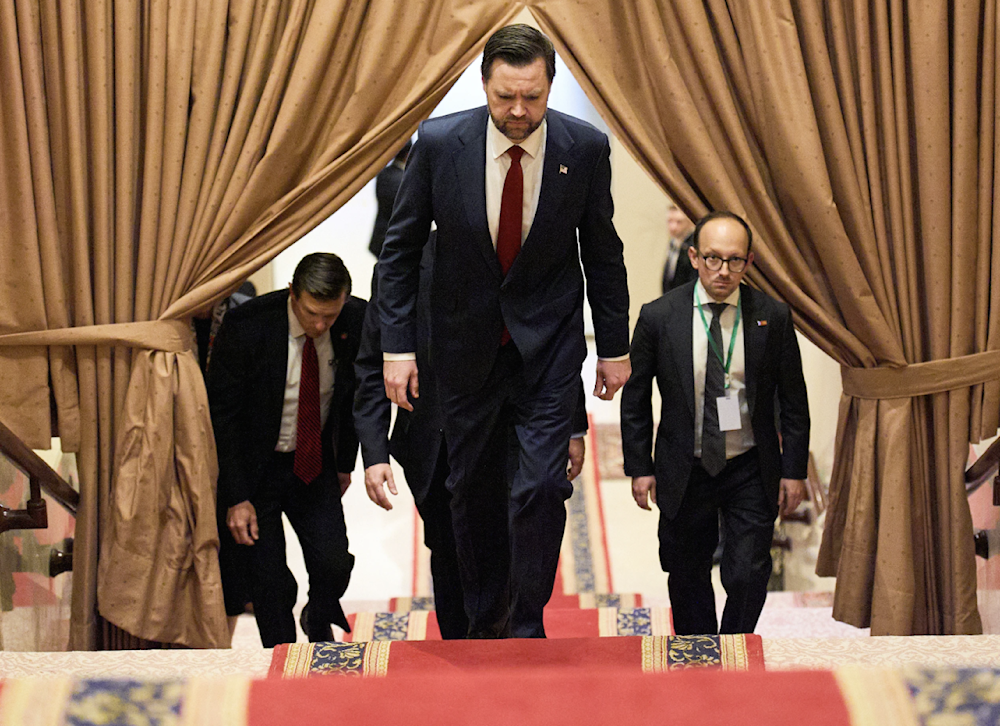
Vice President JD Vance, center, walks up a flight of stairs to meet with Pakistan's Prime Minister Shehbaz Sharif for talks about Iran, on April 11, 2026, in Islamabad. (AP)
Iranian and US delegations have begun the third round of talks in Islamabad, with Pakistani officials participating as mediators, according to Iranian media reports.
Technical teams from the Iranian and US delegations have reached the stage of exchanging written texts on the issues under negotiation following the conclusion of direct talks in the latest round of negotiations in the Pakistani capital, Islamabad, Iranian news agency IRNA reported Saturday, citing informed sources.
IRNA added that expert teams from both sides concluded a round of direct talks lasting several hours in Islamabad on Saturday afternoon.
Iranian state television had earlier reported that expert delegations and specialised committees had convened in the main negotiation room, following initial rounds of dialogue and consultations that, according to Tasnim News Agency, had moved beyond general frameworks and into detailed, technical discussions across several files.
The Tasnim News Agency confirmed that the third round of negotiations started minutes before the announcement, noting that Pakistani officials are facilitating communication between the Iranian and US delegations.
US obstruction stalls framework talks
Nonetheless, as discussions reached the stage of exchanging written texts to establish a common negotiation framework, the US delegation obstructed progress through "excessive demands," reported Tasnim News Agency.
Yet consultations are still ongoing, with Iran insisting on preserving its military gains and securing the rights of the Iranian people.
The Strait of Hormuz remains a central point of serious disagreement. A source cited by Fars News Agency reported that Washington is putting forward "excessive and unreasonable demands" on the strait, adding that "the US now expects to obtain through negotiations what it failed to achieve during 40 days of war."
Beyond the Strait, the source said that Washington has also put forward unacceptable demands on several other files, while stressing that "the Iranian delegation is determined to safeguard the gains achieved on the ground."
Moreover, citing an informed source, Tasnim reported that despite no progress in talks over the past hours due to US demands, Western media outlets are publishing positive reports in an effort to calm markets.
The source added that there has so far been no tangible change in the course of negotiations, noting that while some initial progress was achieved in expert-level discussions, the issue of the Strait of Hormuz, along with other matters, remains unresolved.
Talks expected to run through the night
Two rounds of talks between the delegations have taken place, with a third round scheduled, Iranian state television reported. The trilateral talks between Iran, the United States, and Pakistan are being held at Islamabad's Serena Hotel, with CNN citing a Pakistani source as saying discussions may continue through Sunday.
The negotiations are proceeding amid deep mistrust on the Iranian side. Tehran has set firm red lines ahead of the talks, centring on the release of its frozen assets and a comprehensive ceasefire across all fronts, including Lebanon.
After a session lasting more than two hours, Iran's Mehr News Agency reported that Washington had agreed to release Iran's frozen funds, a claim the United States subsequently denied. A senior Iranian source had told Reuters earlier that the potential unfreezing of assets held in Qatar and other foreign banks was "directly linked" to ensuring safe passage through the Strait of Hormuz.
'Not dialogue, but a round of demands'
Speaking from Islamabad, Iran's Deputy Foreign Minister for Legal and International Affairs, Kazem Gharibabadi, said this round "differs fundamentally from previous rounds, particularly given the Americans' lack of sincerity, deception, and betrayal of negotiations."
He added that what distinguishes the current round is that "it is not merely dialogue and negotiation, but a round of demands," reflecting Tehran's strengthened negotiating posture following growing domestic unity and US military setbacks.
Gharibabadi also pointed to Iran's leverage over the Strait of Hormuz as a central factor compelling Washington to engage in negotiations at all.
The Iranian delegation of 71 members is headed by Parliament Speaker Mohammad Bagher Ghalibaf and Foreign Minister Abbas Araghchi. Government spokesperson Fatemeh Mohajerani stressed that the high-level composition of the delegation signals Iran's commitment to the process, while reiterating that Tehran "will not compromise and will not retreat from its rights."


