
Iran launches key water transfer project from Gulf of Oman to Isfahan
 3 Min Read
Iran has inaugurated a major water transfer project to supply desalinated water from the Gulf of Oman to Isfahan, aiming to reduce dependence on the Zayandeh Rud basin amid a growing national freshwater shortage.
-
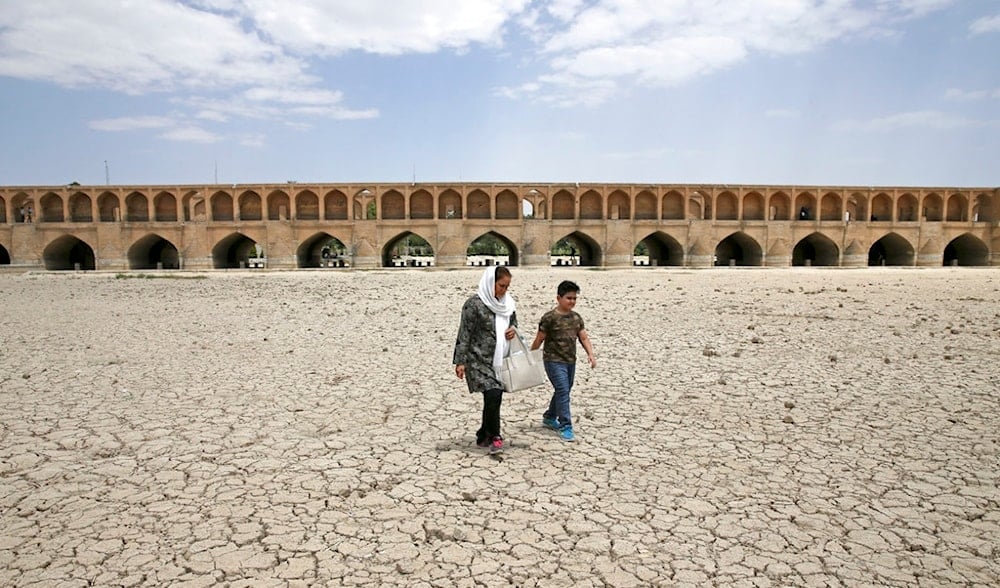
In this July 10, 2018 photo, a woman and a boy walk on the dried-up riverbed of the Zayandeh Roud river in Isfahan, Iran. (AP)
Iranian President Masoud Pezeshkian has officially launched a strategic water infrastructure project to transfer desalinated seawater from the Gulf of Oman to central Iran, aiming to address the country's growing freshwater shortage.
According to a government statement released on Saturday, President Pezeshkian and Minister of Industry, Mine and Trade Mohammad Atabak virtually inaugurated the project, which delivers desalinated water to the central city of Isfahan.
Desalinated water pipeline to support Isfahan industry
The newly launched Gulf of Oman seawater pipeline is designed to reduce the heavy industrial reliance on the Zayandeh Rud water basin, a vital but increasingly strained freshwater source in central Iran.
“The seawater transfer project to Isfahan will eliminate the province's major industrial enterprises' dependence on the Zayandeh Rud,” the government statement read.
The Isfahan desalination project will supply treated seawater to key sectors, ensuring water security for both industrial and, eventually, urban needs.
Iran’s water crisis and shrinking resources
In July, Hashem Amini, head of Iran's state water resources company, warned that nearly half of Iran’s urban population faces drinking water shortages. He noted that the country’s renewable freshwater resources have dropped from 132 billion to 90 billion cubic meters in under three decades, a decline of over 30%.
While water consumption continues to rise, Iran’s capacity to meet demand has steadily declined, intensifying the urgency for infrastructure such as this new project.
The Zayandeh Rud water crisis has been a focal point of national concern for years, with recurring droughts and overuse depleting the river that once supported agriculture, industry, and urban centers. The water transfer initiative marks a strategic pivot to desalination and long-distance pipelines to secure future supplies.
Pezeshkian’s focus on long-term water solutions
The launch of this project underscores President Masoud Pezeshkian’s focus on sustainable infrastructure to address Iran’s freshwater shortage. As pressure mounts from climate change and demographic growth, such projects are expected to play a central role in long-term national planning.
Recently, Iran resolved the dispute over common water resources with Afghanistan following thorough bilateral discussions, Iran's interim ambassador to Afghanistan, Alireza Bikdeli, announced.
As per the treatment, Iran is to receive an annual share of 820 million cubic meters from Hirmand. Afghanistan's violation of this clause has exposed the lives of several Iranians to the risk of drought as civilians rely heavily on the river for drinking water, agriculture, and fishing.
The construction of many hydroelectric projects on the river, including the important Kamal Khan Dam in Afghanistan's Nimrouz province, and the Kajaki Dam 100 miles (160 km) northwest of Kandahar province, has caused a major rift between them.


