
Iran put diplomatic proposal forth, ball in US court: Khatibzadeh
 3 Min Read
Khatibzadeh says the ball is currently in the US court after Iran sent a proposal through Qatar; Pezeshkian touts regional trade and dialogue, while defense officials reject claims of weakened capabilities.
-
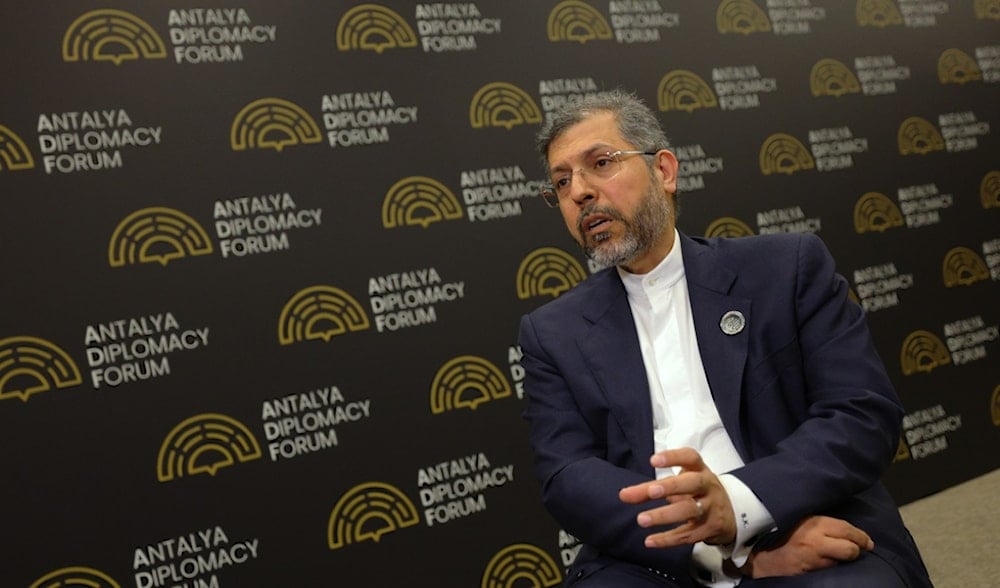
Iran's Deputy Foreign Minister Saeed Khatibzadeh talks during an interview with the Associated Press at the Antalya Diplomacy Forum, in Antalya, southern Turkey, Saturday, April 18, 2026. (AP)
Iran has conveyed a proposal to the United States through Qatar aimed at resolving the ongoing US war on Iran, Iranian Deputy Foreign Minister Saeed Khatibzadeh said Thursday, stressing that "the ball is now in the US court."
Speaking to Russia's Vesti television channel, Khatibzadeh said Tehran had transmitted its proposal through Qatari mediation, placing the next step squarely with Washington.
He also praised Iran-Russia ties for having reached the level of a strategic partnership, underscoring the significance Tehran attaches to its relationship with Moscow.
Iran prioritizing regional cooperation, Pezeshkian says
Iranian President Masoud Pezeshkian, meanwhile, said Tehran was pursuing efforts to strengthen economic diplomacy and deepen engagement with neighboring countries.
Pezeshkian said Iran had removed most obstacles to expanding cross-border exports and imports with Pakistan, Iraq, Turkmenistan, and Azerbaijan, highlighting regional economic ties as part of Tehran's broader approach to navigating the aftermath of the war.
He said US and European officials had not anticipated that Iran would be capable of managing the country under wartime conditions, stressing that Tehran was defending the rights of its people while preserving its dignity and sovereignty.
Pezeshkian also rejected any suggestion that Iran had closed the door to dialogue, stressing that the country had never shied away from negotiations and would not do so.
He accused the United States and the Israeli regime of seeking to destroy Iran, saying their calculations were disrupted when they encountered comprehensive resistance.
"The enemies believed that the country would collapse with the martyrdom of the Leader of the Revolution, commanders, and scientists, but national and internal unity and cohesion in Iran increased," Pezeshkian said.
Addressing Washington directly, the Iranian president said the United States must abandon the notion that it could bring Iran under its control through assassinations.
Tehran rejects claims of weakened defense capabilities
Iran's acting Defense Minister, Brigadier General Majid Ibn al-Reza, moreover, accused the US administration of attempting to obscure its domestic difficulties and what he described as mounting confusion on the battlefield.
"Washington's fictional war dramas will not conceal the confusion and disarray prevailing in the White House," Ibn al-Reza said.
He said US calculations had been visibly disrupted by "public pressure, the attrition of forces, and the mounting costs of the war," arguing that these pressures were increasingly weighing on decision-makers in Washington.
Responding to statements from the US administration, Ibn al-Reza dismissed claims that Iran's defense industry had been destroyed.
"Claims of destroying Iran's defense industry will change nothing about reality," he said, stressing the resilience of Iran's military and security capabilities and the cohesion of its defense structure.
The acting defense minister concluded by reaffirming the readiness of Iran's armed forces and delivering a direct warning to Washington: "You will see Iran's capability and initiative on the battlefield, and you will taste its political impact."
Read more: Iran receives US response on seven-day Hormuz reopening plan: Reuters


