
Iran's Jewish community condemns US-Israeli strike on Tehran synagogue
 3 Min Read
Iran’s Jewish community denounces the destruction of a Tehran synagogue in recent US-Israeli strikes, calling it an attack on both a religious site and the country.
-
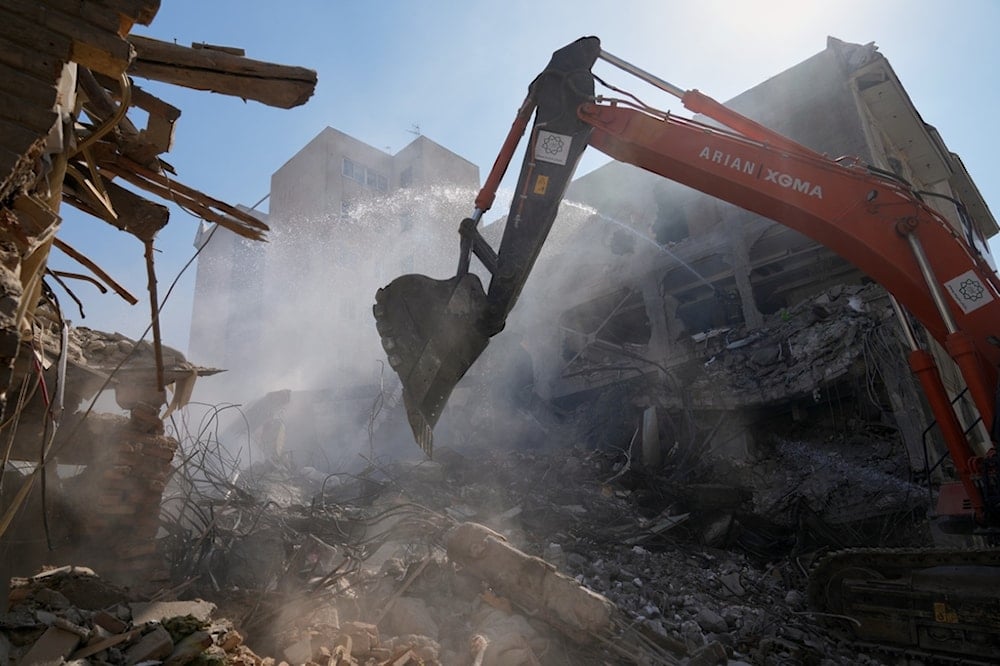
An excavator removes rubble at the site of a strike that, according to a security official at the scene, destroyed half of the Khorasaniha Synagogue and nearby residential buildings in Tehran, Iran, Tuesday, April 7, 2026 (AP Photo/Francisco Seco)
Iran’s Jewish community has strongly condemned the destruction of the Rafi’-Nia synagogue in central Tehran, following US-Israeli strikes that they say deliberately targeted both a sacred religious site and the country as a whole.
The attack, which reportedly reduced the synagogue to rubble, forms part of a broader wave of US-Israeli aggression that has increasingly impacted civilian areas and vital infrastructure, raising alarm over the widening scope of the campaign against Iran.
In a statement, the community said, "We, the Jews of Iran, condemn the brutal attacks carried out by the American-Zionist enemy against our dear homeland and the Rafi’-Nia synagogue."
The statement also affirmed that members of the community stand "alongside the people and the system of the Islamic Republic of Iran" and would defend the country "until our last breath."
Homayoun Sameh Yah Najafabadi, the representative of the Jewish community in the Iranian Parliament and head of the Jewish Association in Tehran, stressed that the strike directly hit a place of worship during a sacred period.
"Unfortunately, during the Jewish holidays, the Israeli entity targeted us and did not even spare Jews in Iran, as it struck one of our old and sacred synagogues," he said.
He added that the building was completely destroyed, with Torah scrolls buried under the rubble, describing the attack as "something that pains all Jews around the world."
He further accused "Israel" of showing no mercy toward religious communities, stating that its actions have impacted not only Muslims but also other groups worldwide, including the Jewish community.
🇮🇷⚔️🇺🇸🇮🇱
— Restitutor Orientis 🇱🇮 (@restitutorII) April 7, 2026
Iran: L'aviation israélo-américaine a détruit la synagogue Rafi Nia, située en plein centre de Téhéran. pic.twitter.com/h7uP2DCSRS
Blame Deflection Pattern
Israeli officials have once again moved to deflect responsibility, claiming they are “looking into” the incident while insisting that the entity “does not target synagogues.” Such statements divert attention from the reality on the ground, where a religious site was destroyed, and instead rely on rhetorical claims of intent that stand in stark contrast to repeated evidence of civilian and cultural damage.
This response reflects a recurring pattern in Israeli conduct, whereby direct attacks on civilians or the destruction of protected sites are immediately followed by denial, doubt-casting, and the promotion of alternative narratives aimed at shifting blame. Similar dynamics were observed following the massacre at Al-Ahli Arab Hospital in Gaza, where Israeli officials swiftly rejected responsibility in the aftermath of mass civilian losses and advanced competing accounts, even as evidence proved "Israel" carried out the attack.
Such narrative maneuvers serve to dilute accountability and manage international backlash, reinforcing "Israel’s" longstanding efforts to present its aggressions as precise and justified despite mounting reports of civilian areas, medical facilities, and religious sites being impacted.
The destruction of the synagogue comes amid a broader pattern of US-Israeli attacks that have affected cultural and religious sites across Iran, with multiple heritage locations reportedly damaged since the start of the war, raising serious concerns over the systematic erosion of civilian and cultural protections.
Judaism remains a recognized religion in Iran, with a longstanding community that continues to practice freely and maintain representation in parliament, countering persistent narratives that seek to portray otherwise.
Read more: Schools, hospitals, historic landmarks: Targets of aggression on Iran


