
Iran's nuclear program to continue ‘with full strength’: AEOI chief
 4 Min Read
Mohammad Eslami says safeguards are in place to protect the country’s nuclear assets as committee members reaffirm support for Tehran’s nuclear program.
-
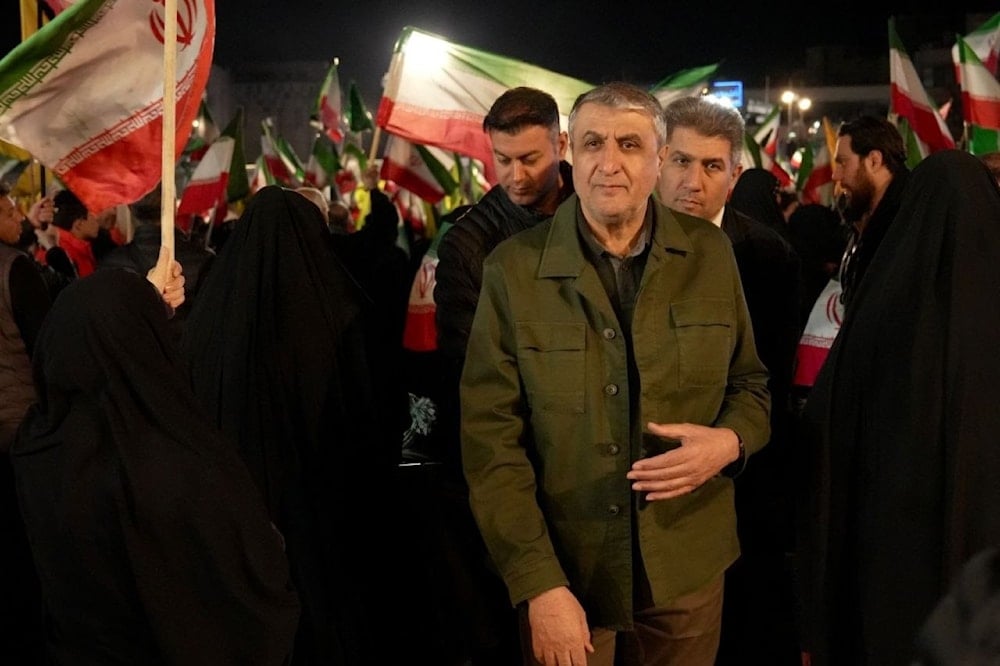
The Head of the Atomic Energy Organization of Iran, Mohammad Eslami, is seen at the public gathering in Enqelab Square, April 15, 2026. (@AEOI_admin channel on Telegram)
Safeguards are in place to protect Iran’s nuclear assets, head of the Atomic Energy Organization of Iran (AEOI) Mohammad Eslami said, reaffirming that the country's nuclear program will continue its peaceful activities “with full strength,” as cited by IRNA.
The remarks came during a meeting with Parliament’s National Security and Foreign Policy Committee, according to committee spokesperson Ebrahim Rezaei, who cited Eslami as stressing that all of Iran’s nuclear achievements would be preserved.
“Iran’s nuclear activities have always been, and will remain, entirely peaceful,” Rezaei quoted Eslami as saying.
Committee members emphasized during the session the need to safeguard nuclear facilities and strategic assets, while reiterating criticism of Iran’s membership in the Nuclear Non-Proliferation Treaty (NPT), describing it as “fruitless". According to IRNA, they also stressed the importance of resisting external pressure and maintaining the country’s nuclear advancements.
The chairman of the National Security and Foreign Policy Committee said Iran’s nuclear industry is a domestically developed sector with broad scientific and research applications, describing it as vital for both current and future generations.
He added that parliament would use its full authority to support the country’s nuclear sector and protect its achievements.
IAEA's complicity over aggression
In early April, Eslami sent a protest letter to the International Atomic Energy Agency (IAEA), accusing the UN nuclear watchdog of failing to respond to the aggression on Iran’s peaceful nuclear facilities by the United States and "Israel".
In a post on X, the AEOI said the international agency’s silence over the ongoing aggression was “not merely inaction” but amounted to “clear complicity with the perpetrators.”
The IAEA’s silence on US and Zionist regime’s attacks on Iran’s peaceful nuclear facilities is not merely inaction but clear complicity with the perpetrators. AEOI Chief has sent protest letters to the DG.This historic negligence erodes the @iaeaorg little remaining credibility.
— Atomic Energy Organization Of Iran (@aeoi_ir) April 3, 2026
It further warned that this “historic negligence” undermines the "little remaining credibility" and legitimacy of the IAEA.
The agency’s lack of response to “US and Zionist regime’s attacks” was not simply inaction but “clear complicity with the perpetrators," it added.
Quarter of all IAEA inspections made on Iran nuclear facilities
As far back as February 2025, the AEOI pointed out that roughly a quarter of all IAEA inspections were dedicated to its nuclear facilities, despite those facilities representing less than 3% of the world's nuclear sites
The decisive rupture came in June 2025 when the IAEA passed a non-compliance resolution against Iran, the day before "Israel" launched its unprovoked aggression against the Islamic Republic.
Tehran accused the agency of providing the Israeli regime diplomatic cover for its attacks, and revealed that sensitive nuclear data shared with the IAEA had been leaked to Israeli intelligence, leaks that Iranian officials say contributed to the assassination of nuclear scientists. Iran suspended all cooperation and barred Grossi from its facilities.
A partial reset came via the Cairo Agreement in September 2025, brokered by Egypt, under which the IAEA formally acknowledged the illegality of the strikes. But when the US and E3 passed a new censure resolution weeks later, Tehran terminated the deal entirely.
When the current war began on February 28, the IAEA again stopped short of condemning the aggression, instead urging the aggressor and aggressed to show restraint.
Several Iranian nuclear facilities have come under attack since the outset of the US-Israeli attacks, including sites in Bushehr, Natanz, and Isfahan.
In response, Iran continued to exercise its legitimate right to defend its territory, targeting US bases across the region, as well as military and strategic sites in the occupied Palestinian territories.
Read more: Iran’s 'threat' to Western hegemony is not nuclear weapons


