
Iran reviews NPT exit as inspections facilitate US-Israeli espionage
 3 Min Read
Iran is urgently reviewing withdrawal from the NPT, framing it as a defensive move against "espionage" under international inspections amid escalating tensions.
-
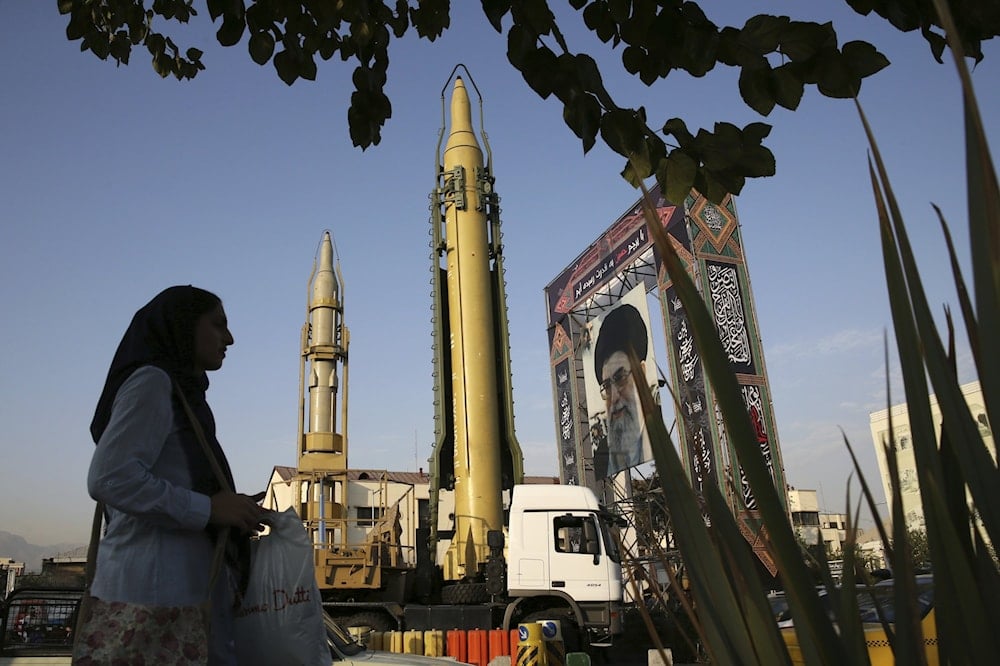
A Ghadr-H missile, center, a solid-fuel surface-to-surface Sejjil missile and a portrait of then-Leader martyr Sayyed Ali Khamenei are on display for the annual Defense Week, marking the 37th anniversary of the 1980s Iran-Iraq war, at Baharestan Sq. in Tehran, Iran, Sept. 24, 2017. (AP)
Iranian authorities are urgently examining the possibility of withdrawing from the Treaty on the Non-Proliferation of Nuclear Weapons (NPT), as a growing consensus takes shape that continued membership no longer serves the country’s interests, Tasnim reported on Saturday.
According to the outlet, institutions including the Islamic Consultative Assembly (parliament) are assessing the move, with deliberations advancing toward a “final conclusion” that there is no justification for remaining in the treaty.
The development follows a surge in official statements questioning the value of the NPT, including remarks by parliamentary figures who said the agreement has failed to offer any tangible benefits to Iran or protect it from repeated attacks on its nuclear facilities.
Iranian officials have stressed that, despite remaining within the treaty framework, the country has continued to face strikes and sabotage targeting its nuclear infrastructure. They also said the treaty has enabled foreign intelligence services to exploit international inspections as a cover for espionage targeting sensitive nuclear sites.
The report also comes in light of recent US-Israeli aggression targeting Iran’s nuclear infrastructure, including strikes on facilities linked to uranium processing and heavy water production. These attacks have raised serious international concern, with the International Atomic Energy Agency (IAEA) warning that targeting nuclear sites could have “grave consequences” and risk radiological fallout affecting the wider region. Despite these warnings, such facilities have continued to come under attack, reinforcing Tehran’s position that international mechanisms have failed to provide even minimal protection.
Strategic policy shift
Under Article X, the NPT permits withdrawal when a state’s supreme interests are threatened, requiring a three-month notice period.
Iranian officials and affiliated media have increasingly argued that the NPT imposes obligations without providing corresponding security guarantees, particularly in light of continued aggression and sabotage operations attributed to hostile actors. Tehran has also raised serious concerns about the role of the International Atomic Energy Agency (IAEA), stating that inspection mechanisms have been exploited for intelligence-gathering purposes.
International reactions have further underscored the risks surrounding the recent attacks. The United Nations has described the situation as “extremely dangerous,” while Russia has warned that strikes near Iran’s nuclear facilities could lead to serious and potentially irreversible consequences.
The debate comes as cooperation between Iran and the IAEA has already been affected following the US-Israeli aggression that began on February 28, with restrictions on inspector access reducing international visibility over Iran’s nuclear activities.
Read more: 'Meaningless stay': Iran hints at potential withdrawal from NPT


