
Iran says US truce shows strategic failure, not diplomacy: Source
 3 Min Read
An Iranian political-security source told Al Mayadeen that the ceasefire announced by Washington reflects internal disarray within the US-Israeli command structure.
-
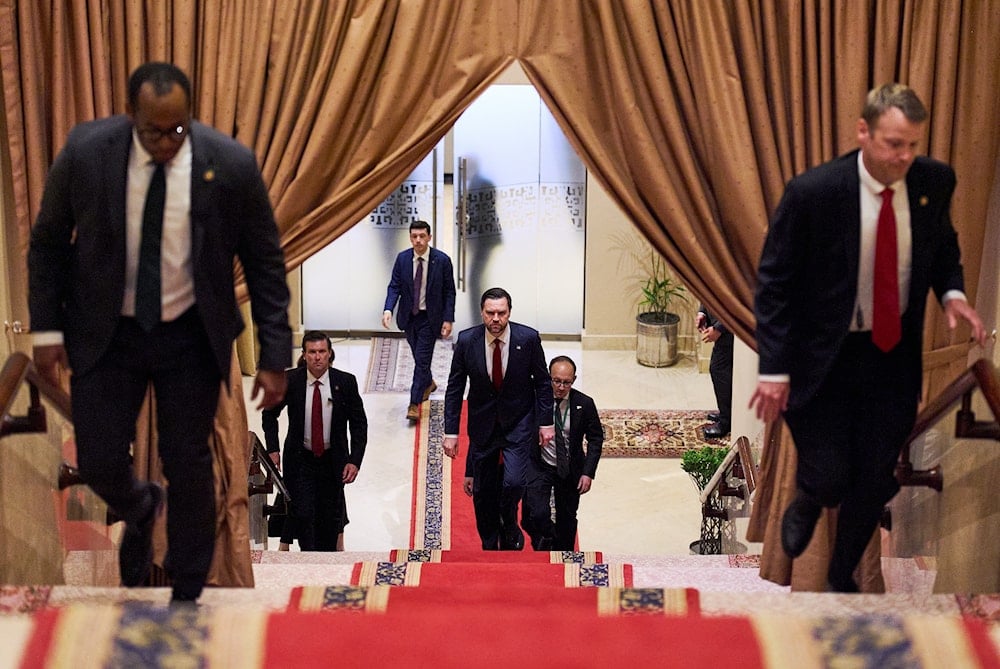
US Vice President JD Vance, center, walks up a flight of stairs to meet with Pakistan's Prime Minister Shehbaz Sharif, April 11, 2026, in Islamabad, for talks about Iran (AP)
An Iranian political-security source told Al Mayadeen that the unilateral ceasefire announced by Washington did not stem from diplomacy, but from a fundamental breakdown in how the war was managed.
According to the source, developments on the battlefield reveal significant shortcomings within both Washington and Tel Aviv, pointing to fractured decision-making processes and ongoing operational uncertainty.
The source said Tehran has identified a widening disconnect within the American-Israeli axis, highlighting inconsistencies between publicly stated objectives and the actual capacity to carry them out.
They added that both sides have struggled to agree on how to proceed with the war, suggesting the ceasefire reflects a temporary measure aimed at buying time rather than a durable shift in strategy.
Tehran prepares for escalation risks
The source emphasized that Tehran views the truce as a tactical pause and is responding accordingly, preparing for what it termed as potential “treacherous contingencies.”
From Tehran’s perspective, the consolidation of Resistance fronts and the creation of a joint operations framework have significantly raised the cost of confrontation for its adversaries.
The source pointed to vulnerability along "Israel’s" northern front, estimating that around 80,000 troops and 20 billion shekels would be needed to reinforce positions. It also cited mounting pressures, including the economic burden of the war and the risks posed to energy market stability.
They further noted that discussions at the International Energy Conference held in Kuala Lumpur on April 9 emphasized increasingly complex considerations, particularly as major companies urged caution against actions that could destabilize regional and global markets.
Domestic cohesion seen as a strategic factor
Despite what the source characterized as persistent rhetoric, it said the American-Israeli axis has come to recognize the level of internal cohesion within Iran, which it argued has amplified the political and operational setbacks faced by its adversaries.
The source told Al Mayadeen that Tehran does not interpret the ceasefire across multiple fronts as an endpoint, but rather as a transitional phase during which Washington and Tel Aviv are reassessing strategies already burdened by structural weaknesses.
They concluded by stressing that the reported 30 million Iranians registered for enlistment should not be seen as symbolic, but as an indication of a sustained and decisive phase of confrontation.


