Iran sets schedule for Martyr Sayyed Khamenei's funeral in Iran, Iraq
 3 Min Read
Iran has announced the full schedule for the farewell, funeral, and burial of Sayyed Ali Khamenei, Leader of the Islamic Revolution.
-
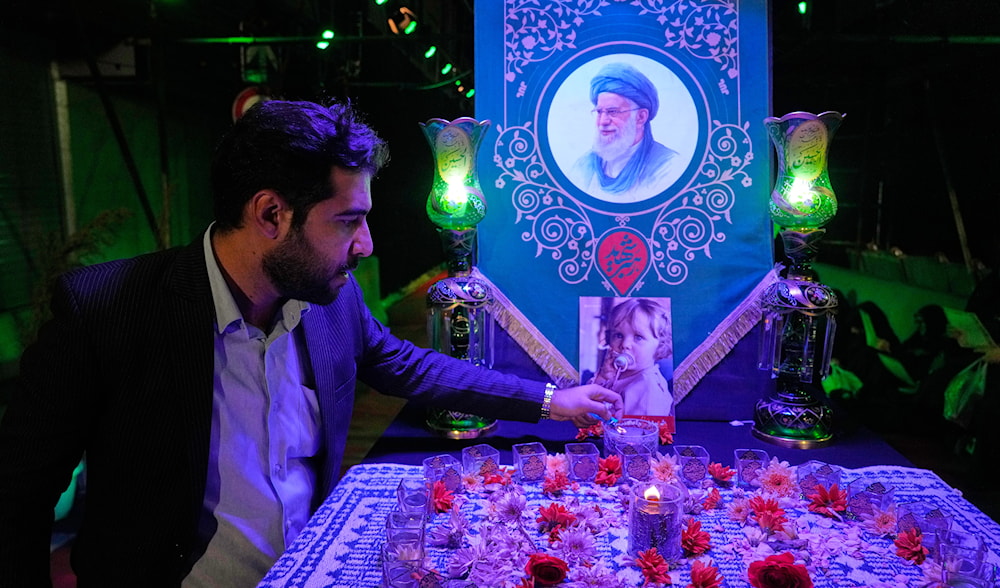
A man lights candles at a memorial for martyred Iranian Leader Ayatollah Ali Khamenei during a pro-government gathering in Tehran, Iran, Monday, May 18, 2026. (AP Photo/Vahid Salemi)
The head of the committee overseeing the funeral of the Leader of the Islamic Revolution announced on Monday the full schedule and locations for the official farewell, funeral, and burial ceremonies for martyred Leader Sayyed Ali Khamenei, set to officially begin on Saturday, July 4, corresponding to 19 Muharram.
In a statement, the head of the funeral committee, Iman Attarzadeh, said the farewell to the martyred Leader will be held under the slogan "We must rise" and the symbol of the raised fist. Attarzadeh added that the farewell ceremonies will first take place over two days at the Grand Imam Khomeini Mosque in the Iranian capital, Tehran.
Prayers over the Leader's body will be held in the cities of Tehran, Qom, and Mashhad, he said, with Tuesday, July 7, designated for the funeral procession and prayers over the body of the Sayyed Khamenei in the holy city of Qom. Specific details will be announced in subsequent statements.
Beyond Iran, the head of the funeral committee confirmed that the body will be taken in procession through the holy cities of Najaf al-Ashraf and Karbala in Iraq on Wednesday, July 8. Logistical details regarding the funeral ceremonies in Iraq will be announced later.
At the conclusion of the ceremonies, the funeral procession in the holy city of Mashhad will take place on Thursday, July 9, corresponding to 24 Muharram, where Sayyed Ali Khamenei will be laid to rest in the shrine of Imam Ali ibn Musa al-Rida.
Leader of the Ummah, Sayyed Ali Khamenei, martyred in US-Israeli aggression
The leader of the Islamic Revolution in Iran and the Islamic Republic of Iran, Sayyed Ali Khamenei, was martyred in the joint US-Israeli aggression on Iran on February 28, 2026.
Sayyed Khamenei was martyred at his workplace while he was carrying out his duties in his office following the joint US-Israeli attacks in the early hours of Saturday.
Aged 86, Sayyed Ali Khamenei guided the Islamic Republic of Iran from the early days of the post-revolutionary era through decades of struggle and transformation. After taking part in the 1979 Revolution that overthrew the oppressive, US-backed Pahlavi monarchy, he served as president throughout much of the 1980s before being elected as the Leader of Iran in 1989 following the death of Imam Ruhollah Khomeini.
In that position, he became the highest authority in Iran's political and religious system, shaping domestic policy, overseeing national institutions, and directing Iran's strategic orientation for nearly four decades.
During his leadership, he maintained Iran's sovereignty in the face of international pressure, steered the country through regional conflicts, and fostered alliances with movements and governments across West Asia.
His tenure also oversaw significant developments in Iran's nuclear program and the expansion of Iran's Armed Forces, making him one of the most significant figures in contemporary Iranian and regional history.