
Iran announces funeral, burial services for martyr Sayyed Ali Khamenei
 3 Min Read
Iran has announced the funeral schedule for the martyred Leader Sayyed Ali Khamenei, with the main procession in Tehran on July 6 and burial in Mashhad on July 9 following ceremonies in Tehran and Qom.
-
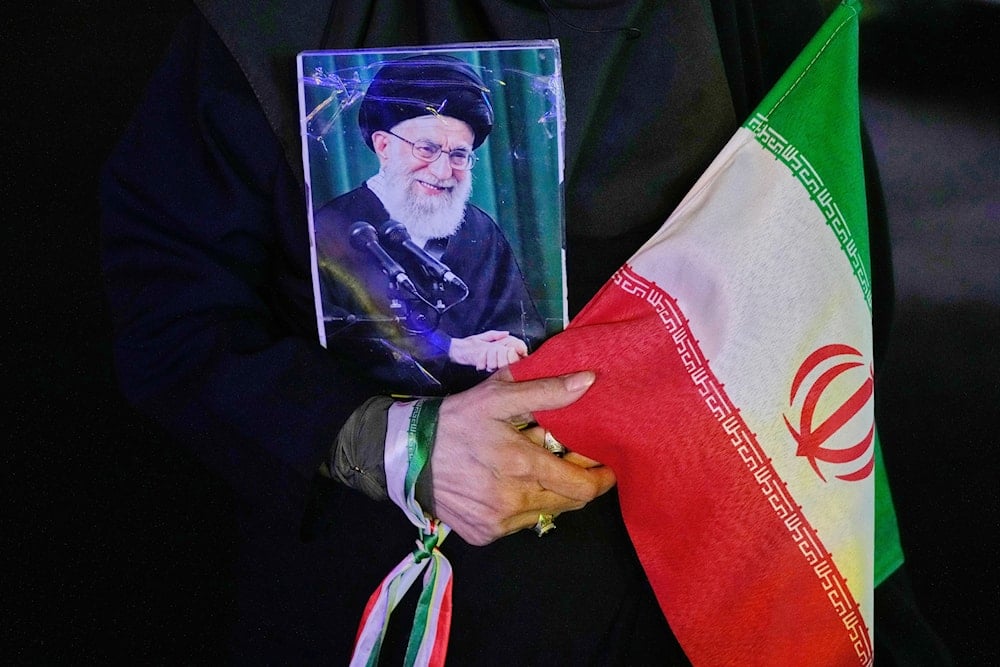
A demonstrator holds a poster of martyred Iranian Leader Sayyed Ali Khamenei and an Iranian flag during a gathering at a square in downtown Tehran, Iran, May 19, 2026 (AP)
The main funeral procession for the martyred Leader of Iran, Sayyed Ali Khamenei, will be held in the capital on July 6, with burial set for July 9 in Mashhad, according to an official announcement.
According to official details released by the Office for the Preservation and Publication of the Works of the Martyred Leader Sayyed Ali Khamenei, a farewell ceremony for the leader's body will be held at Grand Mosalla of Tehran on Saturday and Sunday, July 4 and 5. The main funeral procession will take place in Tehran on Monday, July 6.
A separate funeral ceremony will be held in the city of Qom on Tuesday, July 7. The final rites and burial are scheduled to take place in the city of Mashhad on Thursday, July 9.
Leader of the Ummah, Sayyed Ali Khamenei, martyred in US-Israeli aggression
The leader of the Islamic Revolution in Iran and the Islamic Republic of Iran, Sayyed Ali Khamenei, was martyred in the joint US-Israeli aggression on Iran on February 28, 2026.
Iranian state television reported that the leader of Iran, Sayyed Ali Khamenei, was martyred at his workplace while he was carrying out his duties in his office following the joint US-Israeli attacks in the early hours of Saturday.
According to Iranian state television, Sayyed Khamenei's martyrdom at his workplace once again refuted claims by "outlets linked to the Israeli regime and regional reactionary currents that the leader was in a secure and undisclosed location," affirming that he remained present on the frontlines of responsibility among his people.
Aged 86, Sayyed Ali Khamenei guided the Islamic Republic of Iran from the early days of the post-revolutionary era through decades of struggle and transformation. After taking part in the 1979 Revolution that overthrew the oppressive, US-backed Pahlavi monarchy, he served as president throughout much of the 1980s before being elected as the Leader of Iran in 1989 following the death of Imam Ruhollah Khomeini.
In that position, he became the highest authority in Iran's political and religious system, shaping domestic policy, overseeing national institutions, and directing Iran's strategic orientation for nearly four decades.
During his leadership, he maintained Iran's sovereignty in the face of international pressure, steered the country through regional conflicts, and fostered alliances with movements and governments across West Asia.
His tenure also oversaw significant developments in Iran's nuclear program and the expansion Iran's Armed Forces, making him one of the most significant figures in contemporary Iranian and regional history.


