
Iran tables strategic Strait of Hormuz bill after US claims control
 4 Min Read
The Iranian Parliament has officially submitted a strategic Strait of Hormuz bill following US claims over the waterway, reaffirming Tehran's stance on Persian Gulf security.
-
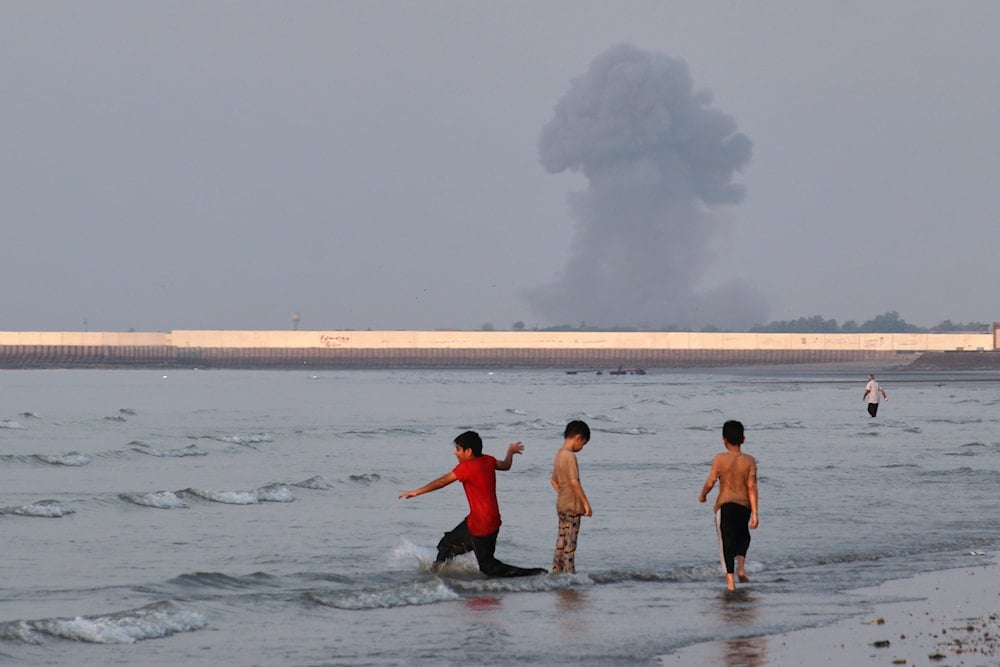
Three boys play in the shallow waters of the Strait of Hormuz, as a plume of smoke rises from an explosion in the background, off Bandar Abbas, Iran, Monday, July 13, 2026 (ISNA)
Iran’s parliamentary leadership has formally submitted a strategic bill on the management of the Strait of Hormuz and the Persian Gulf, a move that comes in direct response to recent US assertions of control over the vital waterway.
Ibrahim Azizi, the head of the National Security and Foreign Policy Committee of the Iranian Majlis (Parliament), announced on Monday that the "Strategic Action for Security and Sustainable Development in the Strait of Hormuz and the Gulf" bill had been officially tabled before the chamber.
"This is the first step," Azizi stated, adding that "Further measures will follow that will make the enemy regretful," while emphasizing the legislature's firm commitment to defending Iran's red lines, particularly concerning the administration of the strait.
The announcement follows a declaration by Iran's Khatam al-Anbiya Central Headquarters, which reiterated that Tehran would never permit US interference in the management of the strategic chokepoint. The headquarters warned that "American adventures to intervene in management have seriously endangered regional security, international trade, and the transit of oil tankers."
Roughly one-fifth of the world's petroleum passes through the Strait of Hormuz, making its security a critical issue for global energy markets. Iran has repeatedly threatened to close the strait in response to hostile actions or severe sanctions, while the US maintains a naval presence in the region to ensure freedom of navigation.
Trump demands Gulf pay 20% for US protection in Strait of Hormuz
Iran's move comes in response to Trump claiming that the US is in control of the Strait of Hormuz, while asking for reimbursement for cargo passing through the Strait.
In a post on TruthSocial on July 13, Trump claimed that "The Hormuz Strait is OPEN, and will remain OPEN, with or without Iran. We are reinstating the THE IRANIAN BLOCKADE, so named because it is only stopping Iran’s ships or customers from entering or leaving."
He went on to claim that "All other countries will have fair and open use of the Strait. The U.S.A. will be, from this point forward, known as 'THE GUARDIAN OF THE HORMUZ STRAIT,' but as such, and as a matter of FAIRNESS, will be reimbursed, at the rate of 20% on all cargo shipped, for any and all costs necessary to do the job of providing safety and security to this very volatile section of the World."
On July 14, President Donald Trump called on Gulf nations to reimburse the United States for its military operations in the Strait of Hormuz, citing the high cost of protecting regional allies amid ongoing tensions with Iran.
Speaking to reporters in the Oval Office, Trump argued that Washington is expending significant resources to secure the strategic waterway and that compensation from regional states is now due.
"I want to be reimbursed because we're protecting a very rich portion of the world. We're spending money, so… we are going to be reimbursed for protection," Trump said.
The President specifically named Saudi Arabia, the United Arab Emirates, Qatar, Bahrain, and Kuwait as beneficiaries of US military commitments, adding that Washington is also safeguarding "Israel".
"We're protecting allies… including Israel, including Saudi Arabia, including Qatar, including UAE. We're protecting all of them, and we've done a very effective job," he stated.


