
Iran was compelled into taking action regarding Hormuz: Deputy FM
 4 Min Read
Iran’s Deputy Foreign Minister says ship movement in the Strait of Hormuz operates within a framework of mutual goodwill and international practice.
-
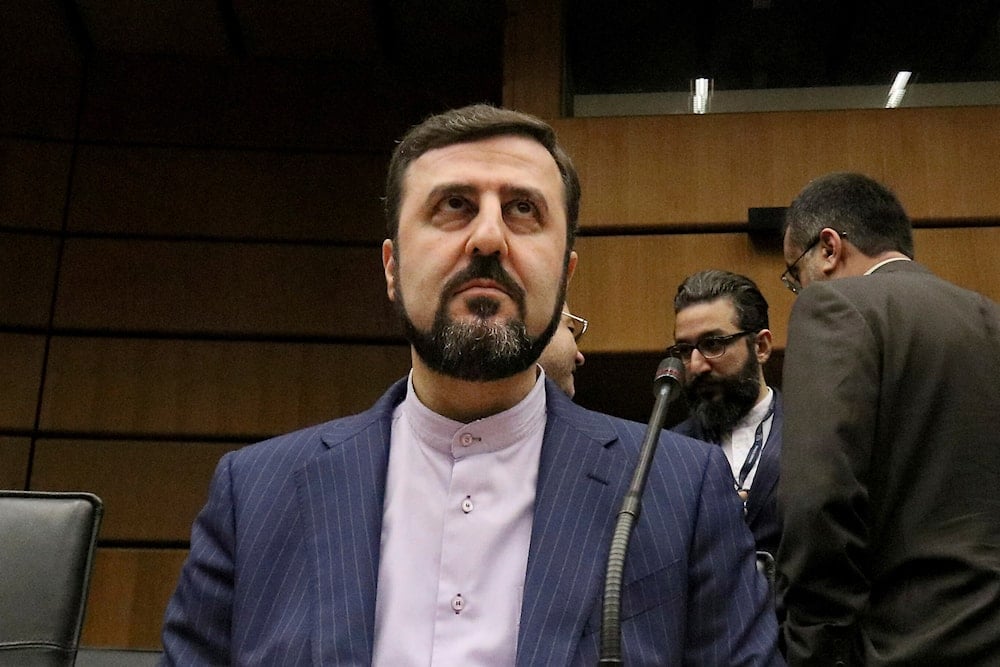
Iran's then-Ambassador to the International Atomic Energy Agency, IAEA, Kazem Gharibabadi, waits for the start of the IAEA board of governors meeting at the International Center in Vienna, Austria, on November 21, 2019 (AP, File)
Iran’s Deputy Foreign Minister for Legal and International Affairs, Kazem Gharibabadi, affirmed that "the movement of ships in the Strait of Hormuz has been taking place within an interactive framework based on international courtesy and mutual goodwill, and Iran has been facilitating the passage of ships for years".
In an opinion piece for the newspaper Iran on Thursday, Gharibabadi pointed out that "the fundamental change in circumstances and the security shift in the landscape has rendered taking the necessary measures based on respect for the sovereign rights of the coastal state an unavoidable necessity."
He pointed out that "some neighboring countries participated in committing the crime of aggression against Iran by placing their territories at the disposal of the aggressors, an action that is considered proof of the aggression."
Gharibabadi added that "the aggression exposed the security and safety of the region, particularly the Strait of Hormuz, to serious and far-reaching damage, and Iran found itself compelled to take measures to manage the developments," noting that "these measures are aimed at preventing further risks to ships and sailors in the Gulf, the Strait of Hormuz, and the Sea of Oman."
He stated that "the Security Council has remained effectively incapable of condemning the aggressor and has failed to fulfil its core responsibility of maintaining international peace and security and restoring stability to the region."
"The coastal state’s commitment to facilitating passage is contingent on conditions that do not seriously disrupt navigational safety or maritime public order," the Iranian deputy FM added.
Maritime sovereignty and legal framework
Gharibabadi further stated that “the sovereignty of coastal states over their territorial sea, including even sections that lie within an international strait, and the exercise of the rights and powers arising from that sovereignty are a fundamental and well-established principle of the international law of the sea."
He stressed that "the transit management arrangements in the Strait of Hormuz were established within the framework of Iranian and Omani domestic law, as well as customary international principles, relevant treaties, the principles of the United Nations Charter, and international jurisprudence".
"No right under international law, including the right of passage, may be exercised in a manner that results in a threat, military aggression, or a violation of the coastal state’s security," he stated.
Iran’s position on international maritime conventions
Gharibabadi pointed out that "Iran is not a party to the 1958 Convention on the Territorial Sea and the Contiguous Zone, nor to the United Nations Convention on the Law of the Sea, and therefore does not consider itself bound by their provisions."
He explained that "the legal framework applicable to crossings in the Strait of Hormuz is the same as the customary right of 'innocent passage' in straits used for international navigation," while noting that "the coastal state has the right to regulate passage, collect maritime service fees, request prior notification or permission for the passage of warships, and take the necessary measures to maintain its security."
Iran establishes maritime control zone in Strait of Hormuz
In this context, Iran’s Persian Gulf Strait Authority announced earlier today the establishment of a new maritime control zone in the Strait of Hormuz, as Tehran continues to tighten oversight over one of the world’s most strategic waterways.
In a statement published on X, the authority said the control zone extends from the line connecting Jabal Mubarak in Iran to southern Fujairah in the UAE on the eastern side of the strait, to the line linking Qeshm Island in Iran with Umm al-Quwain in the UAE on the western side.
The announcement comes one day after Tehran unveiled the new Persian Gulf Strait Authority tasked with regulating navigation and transit through the Strait of Hormuz. Iran stressed that any maritime transit through the strait without prior coordination with Iranian authorities would be considered a violation of the newly established regulations.


