
Iranian missiles can reach any point intended to be targeted: Ghalibaf
 4 Min Read
Iran's Parliament Speaker says the country will not surrender in the “composite war”, highlighting its missile capabilities.
-
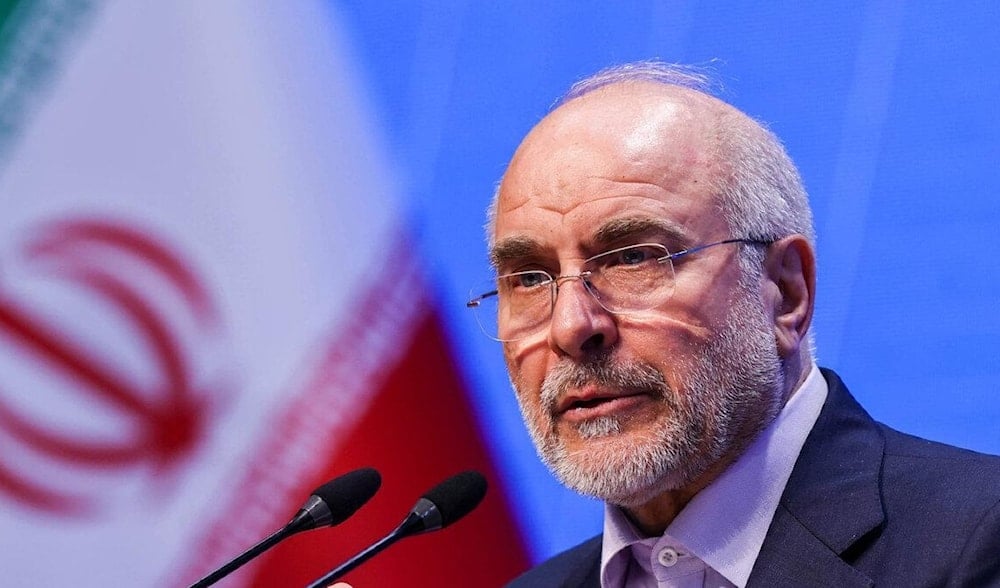
Iranian Parliament Speaker Mohammad Bagher Ghalibaf gestures as he speaks during an event in Iran, undated (WANA)
Iran will not surrender and will continue its actions in the "composite war" being waged against it by the United States, Iranian Parliament Speaker Mohammad Bagher Ghalibaf said on Tuesday, emphasizing that Iranian missiles can reach any point intended to be targeted.
Speaking at a ceremony honoring veterans of the "Sacred Defense", Ghalibaf said, "We have today reached a stage where we are able to target any point we want with our missiles, without restrictions."
He added, "During the years of the Sacred Defense, the enemies would not even sell us barbed wire, the range of our artillery did not exceed 14 to 15 kilometers, and artillery shells were subject to rationing, but the culture of the Sacred Defense has brought us today to these missile capabilities."
Iran able to render enemy incapable on multiple fronts
In the face of a “hybrid war” spanning economic, military, and diplomatic fronts, Ghalibaf said Iran would “never surrender” and would continue its work while responding forcefully. He added that Iran had already managed to “render the enemy incapable” in various fields.
The Parliament speaker also addressed US President Donald Trump, saying, “Trump is facing a historic civilization and a national and religious resistance. He must know that he cannot impose his power on the Iranian nation and Armed Forces.”
Iran possesses “sustainable deterrence” and is capable of standing up to its adversaries, he stressed.
“Let the enemy know that negotiations are also an arena of struggle,” Ghalibaf said, adding that diplomacy does not mean surrender but rather “turning the power of the battlefield into a political achievement.”
Ghalibaf's remarks on this occasion come amid the continuation of the "third imposed war," with Washington escalating economic pressure by increasing the pace of sanctions and the continuation of the naval blockade imposed on the country's ports.
The "Sacred Defense Week" is an official national occasion marked annually in Iran starting on September 22. Events continue for a full week to commemorate the resilience of the Iranian people and armed forces in the "first imposed war," the Iran-Iraq war that began in 1980 and lasted eight years.
IRGC warns US, 'Israel' against further military escalation
Echoing Ghalibaf's statements, Iran's Islamic Revolution Guard Corps warned the United States and "Israel" against further military escalation, stating that Iranian forces remain prepared to deliver a severe response to any new attack or miscalculation.
The warning came in a statement issued by the IRGC on the occasion of "Sacred Defense Week."
The IRGC stated that Iran's Armed Forces remain at a high level of readiness to confront potential threats, presenting the experience of the eight-year war as a foundation for the country's present military capabilities and strategic doctrine.
"We are prepared for a decisive and destructive response against the worn-down and aggressive enemy should the adversary front make any miscalculation," the statement said.
Sooner or later, US, 'Israel' will have to accept region free of them
The IRGC stated that Washington and the Israeli occupation will ultimately be forced to accept a regional order without their presence. "The United States and the Zionist entity must understand this fact: sooner or later, they will have to accept a region free of their ominous and criminal presence, and, God willing, there will be no escape from this fate," the IRGC said.
The Corps linked that position to Iran's growing defensive and deterrent capabilities, stating that years of confrontation and sanctions have strengthened the country's ability to respond independently to military threats.
It highlighted national unity and domestic military production as central elements of Iran's defense strategy.
The statements come amid heightened tensions between Tehran and Washington and "Tel Aviv", with senior Iranian military officials repeatedly warning that any renewed attack on the country would trigger a broader response.


