
Iranian parents recount the horrors at Minab school after US attack
 7 Min Read
Parents recount the moment they rushed into the shattered remains of Shajareh Tayyebeh school, desperately searching for their children amid smoke, dust, and chaos.
-
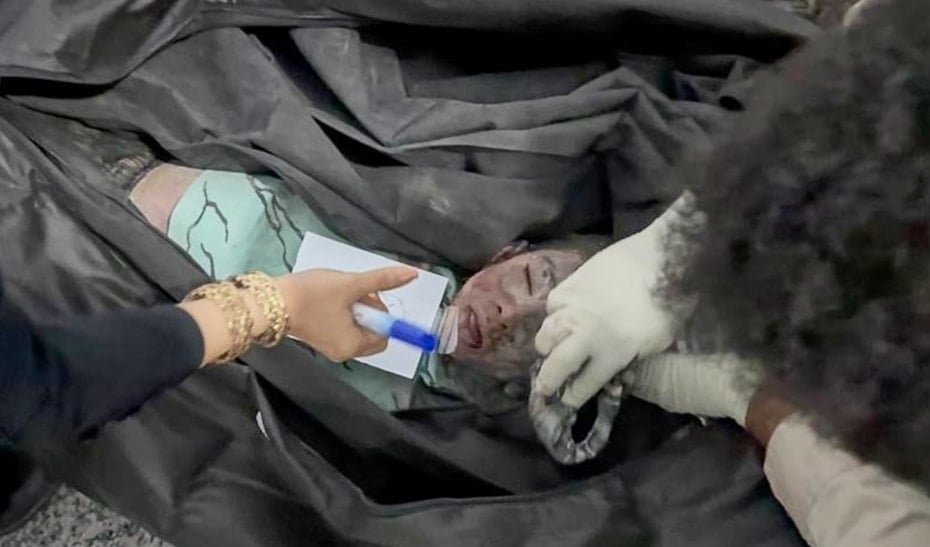
This picture, released by the Iranian government's foreign media department and distributed by the AP, shows a child after being pulled from rubble after a brutal Israeli airstrike on a girls' elementary school in Minab, Iran, February 28, 2026 (AP)
Hours before the global announcement that a US aggression had targeted the Shajareh Tayyebeh school in Minab, families were already combing through debris in search of their children. In this account, four families recount for The Guardian the events of February 28.
When Marzieh heard the first explosion, a powerful blast that shook the house, she initially assumed her youngest son Mohammad was responsible, imagining he had reached the balcony and was forcefully shutting its sliding doors. She rose from her sewing machine and told him to stop.
He responded, “Mum, it wasn’t me."
A second explosion followed, shaking the entire building. Marzieh briefly wondered if construction work or neighbouring renovations could be the cause, but she immediately dismissed the thought, knowing the nearby homes were empty during the day while she and Mohammad remained alone.
Only minutes earlier, at 11.17 am, she had received an abrupt call from Mrs. Mohammadian, the teacher of her eight-year-old daughter Zahra. She was told the school, located a few blocks away, would close early and that Zahra needed to be picked up. No reason was given, as the teacher quickly moved on to contact the next parent.
Marzieh contacted her husband, who arranged for his brother to pick up Zahra and her cousin, who were in the same class.
A morning that changed everything
Standing in her home shortly afterwards, Marzieh experienced a numb shock and realized she was trembling. Voices from the street drew her outside. As she opened the door, she was met with the smell of smoke and the sight of people running in panic. When she asked what was happening, she was told. “War has started."
That morning had begun under clear skies. Mohammadreza Ahmadi chose to take his children to school himself. His work often took him away from Minab for long periods, so when he was home, he valued time with his children: Sobhan, 10, Hanieh, 7, and their toddler sister Hannan.
Sobhan, especially, was deeply attached to his father, following him everywhere and often jumping onto his shoulders despite warnings that it might hurt him. The family had endured miscarriages before his birth, making him especially cherished.
Ahmadi told The Guardian, “I was confused and kept searching for my children’s classrooms. My daughter’s classroom was entirely flattened."
Sobhan had been delayed in early development and initially struggled to speak. His parents devoted years to therapy and support, including long trips to Bandar Abbas for treatment while his mother was pregnant with Hanieh. He eventually learned to speak at age four.
Hanieh, described as playful and humorous, often imitated her mother’s household routines, turning chores into games.
When Ahmadi dropped them at school that morning, he watched as Sobhan embraced his sister before they entered the building. He later received a call requesting that the children be picked up.
Arya’s family: Uncertainty and rising fear
Across town, Marzieh Mansouri received a call at 11.05 am from her son Arya’s teacher. The call immediately alarmed her. Arya, nine, was a quiet, diligent child who was especially close to his mother, often observing her baking and copying her recipes.
“Is he OK?” she asked.
The teacher reassured her that Arya was fine, but the school would close due to reports of an attack in Tehran, and requested that a parent pick him up. Mansouri, increasingly anxious, turned on the television and saw news of a US-Israeli aggression while trying to arrange for Arya to be picked up.
Silently, she began praying.
Confusion spreads: Zahra’s family
Smoke drifted through the neighbourhood as Marzieh moved into her garage for shelter. With Mohammad nearby, she made repeated phone calls to relatives collecting the children, to family members checking on safety, and to her husband, who was already heading toward the school. None provided clarity.
Her brother then called, reporting rumours that a bomb had hit the school and asking about Zahra’s whereabouts.
Marzieh attempted to contact every staff member connected to the school, teachers, religious instructors, administrators, and even the caretaker, but no one answered.
All calls went unanswered.
Arya’s family: First confirmations
Mansouri and her family began hearing distant explosions. Her husband, teaching in a nearby village, reported a plane had flown overhead and struck something in Minab.
Soon after, Mansouri was told directly that the school had been hit.
When she demanded confirmation from her brother, he replied simply, “Yes".
The streets around her descended into chaos. At the scene, she encountered a school staff member covered in dust who refused to speak and walked away silently.
Arrival at the school: Total destruction
Ahmadi arrived at the school but could not process what he saw. The girls’ section had been completely flattened.
Hossein, Marzieh’s husband, was among the first parents to arrive. He described the devastation: the girls’ classrooms had been reduced to rubble while parts of the boys’ section remained standing.
He began digging through debris, believing his daughter Zahra might still be alive. Around him, others searched desperately amid screams and chaos.
Searching through the ruins
Marzieh arrived and saw only destruction. She prayed as she watched rescuers pull bodies from the rubble, hoping for signs of life.
Arya’s father, Morteza Bahadori, ran toward the school on foot after abandoning his car. He believed only a miracle could save his son if he was inside.
As he reached the site, he saw that Arya’s classroom had been completely destroyed. He joined others digging through the debris.
Hours passed as they continued searching, unaware of the full scale of the destruction.
The morgue: Confirmation of loss
Zahra’s body was eventually recovered. Hossein identified her at the morgue, describing her injuries and confirming her identity: Zahra Behroozi, aged eight.
Ahmadi later identified both Sobhan and Hanieh at the morgue. Both children had suffered severe injuries, confirming their deaths.
Arya’s body was also identified later by family members after his parents were unable to face the formal process.
Aftermath and continuing grief
Even after learning of their children’s killings, some parents continued searching at the site, unable to stop digging through the rubble. Hossein returned to the school and continued helping others, saying all children felt like his own.
The destruction of the school would later be confirmed through video evidence, satellite imagery, missile fragments, and leaked intelligence, identifying a US missile strike as the cause.
The aftermath: Calls for justice
One month after the aggression, no one had been held accountable. Investigations were ongoing, and official responsibility had been denied.
Zahra’s father urged the UN and global courts to visit the site and recognize the destruction as a crime.
Zahra’s father said he wants the world to understand that the school was simply an educational institution, not a military target. He called on the UN and international courts to visit Minab and witness the aftermath firsthand. “They must see the rubble and the surrounding area. They must recognize the crimes committed by the United States,” he said. “We demand justice.”
Arya’s younger brother, unaware of the full reality, still waits for his brother’s return each afternoon.


