
Iranian strikes hit Tel Aviv, surrounding, cause casualties, damage
 3 Min Read
Iranian missiles strike central “Israel”, injuring at least 10 and causing fires and damage in “Tel Aviv” and nearby areas.
-
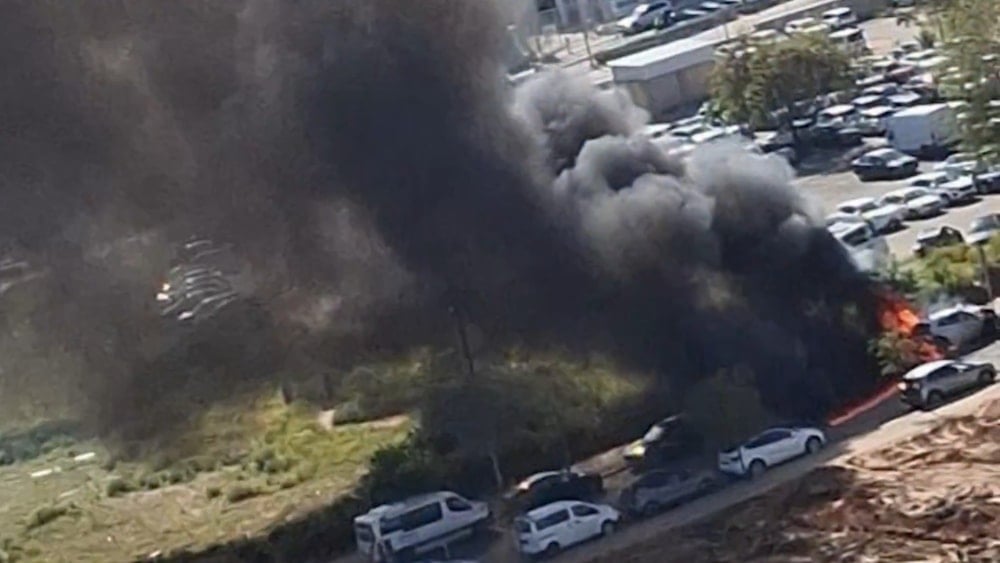
Image circulating online of fire breaking in vehicles following Iranian missile strikes on Tel Aviv, March 31, 2026 (Social media)
Israeli media reported injuries and material damage in central “Israel” after the Islamic Republic of Iran launched a new wave of missiles toward the occupied territories on Tuesday.
According to Israeli Channel 12, at least nine people were initially wounded in Tel Aviv, Bnei Brak, and Petah Tikva, before the number rose to 10 injuries across central areas.
Israeli media also reported fires breaking out in multiple vehicles in and around Tel Aviv following the missile strike, indicating direct impacts in several locations.
#WATCH | Footage circulating on social media shows the aftermath of missile strikes in Tel Aviv, occupied #Palestine.
— Al Mayadeen English (@MayadeenEnglish) March 31, 2026
Israeli media reported that several explosive missile warheads fell in Bnei Brak.
Moreover, at least 13 injuries were reported in Tel Aviv, Bnei Brak, and Petah… pic.twitter.com/UULbfIX5J6
Earlier in the day, Iranian state television announced that the country’s armed forces had launched a salvo of missiles toward the occupied territories.
Israeli media, for their part, reported that sirens sounded across wide areas in central and southern “Israel” after the missile launches were detected.
Meanwhile, Israeli Channel 14 claimed that the attacks were part of an attempt to challenge air defense systems through coordinated operations involving Iran and Hezbollah.
Iran continues to target military sites, strategic facilities, and positions of Israeli forces in the occupied territories, alongside US bases and interests across the region.
These strikes are part of Iran’s Operation True Promise 4, launched in response to the US-Israeli aggression against the country.
Iran Army announced launching drone strikes on Israeli defense firms
Prior to these strikes, the Iranian army announced it carried out a large-scale drone operation targeting Israeli military-industrial infrastructure, including facilities linked to major defense companies, according to an official military statement.
In its 49th statement, the Iranian army said the operation began earlier in the day and involved multiple types of combat drones striking sites associated with the Israeli regime’s defense sector in Tel Aviv and the industrial city of Nof HaGalil.
According to the statement, the operation targeted infrastructure linked to companies, such as Elbit Systems and Kanfit, as well as a production and development center for defensive and offensive systems.
Israeli air defenses strained as Iran breaches grow
The Israeli occupation's air defense systems are showing growing vulnerabilities one month into the US-led war on Iran, with Iranian missiles increasingly penetrating defenses and striking key locations, according to a report by Responsible Statecraft.
The report highlights that major sites, including Tel Aviv, Dimona, and Arad, have sustained damage in recent days, raising concerns about the effectiveness of the Israeli regime's multi-layered air defense network amid sustained Iranian attacks.
While early explanations have focused on the depletion of interceptor stockpiles, Responsible Statecraft noted that deeper structural weaknesses may be at play, particularly within the broader US-Israeli air defense network that spans the wider region.
Facing dwindling stocks of top-tier Arrow interceptors, “Israel” has increasingly relied on upgraded versions of its David’s Sling system, originally designed for shorter-range threats, to target larger, longer-range missiles. Success has been inconsistent.
“The number of interceptors of every type is finite,” said Tal Inbar, senior analyst at the US-based Missile Defense Advocacy Alliance. “You have to make more careful calculations about what to use.”
With more than 400 Iranian missiles and hundreds of drones launched since the war began, combined with dozens of projectiles fired daily by Hezbollah, “Israel” faces continuous pressure on its defense network.


