
Over 5,470 Israelis wounded since start of regional war
 4 Min Read
The Israeli occupation's Health Ministry reports 5,473 injuries between February 28 and March 25, as Iran and Hezbollah continue attacks in the region.
-
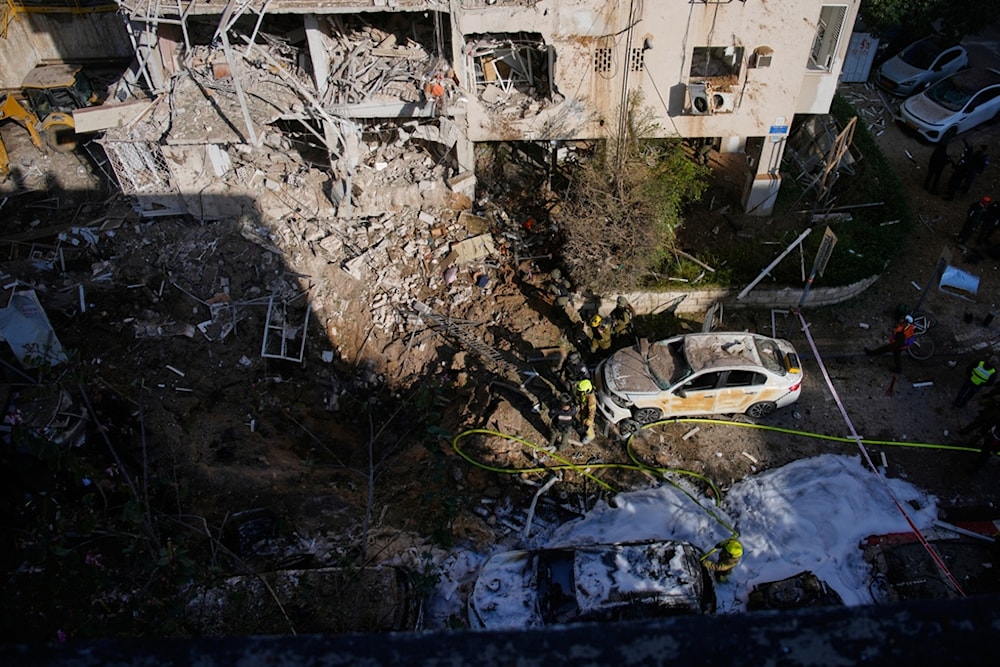
Israeli security forces and rescue team respond at the site of an Iranian missile strike in Tel Aviv, occupied Palestine, Tuesday, March 24, 2026 (AP)
The Israeli occupation’s Ministry of Health reported 5,473 injuries in the ongoing war in the region, covering the period from February 28 to March 25, 2026.
Among these, 149 injuries occurred on the last day of reporting, March 25, according to the ministry.
Since October 7, 2023, the total number of injuries admitted to Israeli hospitals has reached 80,594, the ministry confirmed.
The health ministry’s report comes as Iran continues to retaliate against attacks on its territory, targeting the occupied Palestinian territories and US military bases in the region.
Devastating Hezbollah operations
On another front, Hezbollah has maintained operations against the Israeli occupation since March 2, 2026. Fighters have targeted settlements in northern Palestine and Israeli troop gatherings along the border, intensifying pressure on occupation forces.
Bloomberg on Wednesday reported that Iran has adapted its missile doctrine under sustained US-Israeli aggression, shifting toward fewer but more precise long-range strikes that are yielding increasing battlefield impact.
Despite more than three weeks of continuous airstrikes targeting Iranian infrastructure, Tehran continues to operate from hardened and geographically dispersed launch sites, particularly in eastern Iran, complicating interception efforts and preserving strategic capabilities.
Recent strikes over the weekend, which injured more than 100 in the occupied Palestinian territories, included hits on Dimona, home to "Israel’s" main nuclear research facility. Analysts cited by Bloomberg indicated that the attacks likely involved Khorramshahr missiles, among the longest-range and heaviest payload systems in Iran’s arsenal, capable of being launched from deep inside Iranian territory.
Shift in operational effectiveness
Data reviewed by researchers points to a clear shift in operational effectiveness. Since early March, as many as a quarter of Iranian missiles are reportedly penetrating Israeli air defenses, a notable increase that reflects a move away from earlier saturation tactics toward precision-guided targeting.
Even Western analysts acknowledge the shift. Kelly Grieco of the Stimson Center noted that Iran, despite sustained pressure, is becoming more efficient in imposing costs through carefully selected strikes. Similarly, Nicole Grajewski of the Carnegie Endowment observed a transition toward smaller salvos with disproportionately high impact rates.
This evolution suggests a deliberate strategy: exploiting structural weaknesses in layered air defense systems rather than relying solely on volume. Factors such as interceptor depletion, radar disruptions, and diversified trajectories are likely contributing to the growing penetration rate.
At the same time, Iran continues to field advanced missile systems, including the solid-fuel Kheibar Shekan and Fattah-1. The latter, featuring a maneuverable warhead and terminal-phase acceleration, is specifically designed to evade interception and strike high-value targets with precision. Its ability to maneuver within atmospheric layers that fall between defense coverage zones further complicates interception.
Missile resilience and production capacity
Separately, reporting by The Washington Post underscores growing concern within Israeli security circles over Iran’s sustained missile production and rapid recovery capacity.
Despite claims that Iran’s arsenal was significantly degraded during last year’s 12-day war, Israeli officials acknowledged that Tehran quickly rebuilt its production lines, restoring its stockpile to approximately 2,500 ballistic missiles before the current escalation.
The pace of this recovery has raised alarm. A former senior Israeli security official warned that existing air defense systems “cannot absorb between 3,000 and 5,000 missiles,” pointing to a structural limitation in "Israel’s" defensive capacity over a prolonged conflict.
At the same time, recent strikes that directly hit areas in Dimona and Arad, despite "Israel’s" multi-layered air defense systems, have further shaken confidence in interception reliability. Israeli officials themselves concede that no system can provide complete protection, particularly under sustained and evolving attack patterns.


