
'Iran resilient, far from collapse': Israeli media
 3 Min Read
Israeli media acknowledge that Iran remains far from collapse despite ongoing attacks, as assessments shift amid the war, with debate over Iran’s resilience, missile capabilities, nuclear risks, and the broader regional and energy implications.
-
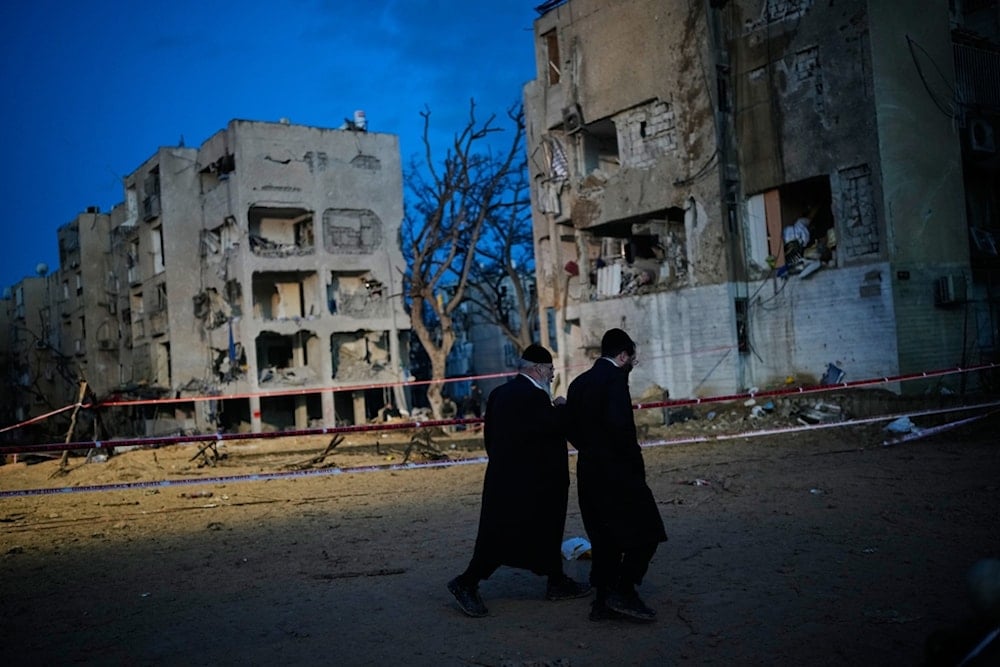
People look at residential buildings heavily damaged by an Iranian missile strike in Arad, southern occupied Palestine, Sunday, March 22, 2026. (AP)
Three weeks into the war on Iran, assessments of Tehran’s trajectory remain divided, with debates intensifying across Israeli media over whether the Islamic Republic is weakening or adapting to a prolonged war.
Within Israeli media discourse, early claims that Iran is "nearing collapse" have given way to more cautious evaluations, as analysts acknowledge the difficulty of drawing definitive conclusions during active warfare. Limited visibility into internal conditions in Iran, combined with ongoing military operations, has complicated predictions about the conflict’s duration and outcomes.
While initial confidence in decisive military gains was evident in the Israeli narrative, there is now growing discussion about the possibility of a drawn-out war of attrition. This has fueled concern that prolonged escalation could ultimately produce a more hardened regional environment rather than strategic breakthroughs.
Related: Iran 'setting pace' of the war, Israeli media admit
Iran’s strategic posture and missile capabilities
Despite sustained attacks, Iran has shown signs of resilience, with indications that it is using the war to reposition itself strategically rather than capitulate. Its missile capabilities have been targeted, including production chains, but assessments suggest that recovery remains possible depending on the extent of damage and remaining stockpiles.
Iran continues to demonstrate the capacity to sustain missile launches, indicating that its operational capabilities have not been eliminated.
The nuclear dimension remains part of the narrative, with Israeli analysts claiming that Iran could accelerate its program if critical infrastructure and stockpiles remain intact.
More: Iran fires missiles at 'Israel' as capabilities intact: Israeli media
Energy leverage and regional consequences
Energy markets have become a critical front in the war, with Iran’s geographic position and influence over key maritime routes, particularly the Strait of Hormuz, serving as a strategic lever. Disruptions to global energy flows and price volatility underscore the wider economic impact of the war, extending far beyond the immediate theater of operations.
Iran’s actions targeting energy infrastructure signal its willingness to sustain pressure on regional and global systems as part of its broader war strategy.
Israeli media affirm that as the war continues, neither rapid collapse nor immediate resolution appears likely. Instead, the situation points toward a prolonged confrontation shaped by military escalation, strategic calculation, and regional power dynamics, with consequences that extend well beyond the battlefield.
Read more: No restraint under attack, Tehran ready for all scenarios


