
No restraint under attack, Tehran ready for all scenarios: MFA
 3 Min Read
Iran says its strike on Dimona marks a shift in the balance of power, asserting its right to control the Strait of Hormuz as part of a broader defensive response to US-Israeli aggression.
-
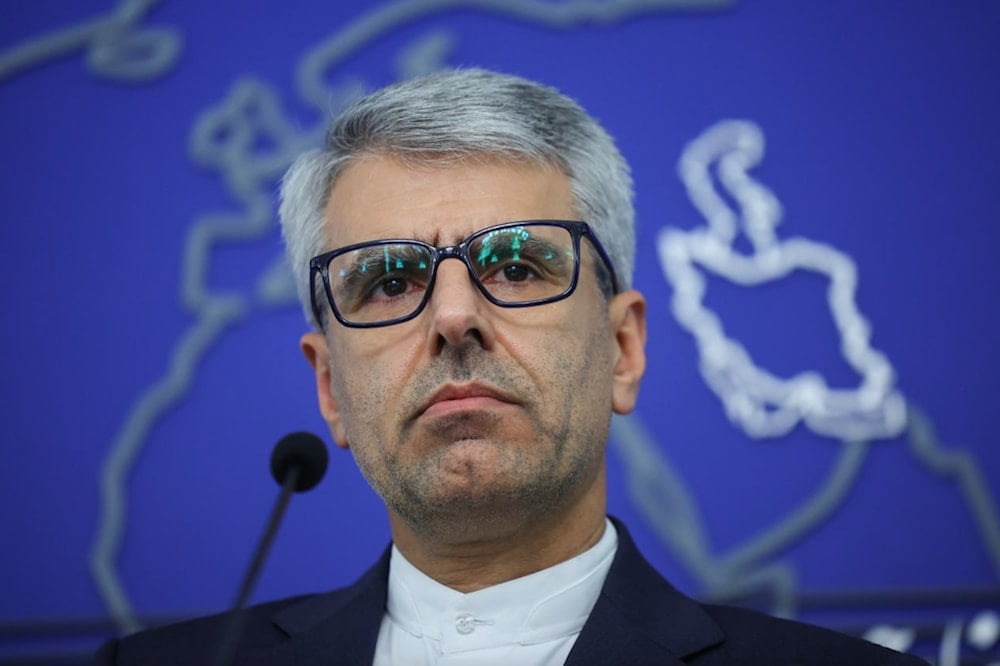
Spokesperson for the Iranian Foreign Ministry Esmail Baghaei during a press conference on April 23, 2025. (Iran Foreign Ministry)
Iran has made clear it will not stand idle in the face of ongoing US-Israeli aggression, asserting both its readiness for escalation and its right to respond.
In an interview with Sky News, Iranian Foreign Ministry spokesperson Esmail Baghaei said Tehran is “prepared for any scenario,” rejecting calls for restraint that would require Iran to stop responding to attacks. “Expecting restraint from Iran means expecting it to stop responding to aggression,” he stated. “No country in the world would remain silent in the face of such brutal attacks.” He stressed that Iran’s actions are strictly defensive.
His remarks come as Iran advances a new phase of operations under Operation True Promise 4, targeting strategic military infrastructure. Missile strikes have hit sites in Dimona in the southern occupied Palestinian territories, with dozens of injuries reported.
According to Iranian sources, the IRGC has targeted early warning radar systems linked to missile defense networks, along with US troop positions and satellite facilities. The use of coordinated missile waves points to a high level of precision and planning, disrupting key military capabilities.
Alaeddin Boroujerdi, a member of Iran’s Parliament National Security and Foreign Policy Committee, described last night's Dimona strike as a decisive moment. “The attack on Dimona has opened a new chapter in shifting the balance of power,” he said, noting that Iran’s ability to blind enemy radar systems demonstrates clear technological and strategic superiority.
Iranian officials also point to the broader implications of these developments, particularly in the Strait of Hormuz. Boroujerdi said that regulating traffic through the strait, including imposing transit fees reportedly reaching $2 million per vessel, reflects Iran’s strength and sovereign right to manage a critical international waterway.
Hormuz leverage reshapes power
The Strait of Hormuz remains a vital artery for global energy flows, accounting for roughly one-fifth of the world’s oil supply. Iranian officials maintain that it has not been closed, but rather disrupted as a direct result of the war initiated by Washington and “Israel.”
The late Secretary of Iran’s Supreme National Security Council, martyr Ali Larijani, had warned that the strait would either remain open to all or become a choke point for those pursuing war.
US officials, for their part, are attempting to avoid a prolonged disruption in the waterway, acknowledging that restoring normal conditions would be extremely difficult without de-escalation.
Efforts by US President Donald Trump to form a naval coalition have already faced European hesitation, amid concerns over being drawn into a wider confrontation with Tehran.
Read more: Iran leverages war to reshape region, energy power: INSS researcher


