
Iraq declares full exit of intl coalition forces from federal areas
 3 Min Read
Iraq confirms the complete withdrawal of International Coalition advisors from all official federal areas, marking a new phase in the Iraq-US security relationship and affirming the readiness of Iraqi forces to counter Daesh.
-
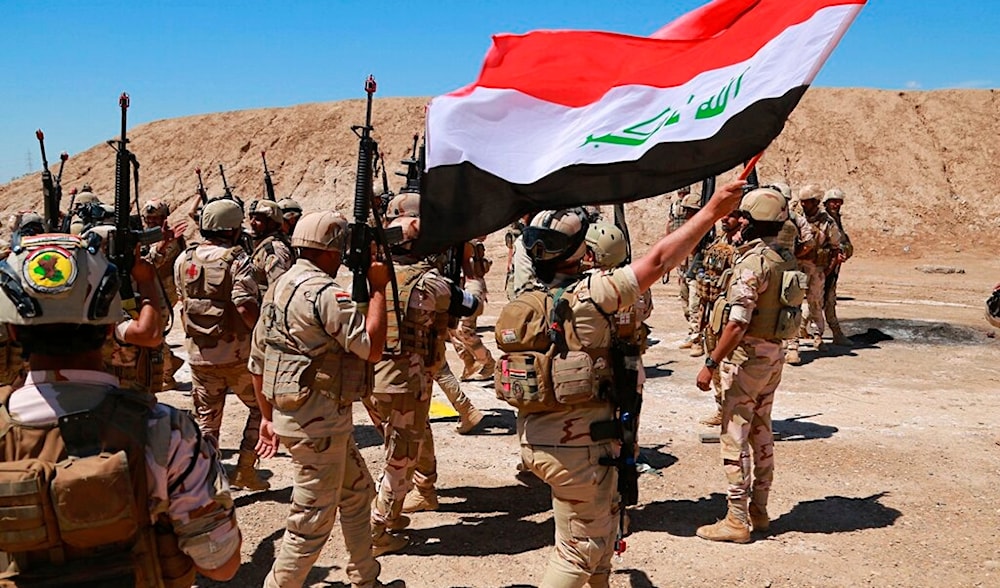
Iraqi soldiers chant slogans against ISIS while Australian and New Zealand coalition forces participate in a training mission with Iraqi army soldiers at Taji Base, north of Baghdad, Iraq, April 17, 2019 (AP)
The High Military Committee for Ending the Mission of the International Coalition in Iraq announced on Sunday the completion of the International Coalition's withdrawal from Iraq’s official federal areas, marking a significant transition in the country’s military and strategic landscape.
Earlier today, Iraqi officials announced that the Iraqi Armed Forces have fully assumed control of the Ain al-Assad air base in western Iraq following the complete withdrawal of United States forces.
According to a statement received by the Iraqi News Agency (INA), the Committee declared that all military bases and command headquarters in Iraq’s federal areas are now free of International Coalition advisors. The final remaining personnel departed from Ain al-Asad Airbase and the Joint Operations Command headquarters, both of which are now under full control of Iraqi security forces.
“In accordance with the Iraqi government statement issued on September 27th, 2024... we proudly announce today the completion of the evacuation of all military bases and command headquarters in official federal areas of Iraq from advisors of the International Coalition to Defeat Daesh in Iraq,” the Committee stated.
Transition to bilateral Iraq-US security ties
Washington and Baghdad agreed in 2024 to wind down the US-led coalition in Iraq by September 2025, with US forces departing bases where they had been stationed. The agreement came after dozens of operations launched by Iraqi Resistance factions, who reject the presence of foreign military forces in the country.
US forces in Ain al-Assad were a main target of these operations, which were executed via one-way attack drones and rockets. The Committee emphasized that the end of the coalition’s mission in federal Iraq marks the beginning of a bilateral phase focused on defense cooperation.
“This will focus on activating the memoranda of understanding for military cooperation and developing the capabilities of our armed forces in the areas of equipment, armament, training, exercises, maneuvers, and joint operations,” the statement noted.
Iraqi Armed Forces assert full readiness against daesh
The Committee praised the Iraqi armed forces' readiness and their growing capabilities to maintain security across the country without foreign assistance.
“Our armed forces, in all their branches and formations, now possess the will and full capabilities to extend security throughout the entire country,” the statement read. “We affirm to the world that Daesh no longer poses a strategic threat and that our forces are fully capable of preventing its re-emergence in Iraq or its infiltration across the borders.”
Continued regional coordination on Syrian file
The Committee also addressed the next phase of the coalition’s efforts in the region, stating that the second phase of the international coalition’s mission to combat Daesh in Syria has begun. While the coalition will no longer be stationed in federal Iraq, coordination will continue from the airbase in Erbil to ensure that remaining ISIS elements in Syria do not endanger Iraq’s national security.
Joint operations with the United States will still be launched from Ain al-Assad Airbase when necessary, in alignment with regional objectives.
Read more: Iraqi resistance urges next government to end foreign presence


