
Iraqi Air Force conducts missions independently: Commander
 7 Min Read
The Iraqi Air Force Commander says Iraq's air missions are conducted independently, while the country expands its F-16 capabilities and negotiates for Rafale aircraft.
-
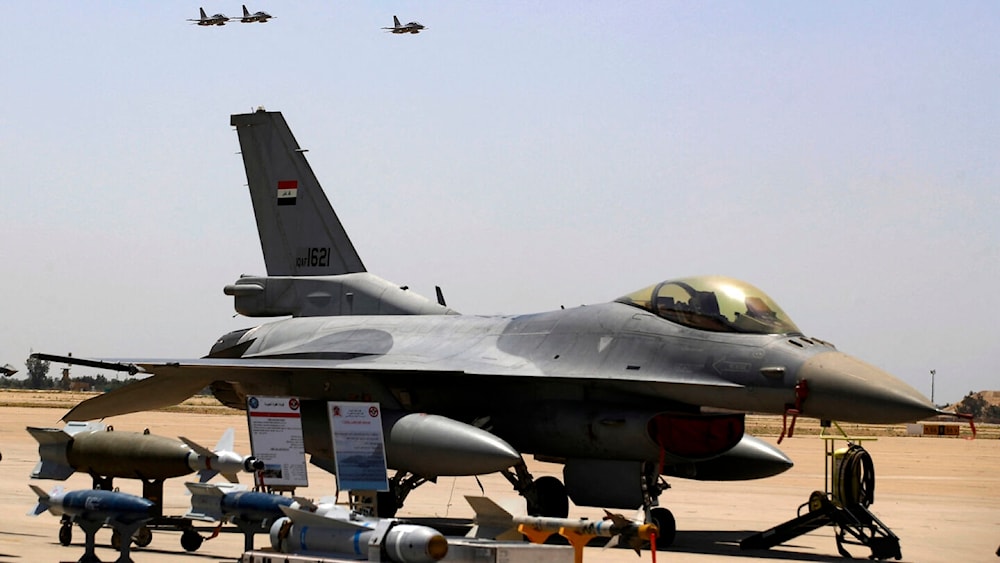
An Iraqi Air Force F-16 fighter aircraft is displayed during an air show at the Balad Air Base north of Baghdad on April 24, 2024 (AFP)
All missions conducted by the Iraqi Air Force within Iraqi territory are carried out with complete independence from the forces of the international coalition, Iraqi Air Force Commander Lieutenant General Pilot Khalid al-Tamimi said on Monday.
In an interview for the Iraqi News Agency, Lt. Gen. al-Tamimi said the Air Force continues to develop its capabilities and build its air system.
"The Air Force was established on April 22, 1931, and its armament underwent development in accordance with the political relations between Iraq and countries around the world. After 2003, its activities came to a halt before it was rebuilt and the Martyr Mohammed Alaa Air Base, formerly known as Al-Muthanna Air Base, was reopened," he stated.
The military commander added, "Iraq began contracting for modern and advanced aircraft, including F-16s from the United States, T-50s and L-159s, followed by Sukhoi aircraft from Russia. During the war against ISIS gangs, the Air Force began to expand and air bases were opened, enabling it to monitor Iraq's skies and territory through advanced reconnaissance aircraft."
Recalling the war on ISIS, al-Tamimi reported that "the Air Force carried out 58,822 missions, including transport, reconnaissance, and other operations."
According to the commander, the Iraqi Air Force "destroyed a very large number of ISIS targets and played a major role in supporting ground forces," adding, "The air forces consist of the Air Force, Air Defense and Army Aviation, and these three forces operate with a high level of coordination."
All missions currently carried out solely by Iraqi Air Force
Regarding the independence of its missions, the Air Force Commander stressed that all missions currently carried out by the Air Force are independent of the coalition forces, and there is no direct support from them.
"We have highly advanced aircraft, including F-16s, T-50s, and L-159s, which is a ground-attack aircraft, in addition to Cessna aircraft for armed reconnaissance and drones that have replaced coalition aircraft. They are 100 percent Iraqi, and there is no coalition-affiliated expert," al-Tamimi said.
He explained that there is a distinction between coalition forces and companies that provide technical services. "These companies are present in all countries around the world and operate for a fee. We are moving toward building an integrated system through workshops, factories and warehouses," he said.
The commander stressed that there have been no coalition forces carrying out any missions inside Iraqi territory from the beginning of 2026 until now.
On airspace coverage, the Lieutenant General said, "We have an air defense system that provides radar coverage for all Iraqi territory, and we have multi-role aircraft, namely F-16s, which can fly for air defense and ground-attack missions. I confirm that F-16 aircraft have carried out missions for more than 10 days and are still continuing without any intervention other than that of the Commander-in-Chief's Office, and the pilots are Iraqi."
He denied reports of US personnel performing maintenance of the aircraft, affirming that all maintenance carried out on F-16 aircraft is performed by 100 percent Iraqi personnel. "The engineers who arrived in 2004 have now reached the rank of brigadier general and received training outside Iraq," he said.
Al-Tamimi added that a certain level of engine repairs is carried out by the global company Pratt & Whitney, but that Iraq also carries out some engine repairs itself.
Expansion plans, daily surveillance, and the terrorism threat
Al-Tamimi noted that the national vision stems from the National Security Strategy, which calls for continuing to build the Air Force. "We aspire for it to become larger and to hold a distinguished position in the region," he said.
The commander affirmed that Iraq conducts a complete daily aerial survey of all of Iraq. "Iraq is divided into sectors, and each aircraft surveys a specific area and submits its reports to the Commander-in-Chief's Office through the Army Chief of Staff," he said.
Al-Tamimi explained that minor security breaches may occur, but they are under control, and any incident reported is dealt with within hours. "There are still sleeper cells in remote and rugged areas; nevertheless, we continue to carry out actual missions," he said.
"The terrorist threat is currently very limited, thanks to citizens' vigilance and the tools at our disposal," al-Tamimi said.
The commander revealed that Iraq is holding negotiations with other countries to acquire advanced aircraft such as the Rafale. "Training a pilot can take up to five years, and we do not want to bring in aircraft and simply accumulate them without a well-calculated plan," he said.
Iraq at the beginning of local manufacturing of drones
Regarding drones, al-Tamimi said there are efforts toward local manufacturing, and there is an idea to establish a command for this type of weapon. "We are still at the beginning, and we have advanced drones distributed among the weapons commands and brought together at the Commander-in-Chief's Office through the Targeting Cell," he said.
The commander stressed that Iraq does not need coordination with neighboring countries because its missions are internal, except for transport missions using C-130 aircraft, which are carried out through diplomatic correspondence via the Foreign Ministry.
Al-Tamimi noted that on April 22, 2025, Iraq conducted a highly advanced exercise at Balad Air Base, in which France, Italy, the United States and Jordan participated. "An exercise was scheduled to be held in France this year but was postponed due to the war in the region. F-16 aircraft will cross eight countries to participate in it, while Rafale aircraft based in Jordan take off and participate with us in monthly exercises," he said.
Rafale negotiations and integrated air defense system
Regarding the Rafale, al-Tamimi explained that there are advanced negotiations to acquire this highly sophisticated aircraft. "The initial batch under negotiation consists of 14 aircraft. They are extremely valuable and very expensive compared with the F-16, while also being newer and more advanced," he said.
The commander explained that the air forces comprise the Air Force, Air Defense, and Army Aviation. "Air Defense detects hostile targets, and there are procedures covering 10 nautical miles before the neighboring country's border and 10 nautical miles on our side. Once an aircraft crosses that point, we consider it to have entered our territory, and interrogation and the initial warning are issued by Air Defense, while the response is carried out by Air Force aircraft," he said.
"We have armed air-to-air aircraft on a daily basis that are ready, and the pilots are at their stations and prepared to respond at any moment," al-Tamimi added.
Regarding the shelling of one of the bases in Baghdad, al-Tamimi said, "Unfortunately, a missile struck an Antonov transport aircraft, causing it to catch fire and rendering it out of service. The cost of repairing it was higher than its purchase price, so we decided to decommission it. The loss of the aircraft is significant and cannot be easily compensated for."
In conclusion, the commander said, "No matter how far we advance, we must keep pace with developments through conferences and by sending pilots to advanced training courses. We have a fully equipped Air Force College, with instructors trained on F-16 aircraft."


