IRGC launches wave 51 of Operation True Promise 4, targeting US bases
 5 Min Read
IRGC fires missiles at al-Kharg base in wave 51 of Operation True Promise 4, reaffirming that Iran would continue to defend itself and its stability against US forces.
-
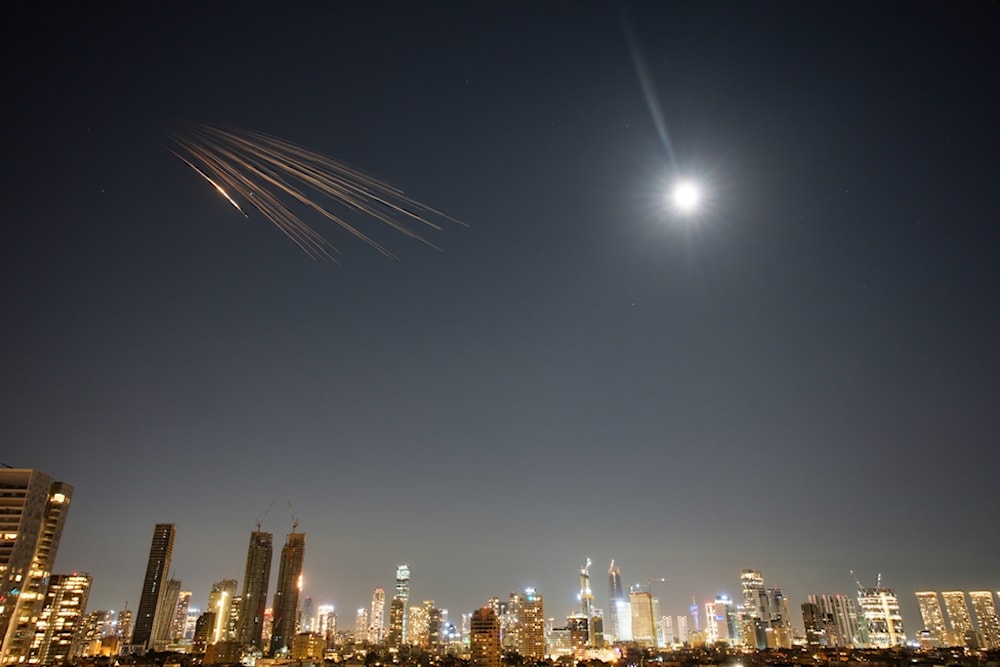
Missiles launched from Iran streak across the sky over central occupied Palestine, Thursday, March 5, 2026 (AP)
Iran's Islamic Revolution Guard Corps (IRGC) announced on Saturday the launch of wave 51 of Operation True Promise 4, under the banner of "O Ali ibn Musa al-Rida."
The operation involved a combination of liquid- and solid-fueled missiles targeting U.S. forces at al-Kharg base, identified as a key hub for American military operations against Iran. The base houses F-35 and F-16 fighter jets, aerial refueling aircraft, and the main early-warning AWACS planes.
The IRGC dedicated this wave to the memory of the late General Abu al-Qasim Babaeian, the head of the military office of the Iranian Leader, and his wife.
This follows wave 50 of the same operation, which targeted six US installations across Al Dhafra, Fujairah, Jufair, the Fifth Fleet, Ali Al Salem, and al-Azraq bases.
Iranian Foreign Minister Abbas Araghchi emphasized that the country will continue to defend itself until the risk of war is eliminated, asserting that Iran remains stable and resilient despite foreign attacks.
US air defense systems, radars under fire
Earlier today, the Islamic Revolution Guard Corps' Public Relations Department said the IRGC naval forces launched three waves of attacks at dawn, targeting “American terrorist bases in the region” with “dense and simultaneous missile fire and drones.”
Al-Dhafra
The attacks targeted Al-Dhafra Airbase, asserting that Iranian forces struck Patriot radar systems, the control tower, and air defense depots using “powerful strikes from one-way drones and precision-guided ballistic missiles.”
Sheikh Isa
According to the statement, the IRGC also struck Sheikh Isa Air Base, asserting that early-warning radar systems, aircraft hangars, the central platform, and US aircraft fuel tanks were destroyed in the attack.
Al-Udairi
The statement further reported that Iranian forces targeted Al-Udairi Base in Kuwait, in which equipment depots, helicopter storage facilities, and gathering points of US forces were destroyed.
Separately, the IRGC warned that the Strait of Hormuz is under its “full and precise control,” adding that oil tankers and commercial vessels belonging to “aggressors and their allies” would not be allowed to pass and would be targeted if they attempted to do so.
'Israel' running low on interceptors
"Israel" has informed the United States that its reserves of ballistic missile interceptors are nearing "critically low" levels as the war on Iran intensifies, according to US officials cited by Semafor.
Israeli authorities reportedly warned Washington that sustained Iranian missile attacks are placing increasing pressure on the entity's air defense network, particularly the systems designed to intercept long-range ballistic missiles. "Israel" is believed to have entered the current war already short on some interceptor supplies after expending significant quantities during last year's aggression.
US officials acknowledged that the shortage was anticipated. “It’s something we expected and anticipated,” one official said.
The Israeli air defense architecture relies on several systems operating at different ranges. While Iron Dome is designed primarily to intercept short-range rockets, long-range threats are countered by systems such as Arrow, which can intercept ballistic missiles outside the atmosphere.
These interceptors are technologically sophisticated but extremely expensive and produced in limited quantities. Analysts estimate that each Arrow interceptor can cost several million dollars and requires lengthy manufacturing cycles.
Iran missile attrition strategy
The pressure on "Israel’s" defenses comes amid a broader dynamic that analysts describe as a war of attrition between Iranian offensive capabilities and the interceptor inventories of the United States and its proxies.
Some experts note that the balance between offense and defense is inherently uneven. Iranian missiles can cost a few hundred thousand dollars to produce, while the interceptors used to destroy them may cost several million dollars each. This disparity means that large missile barrages can quickly force defenders to expend expensive defensive munitions faster than they can be replaced.
At the same time, Iran’s missile production capacity is believed to significantly exceed the rate at which interceptor missiles are manufactured by "Israel" and the United States. Analysts estimate that Iran may produce dozens of ballistic missiles each month, while only a handful of advanced interceptors can be produced during the same period.
This imbalance has led some analysts to argue that Tehran may be pursuing a deliberate strategy of attrition aimed at exhausting the defensive “magazine depth” of its adversaries. Western military experts have increasingly framed the confrontation as a race between Iranian missile production and the available supply of US and Israeli interceptor systems.