
IRGC Navy: Foreign powers have no stake in Strait of Hormuz
 2 Min Read
IRGC Navy warns that US interference in Strait of Hormuz shipping routes will disrupt reopening efforts.
-
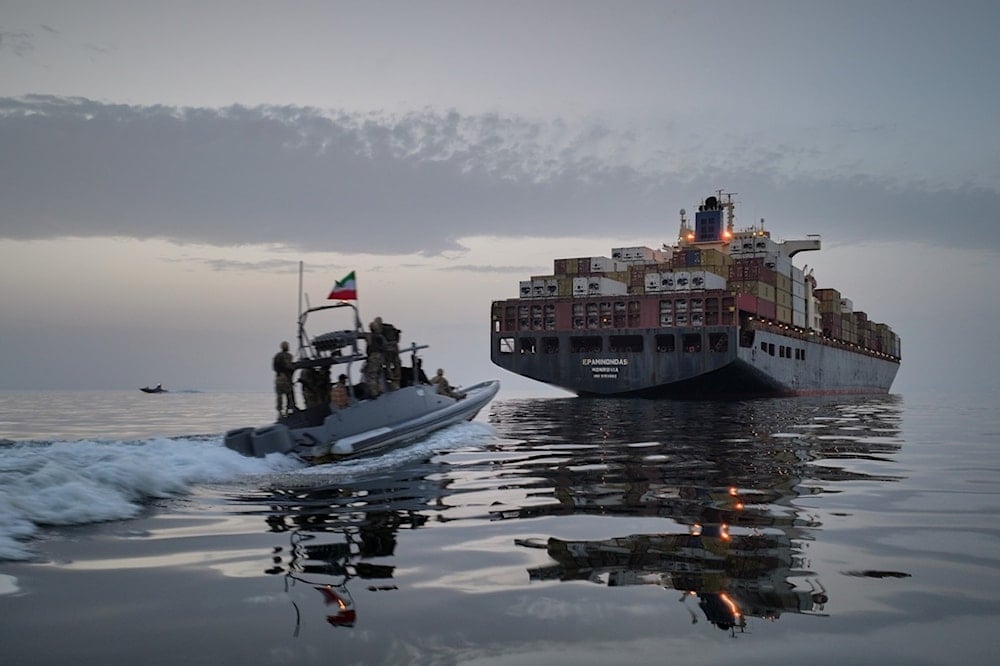
An IRGC speedboat approaches the cargo ship Epaminondas during an operation to seize two vessels that violated conditions placed in the Strait of Hormuz, April 21, 2026 (Meysam Mirzadeh/Tasnim News Agency via AP)
The Islamic Revolution Guard Corps Navy reaffirmed that "foreign powers have no stake in this land or in the Strait of Hormuz," warning that "the US military's adventurism and interference in determining shipping routes will cause serious disruption to the process of reopening the strait."
The IRGC Navy added that "the US military's adventurism will place the interests of countries that benefit from the Strait of Hormuz in real danger."
It further stressed that "the outcome of battle is not determined by the abundance of weapons, but by the strength of faith."
As millions gathered in #Mashhad, Iran, to bid farewell to Martyr Sayyed Ali Khamenei, mourners carried messages reflecting their grief, anger, and demand for justice.
— Al Mayadeen English (@MayadeenEnglish) July 9, 2026
Among the banners raised through the streets were red flags symbolizing vengeance, alongside signs displaying… pic.twitter.com/tbuc3k86cZ
Ship movement through Hormuz plunges
Maritime traffic through the Strait of Hormuz has largely ground to a halt as the US resumed its aggression against Iran for a second consecutive day, unraveling the ceasefire that had been in place.
Vessel tracking data showed that most ship movements were concentrated along the Iran-approved route on the northern side of the waterway, while the US-backed shipping lane sat largely empty.
Only a handful of large vessels, including a US-sanctioned crude carrier and an Iranian-flagged container ship, were observed crossing.
A growing number of tankers have also been transiting with their transponders switched off, a practice that resumed after three tankers were struck earlier in the week, as vessels attempt to avoid detection amid the heightened risk of Iranian retaliation.
Accordingly, an Iranian security source confirmed to Al Mayadeen that Tehran would respond immediately and on a wider scale to any further US attacks, noting that Iran had already made its position clear ahead of the latest escalation, and that higher oil prices resulting from the aggression would not trouble Tehran.
The US aggression, described as the largest since the signing of the memorandum of understanding, attacked five Iranian provinces over two days, killing 14 people and wounding 78 others, according to Iran's Ministry of Health.
In response, Iran struck US military targets in Kuwait, Qatar, and Bahrain, including Patriot systems, early warning sites, and fuel storage facilities, vowing to continue "with full force."
Released footage documents the Iranian preparations and launches in response to the ongoing US aggression against Iran.#Iran #WarOnIran #UnitedStates #AlMayadeen pic.twitter.com/0OQTIOK9IM
— Al Mayadeen English (@MayadeenEnglish) July 9, 2026


