
IRGC Navy: Security of Hormuz Strait contingent on Tehran decisions
 3 Min Read
A senior IRGC official says Tehran possesses capabilities that will be revealed “at the appropriate time."
-
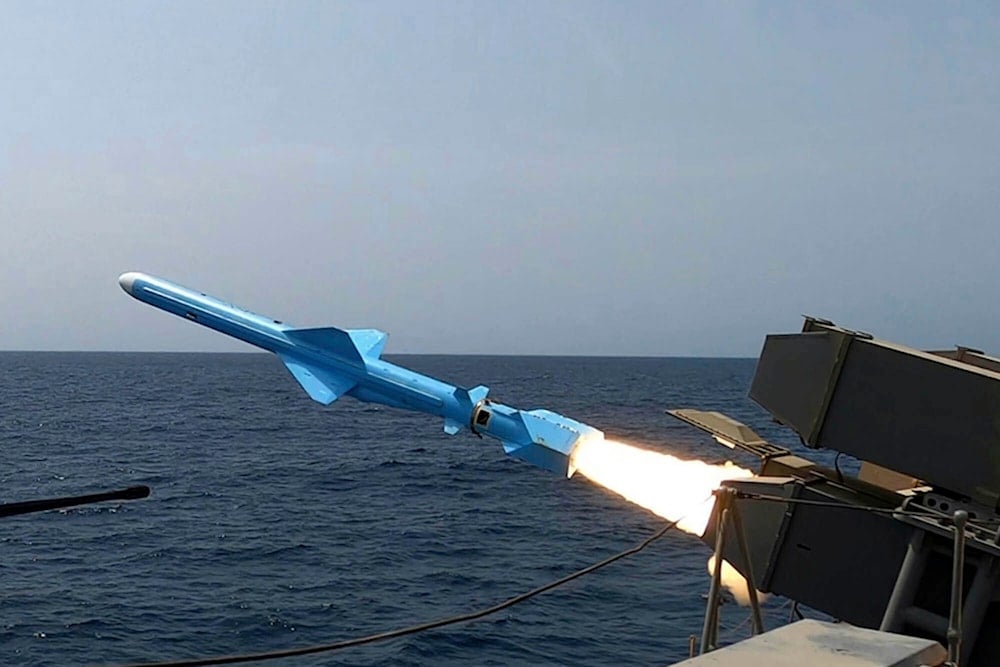
In this picture released by the official website of the Iranian Army on Thursday, Aug. 21, 2025, a missile is fired from a vessel during an Iranian Navy drill in the Gulf of Oman and the Indian Ocean (AP)
Tehran possesses capabilities that will be revealed “at the appropriate time”, a senior IRGC official revealed on Tuesday, while stressing that the security of the strategic Strait of Hormuz is tied to Iranian decisions.
Mohammad Akbarzadeh, political deputy of the IRGC naval forces, said Iran views neighboring countries as friends, but warned that any use of their land, airspace, or waters against Iran would render them hostile parties.
He added that the security of the Strait of Hormuz, one of the world’s most critical energy corridors, is contingent upon decisions taken by Tehran.
Separately, Iranian Intelligence Minister Esmaeil Khatib said Iran has faced numerous plots aimed at undermining national unity and weakening the country, “but they have failed.”
“No threat can shake the unity of the Iranian people,” Khatib said, adding that “the national unity of the Iranian people is the foundation of steadfastness and resistance in the face of every threat.”
Iranian intelligence announces arrests, weapons seizures
Meanwhile, Iran’s General Directorate of Intelligence in Semnan province, northeast of the country, announced on Tuesday the arrest of 80 rioters.
The agency said it seized more than 100 firearms of various types, along with several bladed weapons and Molotov cocktails.
Meanwhile, Iran’s police command in the city of Rezvanshahr, in the northern province of Gilan, said it arrested 104 individuals accused of stirring unrest in the city.
The arrests follow earlier announcements by Iranian authorities that 249 armed rioters were detained in the provinces of Yazd and Gilan two days prior. Tehran said those elements were linked to external actors, including "Israel’s" Mossad and the United States, which it accused of seeking to destabilize the country.
Trump sends 'armada' to Iran
This comes soon after US President Donald Trump confirmed that a significant deployment of American military forces is heading toward Iran, while claiming in an interview for Axios published on January 27 that Tehran “wants a deal.”
Trump’s remarks come amid reports that the USS Abraham Lincoln aircraft carrier strike group has arrived in the region, accompanied by F-15 and F-35 fighter jets, refueling tankers, and air defense systems. The deployment, viewed as a direct show of force, further escalates Washington’s aggressive posture toward Tehran.
“We have a big armada next to Iran. Bigger than Venezuela,” Trump said, without specifying what military options are on the table. According to Axios, the White House continues to threaten military action against Iran, while openly entertaining the possibility of regime change in Iran.
“They want to make a deal. I know so. They called on numerous occasions,” Trump claimed, without offering any confirmation from Iranian sources. Trump’s comments reflect the contradictions in US rhetoric, combining threats of overwhelming military force with vague claims of diplomatic outreach.


