
IRGC Navy strikes 3 tankers, 3 US vessels in response to US assault
 4 Min Read
The IRGC Navy says it struck three tankers and three US vessels in retaliation for Washington's attacks on Iranian oil tankers.
-
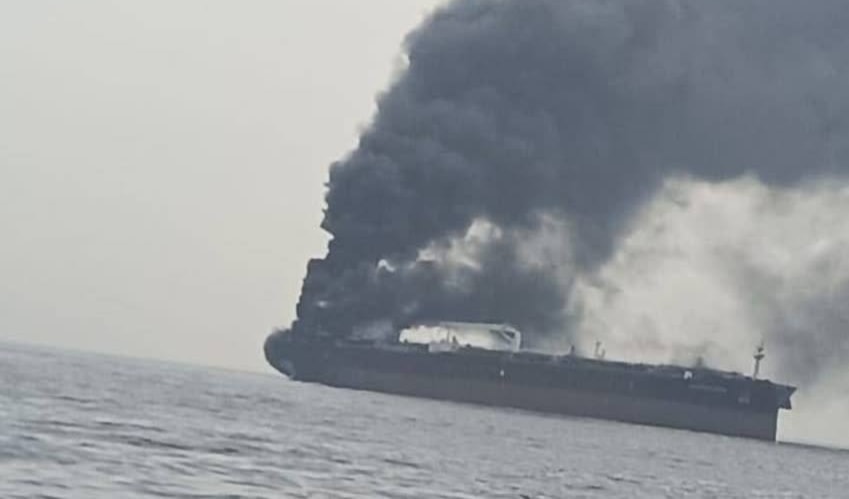
An oil tanker burns at sea in an image circulated following the IRGC’s announcement that it targeted three tankers in retaliation for US attacks on Iranian vessels (Social media)
Iran’s Islamic Revolution Guard Corps (IRGC) Navy (IRGC-N) said Saturday it retaliated against Washington’s attacks on Iranian oil tankers by targeting three tankers transiting an unauthorized route through the Strait of Hormuz, as Tehran warned that attempts to circumvent its maritime restrictions would face military action.
The IRGC-N also announced that it struck three US vessels belonging to the "child-killing America" elsewhere.
The Iranian force said the retaliation followed attacks carried out earlier in the day by the US military against three crude oil tankers belonging to the Islamic Republic, marking another sharp escalation in Washington’s military and economic campaign against Iran.
We just struck six American affiliated tankers and ships in response to their attack on three Iranian ships in the Strait of Hormuz.
— IRAN Monitor (@IRI_Monitor) September 5, 2026
We can keep this up for A LONG TIME! pic.twitter.com/JrCWqbWUyK
IRGC-N warns violating vessels
Issuing a direct warning to vessels in the Strait of Hormuz and the Gulf, the IRGC Navy urged commercial operators not to be "deceived by the US terrorist military" and cautioned all ships to strictly avoid crossing unauthorized waterways or face immediate targeting.
"Avoid crossing unauthorized waterways, or you will become targets," it tersely warned.
The latest announcement signals a widening Iranian response as Washington intensifies attacks on the Islamic Republic’s commercial oil fleet while maintaining a naval blockade aimed at choking off the country's energy exports.
The US military has independently acknowledged attacking three Iranian crude tankers on Saturday. CENTCOM claimed two were permanently disabled and a third was destroyed.
“Let the message to the IRGC be clear: If you shoot at two of our ships, we will impose an even higher economic cost —taking out three of yours. We will not hesitate to defend American forces, and if necessary, destroy Iran’s limited and exposed oil fleet.” — Adm. Brad Cooper,… pic.twitter.com/UGGcSGsUtd
— U.S. Central Command (@CENTCOM) September 5, 2026
Khatam al-Anbiya warns US warships of heavier strikes
The IRGC announcement came alongside an even broader warning from Iran’s Khatam al-Anbiya Central Headquarters, which said continued US attacks, interference with Iranian shipping, and enforcement of the naval blockade would expose American warships to increasingly severe retaliation.
Lieutenant Colonel Ebrahim Zolfaqari, spokesperson for the HQ, warned that Iran's Armed Forces were prepared to expand their operations should Washington persist in attempts to undermine Iranian maritime trade.
“We warn the terrorist US military that if it continues its hostile actions, creates insecurity, harasses Iranian vessels, and imposes a naval blockade on Iran, the strikes carried out by the Armed Forces of the Islamic Republic of Iran against US warships in the region will be more severe than before and could also expand in scope,” the headquarters spokesperson said.
Tehran condemns US 'economic war'
Iran’s Foreign Ministry strongly condemned the tanker strikes, placing them within Washington's wider naval blockade, economic warfare, and military aggression against the Islamic Republic.
“These illegal and aggressive actions, carried out in continuation of the US military aggression against Iran and as part of its naval blockade and economic war against our homeland, constitute a clear violation of Article 2, Paragraph 4 of the UN Charter, a war crime, and a clear threat to international peace and the security of commercial shipping,” the Ministry said.
Tehran stressed that it would continue defending Iranian territory, commercial vessels, and economic interests rather than submit to Washington's attempts to cut the country off from international energy markets.
The Ministry reaffirmed Iran’s determination to “firmly defend its sovereignty and national interests” against what it described as US “state terrorism and aggressive actions.”
It identified those actions as including “the continued naval blockade and economic war, as well as attacks on commercial vessels.”
Tehran also held Washington and states assisting its military campaign responsible for the consequences of further escalation.
Washington seeks to choke Iranian oil exports
Saturday's attacks come amid the US naval blockade targeting Iranian oil exports, which has turned the Strait of Hormuz and surrounding waters into a central front of the war.
Washington initially imposed maritime restrictions before briefly easing them during diplomatic efforts, then restored the blockade in July, sharply constraining Iran-linked shipping around the Gulf of Oman and Hormuz.
Reuters reported that Iranian crude loadings fell from roughly two million barrels per day in March to around 240,000 in August. Tehran, however, says exports and revenues have not stopped, with Central Bank officials reporting continued inflows and around $9 billion in oil revenues made available since the beginning of the year.
Iran argues that the maritime confrontation is inseparable from Washington's wider economic war, warning that US forces cannot enforce a blockade, interfere with commercial vessels and strike Iranian energy assets while expecting their own warships to remain beyond retaliation.
Read more: Hormuz under full Iranian control, US claims false: Khatam al-Anbiya


