
IRGC strikes US bases under Operation True Promise 4
 5 Min Read
The IRGC said its Operation “True Promise 4” targeted US and Israeli sites across West Asia, anouncing hundreds of American casualties.
-
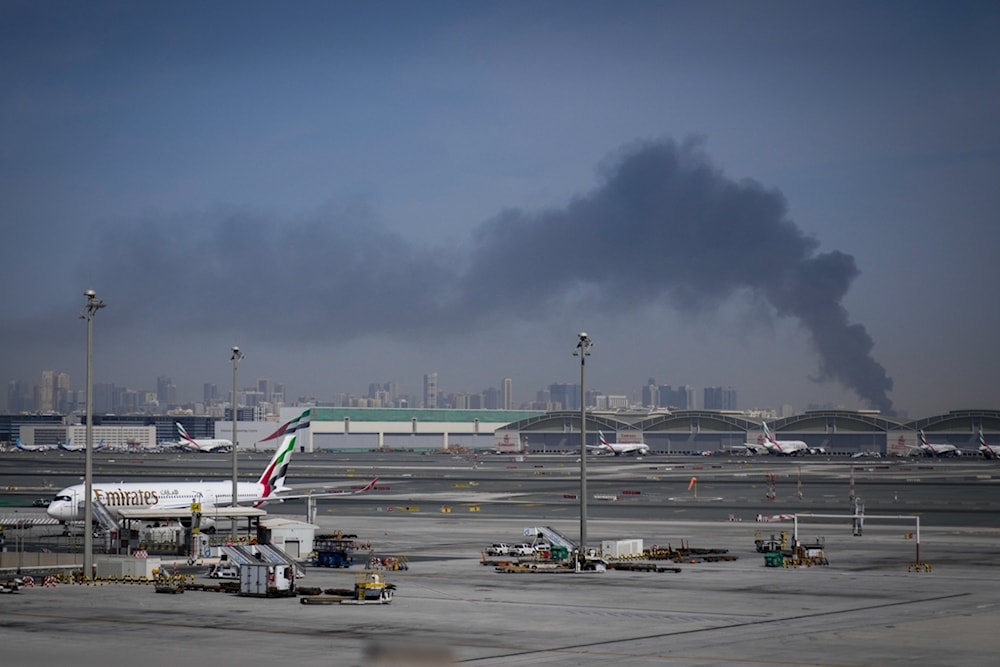
A plume of smoke caused by an Iranian strike is seen in the background as Emirates planes are parked at Dubai International Airport after its closure in Dubai, United Arab Emirates, Sunday, March 1, 2026 (AP)
Iran’s Islamic Revolution Guard Corps (IRGC) Public Relations announced on Sunday that IRGC strikes across US bases in several West Asian countries resulted in the killing and injury of around 560 American service members, according to statement No. 8 of Operation “True Promise 4.”
The statement said the seventh and eighth waves of the operation targeted US and Israeli sites as part of the continued response to the US–Israeli aggression against Iran.
It added that the ongoing sound of sirens and ambulance movements inside US and Israeli bases, based on field and intelligence monitoring, reflects confusion and psychological strain among American troops and Israeli settlers, stressing that “military pressure will continue to further tighten the noose around them.”
The IRGC affirmed that Iranian missile and drone strikes are ongoing in a comprehensive and continuous manner, noting that the Iranian public will be updated on the results and what it described as the armed forces’ “offensive achievements.”
CENTCOM acknowledges American casualties
US Central Command (CENTCOM) acknowledged the deaths of three American soldiers and injuries to others as a result of Iranian strikes on US military bases in West Asia.
The IRGC statement maintained that operations remain ongoing under Operation True Promise 4.
US bases in Kuwait and Bahrain targeted
According to the statement, the US Ali Al Salem Air Base in Kuwait has been rendered out of service following recent Iranian strikes. It added that three maritime infrastructure facilities at Mohammed Al-Ahmad Base in Kuwait were destroyed.
In Bahrain, the US naval base at Mina Salman port was reportedly hit by four drones, causing significant damage to command and support centers.
The residence of US military personnel in Bahrain was also targeted by two ballistic missiles, amid reports of successive strikes on other US bases in West Asia.
The IRGC further announced that three US and UK-affiliated oil tankers in the Gulf and the Strait of Hormuz were struck by missiles, leading to fires onboard.
The statement additionally said the US aircraft carrier USS Abraham Lincoln was targeted with four ballistic missiles in what it described as a concentrated attack.
The IRGC reiterated that missile and drone operations will continue as part of Operation True Promise 4, framing the campaign as an ongoing response to US and Israeli actions in the region.
Baghaei: “This is not Iran’s war but a war on Iran”
In parallel with the ongoing IRGC strikes on US bases under Operation “True Promise 4,” Iranian Foreign Ministry spokesperson Esmail Baghaei told Al Mayadeen that the confrontation was externally imposed on Tehran.
Baghaei described the assassination of Sayyed Ali Khamenei as “an international crime” and a turning point for West Asia, warning that it represents a dangerous escalation that could inflame broader religious and regional tensions. He stressed that the Leader of the Islamic Republic “was not an ordinary leader nor merely a religious authority,” but a central figure whose influence extended beyond Iran’s borders.
Rejecting claims that Iran’s political system is personality-driven, Baghaei asserted that the Islamic Republic remains institutional in nature. “This is not Iran’s war but a war on Iran,” he said, describing the conflict as decisive for the entire West Asia region.
He added that the aggression against Iran began just two days before a scheduled nuclear session in Vienna between Tehran and Washington, arguing that negotiations were used as a pretext for escalation.
Iran mobilizes full defensive capabilities
Addressing Iran’s military response, Baghaei said the country is mobilizing all its capabilities to defend its sovereignty, people, and territory. “Our forces decide what to use and what to target,” he stated, emphasizing that defensive decisions rest fully with Iran’s armed forces.
He further noted that the Zionist enemy succeeded in drawing the Americans into the war, while underscoring that Iran’s targeting of US bases in the region is not directed against the sovereignties of host countries but framed as self-defense against enemy military infrastructure.
Baghaei reiterated that Iran values regional states and considers Gulf countries friendly nations, stressing that Tehran seeks good neighborly relations and has no issue with the peoples of the region.
Regional stability and international accountability
Calling on Muslim and Arab peoples to recognize aggression against Iran, Baghaei urged countries that prioritize international peace and security to condemn the attacks.
“I say to Muslim and Arab peoples that you have witnessed the aggression. We consider all countries our friends, and were it not for the enemies, everyone would live in peace,” he said.
Baghaei concluded that Iran’s current defense posture extends beyond national considerations, arguing that the outcome of the confrontation will shape the future of West Asia as a whole.
Read More: Regional US bases targets for Iran, not host countries: Larijani


