
IRGC turns back 3 ships at Hormuz, cautions civilians in Gulf
 3 Min Read
The IRGC intercepted three container ships attempting to cross the Strait of Hormuz on Friday and issued a separate warning urging civilians in Gulf states to vacate areas where US forces are stationed.
-
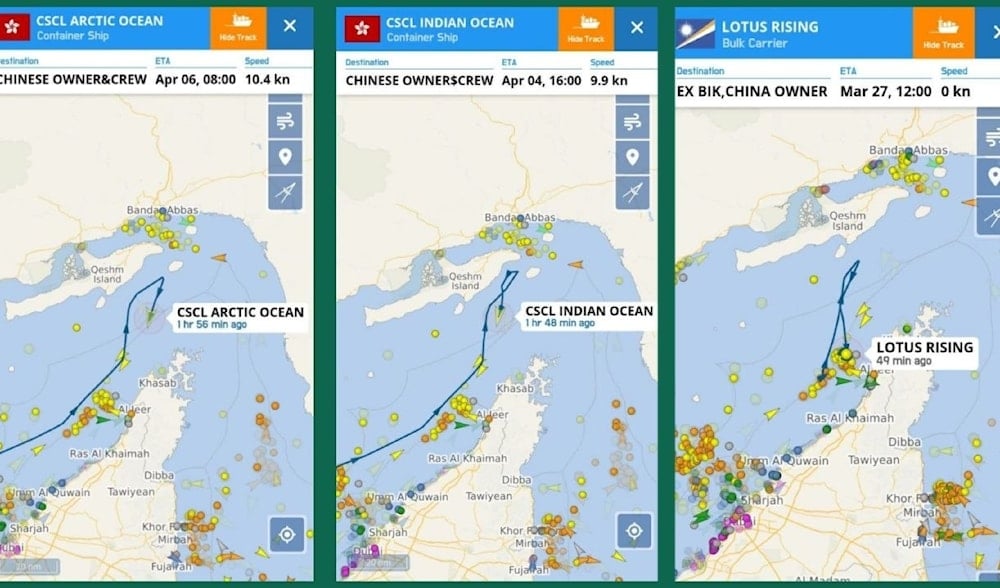
Vessel tracking screenshots show the CSCL Arctic Ocean, CSCL Indian Ocean, and Lotus Rising — the three ships intercepted by the IRGC Navy while attempting to cross the Strait of Hormuz on Friday, 27 March 2026. (Mizan via IRGC)
The Islamic Revolution Guards Corps (IRGC) has issued a stark warning to ships attempting to pass the Hormuz Strait, prohibiting the transit of any vessel heading to or from ports allied with the United States and "Israel," regardless of the ship's destination or the corridor used.
The IRGC's Public Relations Department said that three container ships of different nationalities attempted to enter the designated corridor for authorized vessel traffic on Friday morning, following false claims by US President Donald Trump that the waterway was open.
The vessels were intercepted and turned back after receiving warnings from the IRGC Navy.
"The passage of any vessel to or from ports belonging to allies and supporters of the Zionist-American enemies is prohibited, regardless of destination or corridor," the statement read.
The IRGC Navy reiterated that the Strait of Hormuz remains closed, warning that any attempt to cross it will be met with a firm response.
The warning came as Trump, who has repeatedly contradicted himself on the status of the strait, told reporters recently that the United States is effectively immune to Hormuz disruptions due to domestic energy production.
Hormuz 'indicator' of changing balance of power
In another statement, the IRGC said that the Strait of Hormuz today serves as an “indicator” of the changing balance of power, criticizing US President Donald Trump’s approach, stating that he “wants to use pressure to restore the reality established on the ground, but history does not go backward.”
It added that the military impasse faced by the Americans in this sensitive area underscores "a single truth: the key to the security of this vital waterway will remain in Iran’s hands."
IRGC asks civilians to vacate areas hosting US forces
In a separate statement, issued as Statement No. 48 of Operation True Promise 4, the IRGC urged residents across the Gulf to immediately leave areas where US forces are stationed, warning that US and Israeli forces are using civilian areas as human shields.
"We strongly advise that you immediately leave areas where US forces are stationed, so that you do not come to harm," the statement read.
The IRGC said it considers the elimination of "terrorist US forces and the usurping [Israeli] regime" an obligation, accusing both of indiscriminately killing Iranian civilians and carrying out assassinations.
350 tankers stranded
The strait has remained under effective Iranian control since the beginning of the US-Israeli war on Iran on February 28, with vessel movement plunging by as much as 95%.
More than 350 tankers, including 25 supertankers, 200 conventional oil tankers, and 70 LNG and CNG carriers, are reportedly stranded across the Sea of Oman and the Gulf, awaiting Iranian authorization to proceed.
Iranian officials have consistently maintained that the closure targets only hostile parties and their allies, while permitting the transit of vessels from non-hostile states. Tehran has stressed its control over the waterway as a legal right under international law and a mechanism to enforce any future commitments.
Analysts have noted that Iran's geographic and military advantages, including nearly 1,000 miles of Gulf coastline, mobile anti-ship missile batteries, and a diverse arsenal of drones, sea mines, and fast-attack vessels, make any military effort to force the strait open a formidable challenge.


