
'Israel' faces strategic crisis after Democratic gains: Israeli media
 4 Min Read
Israeli media exposes growing fears that "Israel's" dependence on Washington could become a major strategic liability, as shifting US public opinion and Democratic electoral gains threaten military supplies, operational readiness, and the occupation's regional standing.
-
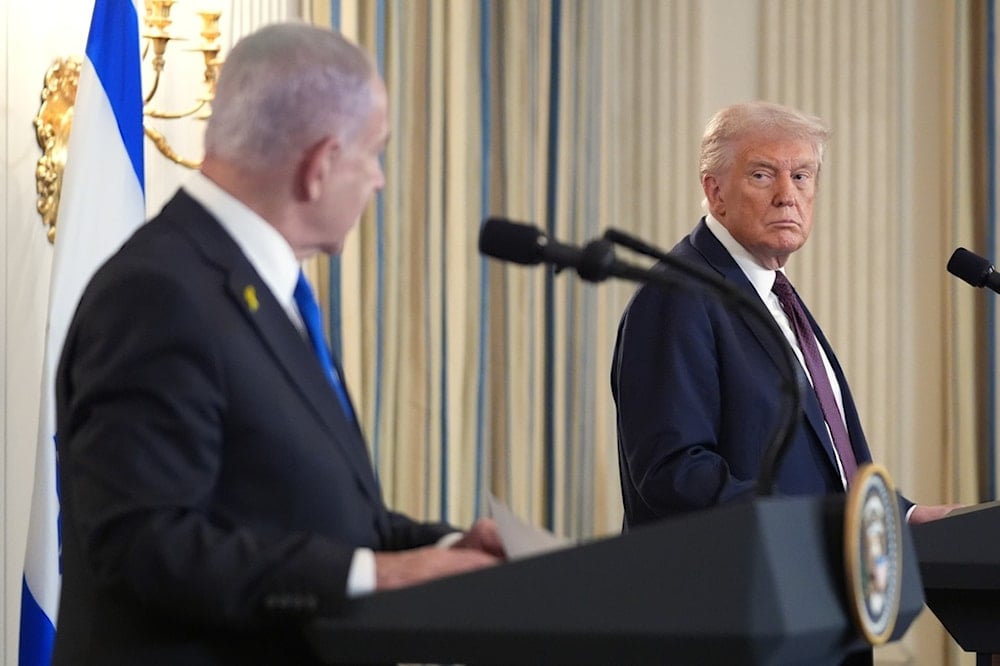
US President Donald Trump listens during a news conference with Israeli Prime Minister Benjamin Netanyahu in the State Dining Room of the White House, Sept. 29, 2025, in Washington (AP/Evan Vucci, File)
An Israeli analyst has warned that Democratic victories in the US midterm elections, coupled with a deteriorating image of "Israel" among the American public, could pave the way for congressional measures restricting arms sales and "threatening the occupation's military superiority."
In an article published by Israeli Yedioth Ahronoth, Israeli commentator Nadav Eyal said that the situation is a "deep and worsening strategic emergency," warning that the Democrats' significant electoral gains and shifting American public opinion could translate into legislative action in Congress.
Eyal said such measures could begin with sanctions over Israeli terrorism in the Palestinian territories, before expanding to efforts to end "Israel's" nuclear ambiguity policy and impose restrictions on offensive weapons sales, potentially extending to arms sales more broadly.
He warned that these developments would not only threaten "Israel's" qualitative military edge but also undermine the Israeli Air Force's operational readiness. He stressed that the Israeli occupation military and air force depend on continuous US supplies of equipment, machinery, and ammunition to maintain their daily operations.
Regardless of the size of its spare-parts stockpile, Eyal argued, a halt in US supplies to the air force would make it extremely difficult for it to "carry out its missions."
US alliance remains central to 'Israel's' regional standing
Eyal argued that the threat to "Israel's" "security" was tangible and considerably closer than the threat of an Iranian nuclear bomb, extending far beyond the supply of weapons and military equipment.
He noted that access to Washington and close ties with the US had long served as a major strategic asset in "Israel's" relations with the Arab world, from the peace treaty with Egypt to the Abraham Accords.
However, he warned that as "Israel" becomes increasingly isolated, its regional partners would have fewer incentives to pursue closer ties with it, while its adversaries would find greater grounds for optimism.
Eyal identified two central pillars of "Israel's" security: its occupation military and security establishment, and its alliance with the United States. Without Washington's support, he argued, the Israeli occupation military and security institutions would suffer a substantial material and operational decline.
Against this backdrop, Eyal called for an immediate change in Israeli occupation government policy and the adoption of broad emergency measures backed by concrete action.
He argued that the occupation government would need to pursue substantive regional initiatives, including swiftly ending Israeli terrorism in the Palestinian territories and dismantling its infrastructure through force.
He also called for a broad political initiative toward the Palestinians, including a peace process and a new Israeli approach to the Gaza Strip, its reconstruction, and rebuilding.
Eyal further urged a careful reassessment of the continued occupation of territories in Syria and Lebanon, weighing the perceived security benefits against the political costs.
Israelis face military and strategic limitations
The Israeli commentator also argued that these changes would require fundamentally challenging the falsehoods instilled in the Israeli public.
Among the realities he identified was that Israeli occupation military achievements had yet to translate into a better strategic situation, that "Israel" had not defeated Hamas in the Gaza Strip, and that the Israeli occupation military could not disarm Hezbollah through its own capabilities.
He further argued that "Israel" could not confidently bring about "the collapse of the Iranian government," while stressing that the Israeli occupation military would always need advance intelligence to respond effectively to surprise strikes, which could occur at any time.
Eyal concluded that "Israel" had yet to fully restore its capabilities, underscoring the gap between its military claims and the strategic challenges it continues to face.
Read more: Congress probe could put 'Israel' in dock over Iran war: Israeli media


