
Israeli envoy to UAE says Flydubai motive remains unclear
 4 Min Read
The Israeli envoy to the UAE says it is too early for conclusions as Abu Dhabi investigates the Flydubai emergency landing.
-
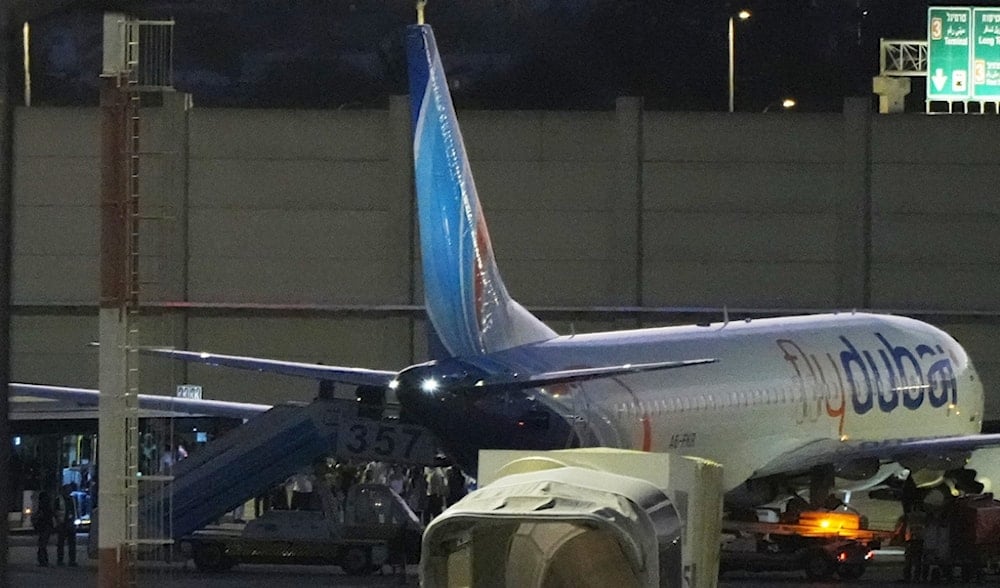
People disembark from a FlyDubai flight carrying Israeli passengers approaching Ben Gurion International Airport near Tel Aviv, Wednesday, Sept. 30, 2026. (AP)
The circumstances surrounding a Flydubai flight that was forced to make an emergency landing in Saudi Arabia remain unresolved, as authorities in the United Arab Emirates launch an investigation amid sharply divergent accounts of what transpired inside the aircraft’s cockpit.
"Israel's" envoy to the UAE said Thursday that the motive behind the incident had yet to be established, cautioning that drawing conclusions at this stage would be premature. He also disclosed that Prime Minister Benjamin Netanyahu spoke with UAE President Sheikh Mohamed bin Zayed on Wednesday, shortly after the incident.
Meanwhile, the UAE judiciary has opened an investigation into the incident, including whether it may have been connected to “any terrorist activity or purpose,” according to the Emirates News Agency (WAM).
WAM reported that the investigative team had commenced its work in coordination with the General Civil Aviation Authority and other relevant state institutions. The UAE attorney general also directed authorities to establish whether the incident was connected to “any terrorist activity or purpose,” or whether it involved prior planning or direction.
What initially happened?
A Flydubai commercial aircraft traveling from Dubai to Tel Aviv signaled an emergency shortly before turning around over Saudi Arabia, Israeli media reported on Wednesday, citing flight-tracking data. The cause was later ruled to be mid-air violence.
Al Mayadeen's correspondent later reported that the Flydubai aircraft has landed in Saudi Arabia.
The aircraft initially transmitted squawk code 7700, an internationally recognized signal indicating a general emergency. A short time later, it changed the code to 7500, which signals a hijacking or other unlawful interference, as per Israeli media.
Israeli Air Force fighter jets were scrambled toward the aircraft, Israeli media reported, citing security sources.
The flight was subsequently diverted to Saudi Arabia, and the cause of the distress call was then found to be a fight that broke out between the pilot and co-pilot. However, Israeli media are increasingly characterizing the incident aboard the flight as a “suspected attack".
Competing accounts emerge
While Flydubai said a confrontation broke out inside the cockpit, Israeli officials and passengers gave a different account, claiming that the co-pilot attacked the pilot in an attempt to crash the plane.
Israeli Prime Minister Benjamin Netanyahu said Saudi authorities had detained the co-pilot, claiming that he had "stabbed his colleague and apparently tried to bring down the plane" as it approached "Israel."
US President Donald Trump said he had spoken at length with Netanyahu about the incident and said it "seems that the co-pilot was either a terrorist or deranged."
The investigation, however, did not assert the allegations.
'Israel' cites threat to so-called 'Abraham Accords'
The incident has since taken on a broader political dimension in “Israel,” with officials portraying it as potentially affecting ties with the UAE.
The Israeli Foreign Ministry reportedly instructed its diplomats to present the incident as an attempt to “undermine relations between Israel and the UAE and the Abraham Accords,” adding a diplomatic layer to an incident whose circumstances remain under investigation.
Against this backdrop, Flydubai announced the suspension of all flights to and from “Israel” until the investigation is concluded.
The suspension comes despite the regular operation of air links between the UAE and “Israel” since the two sides established diplomatic relations under the US-brokered "Abraham Accords" in 2020.
Saudi Arabia rejects Israeli requests
Saudi Arabia's handling of the emergency landing added another layer to the incident.
According to Reuters, Saudi Arabia turned down a request from "Israel" to allow its planes to bring back Israeli passengers from a flydubai flight that made an emergency landing in the kingdom.
The request was made to allow Israeli military planes to bring the passengers back from Saudi Arabia, which has no diplomatic relations with "Israel", two security sources said.
The Israeli Air Force was preparing to send Super Hercules planes to pick up the Israeli passengers, one of the sources said.
Read more: Netanyahu visited UAE to urge support for Saudi war on Yemen: Sources


