
Israeli expert says Hezbollah 'threat far from neutralized'
 4 Min Read
Israeli expert Eyal Zisser criticizes political and military leadership, warning that Hezbollah retains strong capabilities despite Israeli claims.
-
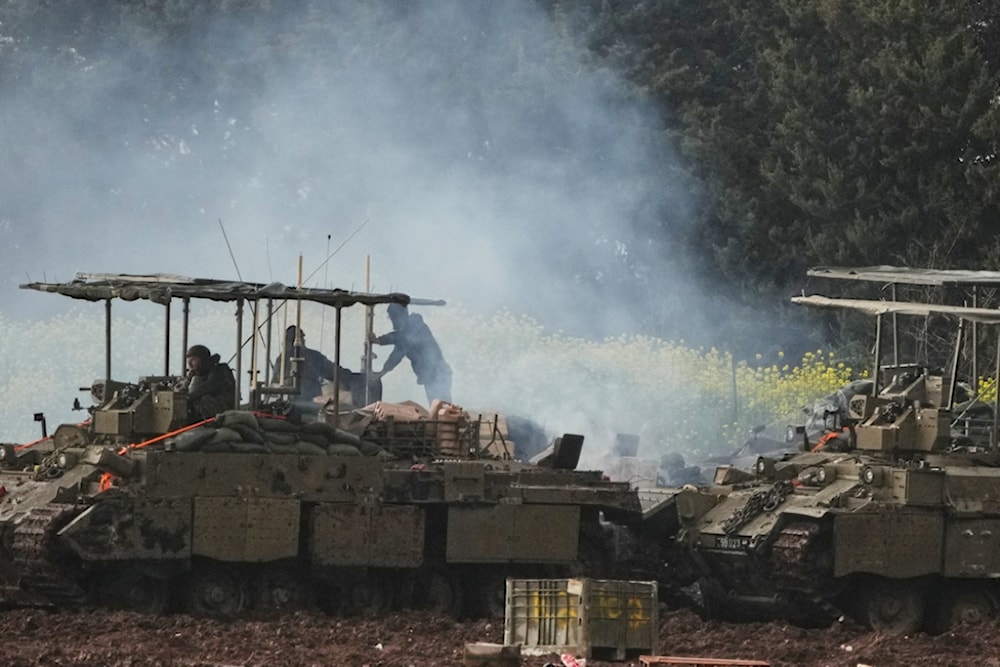
Israeli soldiers atop an APC in northern Israel near the Palestinian-Lebanese border area, Saturday, March 21, 2026 (AP)
An Israeli academic and former senior official has raised sharp concerns over the political and military handling of the ongoing confrontation with Hezbollah, warning that official narratives do not reflect battlefield realities.
According to the Israeli Knesset Channel, Professor Eyal Zisser, deputy head of Tel Aviv University and a specialist in West Asian affairs, criticized both the political and military leaderships, saying that “official statements do not reflect the reality on the ground.”
Zisser questioned claims about degrading Hezbollah’s capabilities, arguing that figures presented by the Israeli occupation do not equate to neutralizing the threat. He explained that “even if two-thirds of Hezbollah’s missiles were destroyed, that would still leave 60,000 rockets out of 180,000,” adding that targeting thousands of fighters would still leave tens of thousands active.
He stressed that such figures leave little room for surprise regarding the Resistance movement's continued strength.
Conflicting military objectives
Addressing the broader military approach, Zisser said he does not believe the Israeli occupation forces currently know what it aims to achieve in Lebanon, describing political messaging as disconnected from reality and tailored for media consumption.
He pointed to contradictions within the leadership, noting that while some generals acknowledge the inability to disarm Hezbollah, the chief of staff has deferred this objective to “future generations,” while insisting it has not been abandoned.
Zisser also revealed that the Israeli occupation remains in a state of shock following the events of October 7, 2023, adding that immediate goals such as establishing a security buffer zone, preventing infiltration, and pushing anti-tank threats away from border settlements are unlikely to be achieved.
He concluded that the Israeli occupation forces are moving from one war of attrition to another without reaching any decisive outcome.
Internal criticism over border security
Separately, criticism has also emerged from within northern settlements, where local officials have expressed frustration over ongoing insecurity.
David Azoulay, head of the Metula settlement council, strongly criticized the Israeli government’s handling of the situation along the Lebanese border, saying residents are living through “days and nights without sleep or normal life” due to continued Hezbollah fire.
In parallel, former Israeli war minister Yoav Gallant acknowledged that Hezbollah’s capabilities were underestimated at the beginning of the war.
Victory an illusion that will end in failure
Israeli newspaper Yedioth Ahronoth warned that claims by occupation leadership about defeating Hezbollah and Iran will ultimately “end in disappointment,” stressing a growing gap between official rhetoric and battlefield realities.
The report described statements by Israeli officials as “arrogant,” noting that expectations of eliminating Hezbollah’s capabilities remain unrealistic. It emphasized that disarming Hezbollah will not be achieved, even if Minister of War Israel Katz increases the frequency of his statements from "five every week to five per day".
The newspaper further pointed to remarks by US President Donald Trump, indicating that he has effectively acknowledged the inability, or unwillingness, to reopen the Strait of Hormuz or extract uranium, undermining alleged strategic objectives.
Recent US intelligence reports have conceded that Iran is unlikely to open the Strait of Hormuz any time soon, acknowledging that Tehran's grip on the world's most vital oil artery provides massive leverage against Washington, according to three informed sources cited by Reuters.
Ongoing resistance operations
These developments come after the Islamic Resistance in Lebanon, Hezbollah, announced on Saturday a series of coordinated operations targeting military bases, settlements, and gatherings of Israeli occupation forces (IOF) and vehicles across northern occupied Palestine and southern Lebanon, using missiles and drones.
Hezbollah confirmed that it targeted the Shraga base, the administrative headquarters of the Golani Brigade command north of the occupied city of Acre, using a squadron of drones.
The resistance also struck the newly established headquarters of the artillery battalion of the 146th Division south of the settlement of Kabri, also using drones.
In a separate operation, the resistance targeted the Meron airbase in northern occupied Palestine with missiles and drones, achieving direct hits. Additionally, early warning equipment belonging to the IOF at Mount Hermon was targeted.


