
Israeli far-right demands Gaza settlements ahead of October election
 3 Min Read
Thousands of settlers march on Gaza's perimeter as far-right ministers push to rebuild settlements dismantled in 2005, defying ceasefire limits.
-
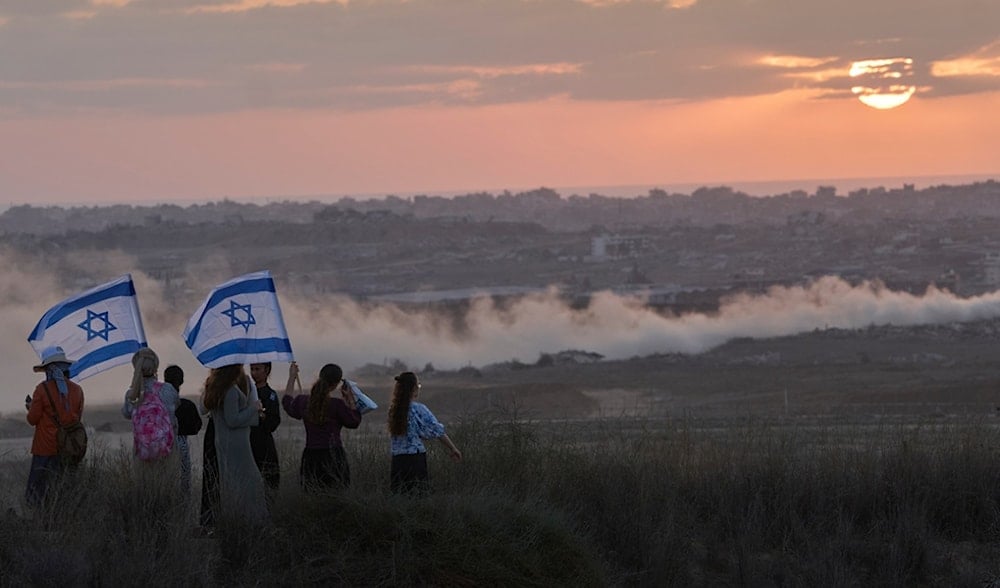
Extremist Israeli settlers watch the northern Gaza Strip during a rally calling for the re-establishment of Israeli settlements in the Gaza Strip, near the border in southern occupied Palestine, Wednesday, July 30, 2025 (AP)
Far-right extremists in the Israeli regime are turning the reconstruction of settlements in Gaza into a defining plank of their campaign for the October 27 election, part of a broader push to force Israeli Prime Minister Benjamin Netanyahu to formally abandon the 2005 disengagement from the besieged Strip.
Police Minister Itamar Ben-Gvir and Finance Minister Bezalel Smotrich, both key figures in Netanyahu's coalition, led thousands of settlers to the Gaza perimeter on Sunday to demand the reestablishment of three former settlements in the north of the Strip, Nisanit, Dugit, and Elei Sinai. The march was reportedly organized by the hardline Nachala settler movement and drew senior government ministers and lawmakers.
Israeli occupation forces (IOF) declared the area a closed military zone in an attempt to keep the demonstration away from Gaza, prompting organizers to reroute. Settlers pressed on regardless, moving around barriers set up by soldiers and police. Buses brought families, including children, from settlements in the occupied West Bank, while youth activists from Ben-Gvir's and Smotrich's parties distributed campaign literature along the way.
Ben-Gvir: 'Gaza is ours'
At the rally, Ben-Gvir claimed "Israel" now controls 70 percent of Gaza, a figure he said would have seemed unthinkable three years ago, and called for the ethnic cleansing of Palestinians out of the strip, an idea the Trump administration floated briefly, under the banner of "voluntary migration", before it was dropped from the ceasefire agreement.
"We are returning home. Gaza is ours," Ben-Gvir told the crowds.
“Gaza is ours.”
— Quds News Network (@QudsNen) July 19, 2026
Israeli far-right National Security Minister Itamar Ben-Gvir declared that “there will be Jewish settlements in all of Gaza,” openly calling for the colonization of the besieged Strip and the forced removal of its Palestinian population. pic.twitter.com/dd2gHfKfVm
Smotrich, who also oversees settlement affairs within the war ministry, described the moment as a fight to preserve the alleged settlement gains of the past four years, warning that a change in government could unravel them entirely. He said in June that finalized plans for the three northern settlements are sitting on Netanyahu's desk awaiting approval and has repeatedly described Gaza as inseparable from the "land of Israel."
Separately, War Minister Israel Katz has said he intends to establish three military outposts in the area, a step settlement expansion in the West Bank has historically followed before outposts evolve into permanent communities.
Occupation footprint exceeds ceasefire terms
Israeli occupation forces currently hold roughly 60 percent of Gaza's territory, with Netanyahu having publicly acknowledged ordering the military to seize 70 percent or more.
The October 2025 US-brokered ceasefire required Israeli withdrawal to about 53 percent of the territory, a line that has since been breached. Washington's plan for Gaza explicitly excluded any Israeli occupation or annexation of the strip, a commitment very far from the reality on the ground.
Before 2005, the Israeli occupation maintained 21 settlements in Gaza housing about 8,000 settlers, all dismantled under the unilateral withdrawal ordered by then-prime minister Ariel Sharon. Last week, the government approved more than 2.3 billion shekels (approximately $766 million) for new settlement construction and access roads in the West Bank, part of a broader effort to entrench the settlement project there.
The UK, France, Canada, Australia, New Zealand and Norway have recently sanctioned groups and individuals tied to the settler movement, with some European states also imposing travel bans on Ben-Gvir and Smotrich, as all settlements in the West Bank remain illegal under international law.


