
Israeli fix to Hezbollah drones 'ineffective, improvised': Report
 3 Min Read
Israeli media reports highlight operational challenges faced by the Israeli occupation forces in countering explosive fiber-optic drones used by Hezbollah in southern Lebanon.
-
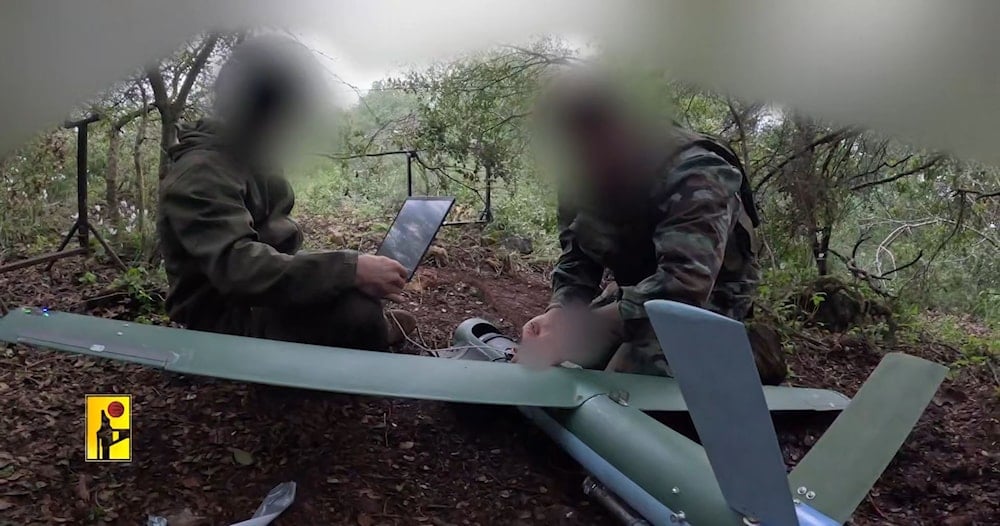
Islamic Resistance fighters prepare a one-way attack drone before launching it toward an Israeli troop gathering in al-Taybeh, Lebanon, March 25, 2026 (Hezbollah Military Media)
Israeli newspaper Israel Hayom has acknowledged that there is currently no effective technological or operational solution capable of fully countering the threat posed by explosive fiber-optic drones operated by Hezbollah in Lebanon.
According to the report, the evolving drone capabilities are outpacing "Israel's" ability to develop reliable counter systems, leaving troops deployed in southern Lebanon dependent on improvised and incomplete field solutions.
The report describes how Israeli occupation soldiers in southern Lebanon are increasingly forced to rely on makeshift methods, including the use of nets intended to intercept incoming drones before detonation.
However, these measures are described as ad hoc and inconsistent, underscoring a growing gap between the sophistication of the drone threat and the available counter tools. Rather than a structured, fully integrated system, troops are reportedly trying to adapt in real time to a rapidly evolving aerial threat environment.
'Israel' asleep as Hezbollah drones strike
A senior officer quoted in the report acknowledged that the response to the drone threat has been significantly delayed, stating that “the awakening came late. They fell asleep.”
The officer called for accelerated development of technologies and operational procedures, including lessons drawn from the Russia-Ukraine war, where drone warfare has played a central role.
He stressed that a comprehensive interception concept should have already been in place, rather than emerging reactively after battlefield incidents.
According to the officer, even basic protective tools such as interception nets should have been developed and distributed earlier, instead of being improvised under battlefield pressure.
Structural limitations and slow adaptation
The report further highlights internal criticism regarding the pace of adaptation within “Israel’s” military establishment.
The officer described existing working groups as slow-moving and insufficiently responsive to battlefield timelines, arguing that the institutional structure struggles to keep pace with rapidly evolving threats.
He emphasized the need for faster decision-making and more agile leadership, noting that the current system responds too slowly to immediate operational realities.
Hezbollah’s evolving drone warfare strategy
The report also acknowledges that Hezbollah’s drone capabilities are becoming more advanced and professionally executed, presenting a growing challenge for “Israel’s” military systems.
The officer cited in the report noted that the military did not fully anticipate the scale and complexity of the current drone threat.
Israel Hayom reports that several countermeasures are currently under evaluation, but no single solution has emerged. The developing approach includes:
- Increased troop alertness and field readiness
- Fortification measures such as barriers and trenches
- Attempts to intercept drones using improvised tools
- Operations aimed at targeting operators and supply chains
In parallel, cooperation with external companies has reportedly been initiated to accelerate the development of more effective solutions.
However, the report states that a significant gap remains between the pace of Hezbollah’s drone development and “Israel’s” ability to intercept.
Efforts are also underway to improve early warning systems, providing occupation soldiers with only seconds of reaction time, highlighting the limited window available under current conditions.
Read more: Ex-intel officer questions Israeli strategy in Lebanon as losses mount


