
Ukraine to install 4,000 km of anti-drone nets along frontline roads
 3 Min Read
Ukraine plans to install 4,000 km of anti-drone nets along frontline roads, allocating $37 million to counter escalating Russian drone attacks.
-
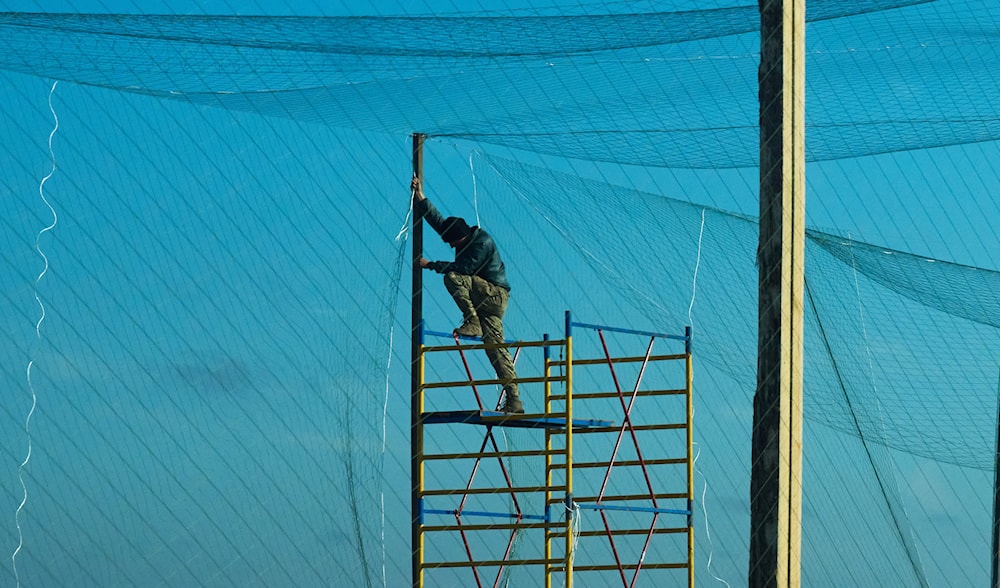
A worker installs an anti-FPV-drone net above the road at the approaches to the frontline city of Kherson, Southern Ukraine, Monday, Nov. 3, 2025 (AP)
Ukraine will speed up the installation of anti-drone nets along roads in frontline areas, aiming to cover 4,000 kilometres by the end of the year, Defense Minister Mykhailo Fedorov announced on Wednesday.
The measure comes as Russia increasingly targets military supply routes and rear bases across Ukraine using remotely piloted aircraft. While a growing number of nets have been deployed over the past year, Fedorov said additional protection is urgently needed. An extra 1.6 billion hryvnias ($37 million) has been allocated from the state budget to strengthen defenses against Russian drones.
Anti-drone nets are designed to snag propellers, preventing drones from reaching high-value targets, such as military equipment, personnel, or civilian areas. Fedorov highlighted progress made in recent months, noting that installation speeds have more than doubled.
"In just one month, we increased the speed from 5 km per day in January to 12 km in February. This significantly improved the safety of military movements and ensured stable functioning of frontline communities," he said via the Telegram app.
Looking ahead, Ukraine plans to expand the pace of deployment. "In March, we plan to close 20 km of roads per day. By the end of the year, we plan to install another 4,000 km of anti-drone protection on roads," Fedorov said.
In addition to road defenses, Fedorov confirmed that Ukraine would accelerate the construction of fortifications in the northeastern regions of Kharkiv and Sumy, as well as the northern Chernihiv region along the border with Russia.
Russia capable of sustaining war in Ukraine through 2026
As Ukraine ramps up its defenses, Russia is expected to maintain its war in Ukraine throughout 2026 despite economic and manpower pressures, while expanding its missile and drone capabilities, according to the International Institute for Strategic Studies (IISS).
Bastian Giegerich, the think tank’s director general, said there is “little indication” that Russia’s capacity to continue high-intensity operations for a fifth year is diminished. IISS’s annual review, The Military Balance, reported that Moscow spent at least $186 billion on defense in 2025, a 3% real-term increase, accounting for 7.3% of GDP, more than double the US proportion and roughly three times that of the U.K.
Fenella McGerty, a defense finance specialist at IISS, noted that military spending has doubled in real terms since 2021, enabling Russia to expand procurement and recruitment for intensive ground and aerial operations. Giegerich added that Moscow continues to strike Ukraine’s critical infrastructure with a mix of cruise and ballistic missiles and one-way attack drones, while developing modernized drones reportedly capable of striking targets up to 2,000 kilometers away, potentially reaching Europe.
The report emphasized the need for NATO to boost missile defense and counter-drone capabilities. European NATO members and Canada have pledged to raise defense spending to 3.5% of GDP by 2035, though IISS warned this would require “sustained and significant investments,” particularly in areas like intelligence, space-based assets, and advanced air defense systems.


