
UN leaders warn rule of force is replacing rule of law
 4 Min Read
UN leaders warn that global conflicts and funding cuts are weakening international human rights protections.
-
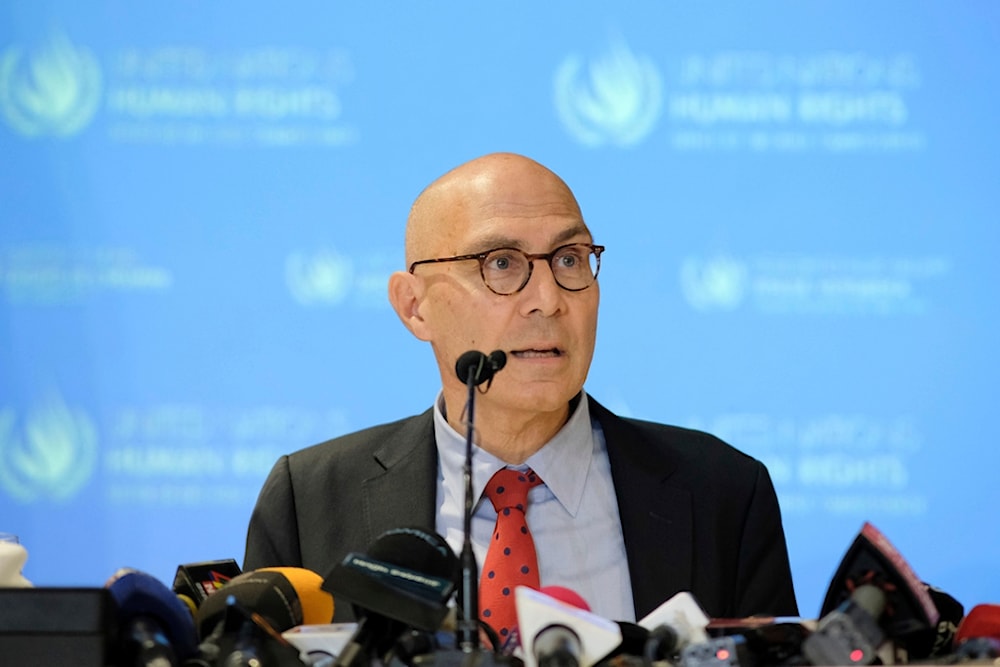
UN High Commissioner for Human Rights Volker Turk addresses media personnel in Dhaka, Bangladesh, on Wednesday, Oct. 30, 2024 (AP)
The UN’s top human rights official has warned that international norms are being steadily undermined, delivering a stark assessment of mounting civilian suffering and eroding legal protections across multiple conflict zones.
Opening the 61st session of the United Nations Human Rights Council in Geneva on February 23, Volker Türk framed his address around what he called the “people’s pursuit of dignity, equality and justice.” He described this pursuit as a historic force that continues to challenge repression, inequality, and authoritarian rule worldwide.
Türk’s warning followed earlier remarks by Antonio Guterres, who told the same session that human rights protections are under growing pressure from Sudan to Gaza and Ukraine.
“The rule of law is being outmuscled by the rule of force,” Guterres said, arguing that the weakening of legal protections is not accidental but deliberate. Human rights, he stressed, must not be treated as a “menu to pick from.”
Conflicts at the forefront
Türk pointed to intensifying geopolitical competition and a normalization of force in global affairs. “Competition for power and control among states is intensifying,” he said, warning that such rivalries are eroding stability and weakening respect for international law.
In Sudan, he called for accountability for war crimes and atrocities, including violence attributed to the Rapid Support Forces in El Fasher, and urged both domestic and external actors to help end the conflict.
On Gaza and the occupied Palestinian territory, Türk described catastrophic humanitarian conditions, raised concerns about ethnic cleansing and unlawful "annexation", and reiterated that any sustainable resolution must be grounded in international law and a two-state framework.
Regarding Ukraine, he noted nearly four years of full-scale war, rising civilian casualties, and attacks on critical infrastructure that could amount to international crimes. He stressed that accountability and human rights protections must form part of any future peace effort.
Five years after the military takeover in Myanmar, the High Commissioner said the country remains trapped in escalating violence and worsening humanitarian distress. He also referenced lethal repression of protests in Iran, underscoring concerns over excessive use of force against demonstrators.
Financial, political strain
Both Türk and Guterres stressed that the human rights system itself is under pressure.
Guterres described the UN’s human rights framework as operating under severe strain, citing shrinking financial support, political attacks on independent experts, and the United States’ disengagement from the Human Rights Council and a key universal accountability review process.
“Humanitarian needs are exploding while funding collapses,” he warned.
Human rights are under full-scale attack around the world. It's happening in plain sight & often led by those with the greatest power.
— António Guterres (@antonioguterres) February 23, 2026
But human rights are not a slogan for good times.
They are a duty at all times.
We must stand up for them even when it is difficult & costly.… pic.twitter.com/frHlCIk0r2
The broader UN system is facing a worsening liquidity crisis, driven largely by US arrears and declining voluntary contributions. According to UN figures, Washington in February paid roughly $160 million of more than $4 billion in outstanding dues. Budget shortfalls have already prompted discussions of significant spending cuts and staff reductions.
Some diplomats have also voiced concern over initiatives that could shift authority away from established multilateral mechanisms. Among them is a US-backed “Board of Peace,” presented by its supporters as a conflict resolution tool but viewed by critics as bypassing traditional UN forums, including the Security Council.
Call for renewed commitment
Against this backdrop, Türk defended international accountability structures, including the International Criminal Court, and urged states to renew their commitment to multilateral cooperation.
Human rights, he said, are not abstract ideals but the “thread” running through historic struggles for freedom and equality. They must remain binding obligations rather than optional standards, particularly at a time when escalating conflicts, political pressure on oversight bodies, and dwindling resources are converging.
Together, the remarks by Guterres and Türk set a sobering tone for the Council’s latest session, reflecting deep concern within the UN system that the credibility of international law and the protection of civilians are facing one of their most serious tests in recent years.
Read more: Vatican turns down Trump's offer to join Gaza 'Board of Peace'


