
US abstains on UNGA Ukraine vote
 3 Min Read
The US abstained from a UN General Assembly vote on a Ukraine peace resolution days after President Donald Trump extended anti-Russia sanctions for another year.
-
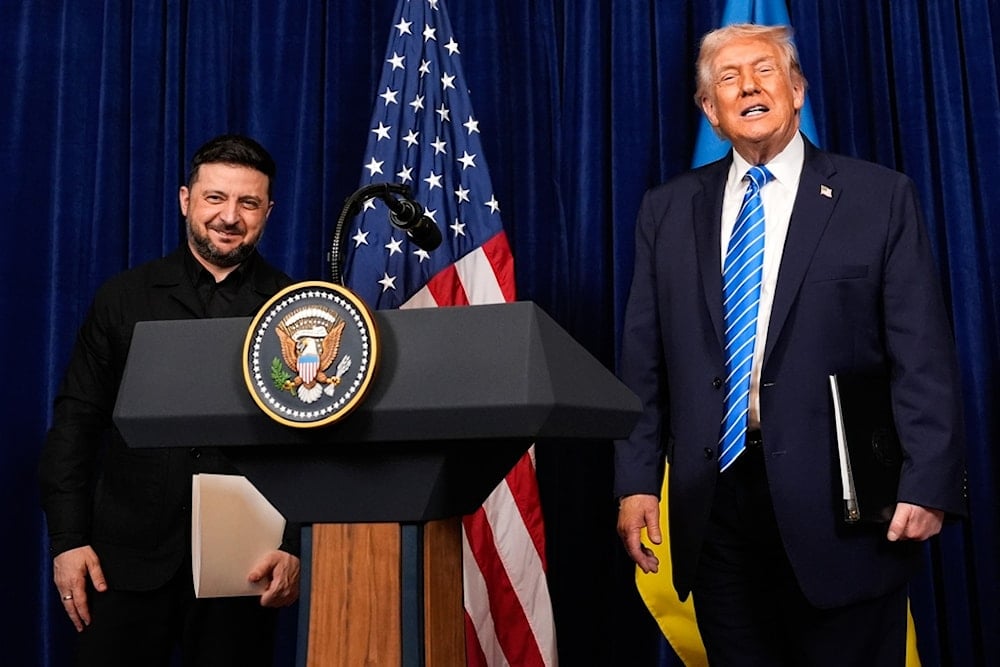
President Donald Trump and Ukraine's President Volodymyr Zelenskyy depart a joint news conference at Trump's Mar-a-Lago club, Sunday, Dec. 28, 2025, in Palm Beach, Fla. (AP)
The US abstained from voting during the 11th Emergency Special Session of the UN General Assembly on an anti-Russian draft resolution on Ukraine, a RIA Novosti correspondent reported.
The draft resolution, titled "Support for lasting peace in Ukraine," was prepared by Ukraine in coordination with several European countries.
Voting results at the UN General Assembly
According to the results of the vote, 107 countries supported the document, while 12 voted against it, including Russia, Belarus, Iran, and North Korea.
A total of 51 countries abstained, among them Armenia, Brazil, Hungary, Kazakhstan, Serbia, the US, and Uzbekistan.
The vote took place within the framework of the emergency special session dedicated to the Ukraine conflict.
Russia criticizes draft resolution
Ahead of the voting process, Russian Deputy Permanent Representative to the UN Anna Evstigneeva stated that the proposed document ignores the complexity of the Ukraine conflict, interprets the norms of the UN Charter unilaterally, and creates obstacles to peace negotiations.
In the preamble to the document, the authors express "grave concern" about alleged Russian attacks against civilians and critical infrastructure, and reaffirm their "firm commitment" to Ukraine's sovereignty.
Russian authorities have repeatedly stated that Russia does not strike civilians or civilian infrastructure in Ukraine.
Resolutions adopted by the UN General Assembly do not carry legally binding force.
US extends anti-Russia sanctions for one year
Separately, US President Donald Trump extended for one year a series of US sanctions on Russia related to the situation in Ukraine, according to a notice published in the Federal Register on February 20.
The decision maintains restrictions first introduced under executive orders issued in February 2022, September 2018, and March and December 2014, including measures connected to Crimea.
All of the restrictive measures “must continue in effect beyond March 6, 2026,” Trump said in the official notice.
In the statement, Trump said the policies addressed in the executive orders continue to pose a threat to US national security and foreign policy.
“The actions and policies addressed in these Executive Orders continue to pose an unusual and extraordinary threat to the national security and foreign policy of the United States,” he said.
“Therefore, in accordance with section 202(d) of the National Emergencies Act (50 U.S.C. 1622(d)), I am continuing for 1 year the national emergency declared in Executive Order 13660,” Trump added.
Executive Order 13660, first issued in 2014, declared a national emergency in response to developments in Ukraine and laid the groundwork for sanctions targeting individuals and entities linked to Crimea.
The extension ensures that sanctions imposed over the Ukraine conflict and Crimea will remain in effect for another year, preserving existing financial and economic restrictions.


